Urban Design in the Age of Undifferentiated Crisis

rossexo's avatarmachines of urbanization

Syllabus blurb for advanced seminar in urban design theory and practice, Iowa State University, Spring 2019

alarmist prephub dimaxion globe of risk screenshot of promotional video by MIT Urban Risk Lab’s Prephub project

URB D 522: Contemporary Urban Design Practices/ARCH 575: Contemporary Urban Design Theory

‘Pre-emptive design,’ ‘resilience urbanism,’ ‘proactive preparedness’: Urban design is a practice caught between two irresolvable demands. On the one hand, it is called upon to attenuate the effects of multiple risks that contemporary life produces: urban design must protect the inhabitants of cities and provide infrastructures through which to maintain current modes of existence in the face of climate change and the host of other human and more-than-human crises it precipitates. Contemporary urban design, we might say, measures itself against a field of undifferentiated crisis. On the other hand, today’s urban design, unlike in its modern predecessor, is a venture fueled almost exclusively by an ever expanding financial market for private real…

View original post 210 more words

Posted in earth | Leave a comment

Concentric Zone model or CCD Model of Burgess

Urban Environments are complex interacting systems constantly adopting to changes in technology, culture and science. In order to understand how they evolved one must look at the structure. In 1924 Burgess gave the first model explaining the social and economic structure of an urban area.
His model was very simple and showed how a city grows from a  central point in a series of rents.

240px-burgess_model1-svg

Key (from outside to inside)

  Commuter zone (outer ring)
  Residential zone
  Working class zone
  Zone of transition
  Factory zone
  Central business district (centre)

The concentric zone model, also known as the Burgess model or the CCD model, is one of the earliest models to explain urban social structures. It was created by sociologist E. W.Burgess in 1925.

Based on human ecology theory done by Burgess and applied on Chicago, it was the first to give the explanation of distribution of social groups within urban areas. This concentric ring model depicts urban land usage in concentric rings: the Central Business District (or CBD) was in the middle of the model, and the city expanded in rings with different land uses. It is effectively an urban version of Von Thünen’s regional land use model developed a century earlier. It influenced the later development of Homer Hoyt’s sector model (1939) and Harris and Ullman’s multiple nuclei model (1945).

The zones identified are:

  1. The center with the central business district,
  2. The transition zone of mixed residential and commercial uses or the zone of transition,
  3. Working class residential homes (inner suburbs), in later decades called inner city or zone of independent working men’s home,
  4. Better quality middle-class homes (outer suburbs) or zone of better housing,
  5. Commuter zone.

Bid rent curve

Burgess’s work helped generate the bid rent curve. This theory states that the concentric circles are based on the amount that people will pay for the land. This value is based on the profits that are obtainable from maintaining a business on that land. The center of the town will have the highest number of customers so it is profitable for retail activities. Manufacturing will pay slightly less for the land as they are only interested in the accessibility for workers, ‘goods in’ and ‘goods out’. Residential land use will take the surrounding land.

Criticisms

The model has been challenged by many contemporary urban geographers. First, the model does not work well with cities outside the United States, in particular with those developed with a history. Even in the United States, because of changes such as advancement in transportation and information technology and transformation in global economy, cities are no longer organized with clear “zones” .

  • It describes the peculiar American geography, where the inner city is poor while suburbs are wealthy; the converse is the norm elsewhere.
  • It assumes an isotropic plane – an even, unchanging landscape.Physical features – land may restrict growth of certain sectors; hills and water features may make some locations unusually desirable for residential purposes.
  • Commuter villages defy the theory, being a distant part of the commuter zone.
    Decentralization of shops, manufacturing industry , and entertainment.
    Urban regeneration and gentrification – more expensive property can be found in formerly ‘low class’ housing areas.
  • Many new housing estates were built on the edges of cities in Britain.
  • It does not address local urban politics and forces of globalization.
    The model does not fit polycentric cities, for example Stoke-on-Trent.

Source(s):

Wikipedia

Posted in Class Notes, earth, urban morphology, Urban Studies | 1 Comment

Future City Assignment by Laskar


Meaning :  The word future city is formed by 2 words Future, city.

Future  means, a period of time regards as still come, that is not present.

City – An urban settlement with population 1 lakh or more (according to Census of India).

So combindly a Future City is make a planning for future to build a city.

My Future City :

A city that is prosperous in its facilities. Its beauty, its management, communication and its standard of life, which fulfill the ultramodernized facilities and accordant with the legendary imagination of future generation. It would as dynamic as complex, as the human behaviors and his nature.

Salient Features :

According to my vision/future imagination a future city. Green Queen may construct with following characteristics.

Location : Selection of location is the most important factor because most of the facilitative factors are changed, depending on location. We may take as independent variable.

  1. i) Climate : Generally hot and humid climate is more suitable for people. If we see the population picture of the world (Population distribution). Most of the people are live in hot humid climatic zone.

Ave temp. = 200 – 250 C

Ave rainfall = 100 – 125cm

  1. ii) Landform/Physiography :- Obviously in plain land and should be located nearer to coastal area to get suitable climate and easy transportation.

iii) Vegetation : A belt of vegetation  should have near the coastal and outer border of the city, which protect from any climatic hazard (like cyclones) and also it plays as a filter of city atmosphere.

  1. iv) Soil :- Ofcourse coastal fertile alluvial soil, not rocky like peninsular India.

Settlement Type :-

            Different settlement types should be developed. (i) Along the road  side linear. (ii) Along park and nodal area circular.

Building size :- Building size would be varied from outer side to city centre. Along the roads, from outer side it should be lower (1 to 2 floor) and in middle 3 floor and near city centre 4th – 5th floor in city centre. Administrative buildings should be more higher about (10 – 12th floor).

In middle portion around part and lake middle size buildings should be located.

Green Building :- Building should be energy efficient and Eco-friendly. Every building should have solar panel system on its root for electricity supply of that building.

Drainage : A well drainage system should required for the city. Totally ot would be a sub-surface drainage system.

All the building must be linked with smaller drains and smaller drains link with the large high drains that flow to the nearest sea or ocean.

During rainly season to make quick and easy drain the slope of the area should be formed uniclinal from entre to outer sides, and make linking are the drains and high drains with surface.

Transportation :- The city transportation system should be highly developed including – Air transportation, Roadways, Railways, Metro-Railways, Mono-Railways and also water ways.

To link within the city areas Roadways, Railways, Metro Rail, Mono Rails are main transportation system.

And to interlink with outer areas Roadways, Railways, Airways and Water ways are more efficient. Instead of private transportation I want to design public transportation system in more better way.

Educational System :-

Educational system should be highly modernized in my future city. Educational institutions will be established nearer to the city main nodal areas (small towns) and connected with well transportations system.

(i) Class Room Teaching :- Class room should be smaller teachers should be highly educated and experienced.

Syllabus should make by teacher discussing with the students.

All digital facilities required to find out the required information in the classroom.

  1. ii) External Teaching :- Every day at a certain time a tell class should be held by the institution for the students and similarly another class for the guardians.

Health Facilities :- Health facility also should be highly developed. Within every 10 km distance. A special hospital and health centre has to be developed. They are well served for 24 hours by different shifting doctors and where ambulances facility will be available for 24 h. There  would be a Moving Health Centre in every nodal area and also surrounding areas-for 24 h that will provide the medical facilities in every moment in emergency.

Particular road will be separated for emergency medical facility.

Energy Facility :-

Total area will be developed by Eco-friendly energy and renewable energy solar energy will be produced from each building, that will be made by solar photo voltaic plate.

Wind energy from nearest sea coast tidal and  water energy also will be developed from sea coast.

In different vehicles there will a system which is the best option.

In day time solar energy engine provide energy for each vehicle.

Along the road side within the grown but with the interval of 2 meters a Jolar Panel has to be constructed.

Pollution Free Area :-

Totally the area will be a pollution free zone no use of fossil fuels. No vehicular emission of GHGS, No  use of plastic polythin.

Green will be developed in the city along the road side area of settlement and in open spear.

Human used garbage will be recycled and reused. In stead of plastic polymer, polythin-another eco-friendly product must be used there.

Instead of fossil fuel-solar, wind tidal, energy will be used for energy supply.

Entertainment :

For city entertainment in every open space there will be pare be side him a water body (Lake).

Different malls cinema hall, clubs are also developed in the middle centre of the settlement.


Digital Life Style :-

An Ultral Modern digital life style will be drawn in my future city.

  1. Education facility, also will be digitalized use of projected aids must be increased. Instead of black board in class room there would be 3D projector to show the pupils any event and any relevant discussion more and more efficiently.

In case of absence of any student in any class should be sent to his home in audio-visual way.

  1. Health facility, also will be digitalized any inner operational work should be done digitally such as Heart operation, Brain operation etc.
  2. Digital entertainment, facilities also required.
  3. In our everyday life Robot Workers are needed such as cooker. Hour worker, driver singer etc.
  4. In lighting facility, it would be also modernized Automatic lighting system should be required which automatically starts in the absence of sunlight and off in the presents of sunlight.
  5. Road ways – There will be developed Self-cleaning roads: that automatically cleans the road with proving sea water.

To  connect one road to another there will be construct Super fly over.

  1. Antificial Rainfall system – in dry weather and in order to get beautiful environments : by using AgBr in artificial cloud.
  2. Artificial Patrolman – In every time to protect me city beauty and its people Artificial patrolman also developed that provide the protection service in each nodal area as  well as city inner area.
  3. Satellite System : – A satellite also will be developed which provide each every time the condition of my city.
  4. Administrative System :- There will be an administrative system in my city. That will be efficient for everyone totally the system will be for developing purpose and blessing to the people.

Figure


Green Queen

Morphological Structure :- The morphology of my future city Green Queen will divided into certain segments. The overall outer structure will be Circular or Elliptical.

Centre :-

  1. In the middle portion it is the centre of the city. Where an Air Transportation System will be developed.
  2. Around him there will be established Administrative Centres, buildings etc. and will be connected by Digital Road ways.
  3. This portion will be covered by Green Belt.

2nd Zone :-      This area will be consisting by some Nodal Points (Smaller Towns) Where every Nodes will be connected with Metro Roil in sub-surface area. And they will be connected with main centre by Mono Rail.

And from every Metro Station to difference settlement zone i.e. in inner portion will be connected by Road Ways.

And from every nodal point, High Road will be connected to the outer areas.

  1. Along the road way in both side Green belt.
  2. In middle portion (Inner area) there will be a park 0) any section, beside the Park will be a lake, and around, it different entertainment place will be established.
  3. Around the parse Settlement Patches will be developed in circular pattern. And will be covered by Green Belt.
  4. Educational institution will be established in the corner, nearer to the Nodal area.

3rd Zone :-

  1. Here also in different section in centre there will be an open space park. Around if settlement patches will be developed.
  2. There will be some Agriculture field, in the edge areas that fields will be practiced for Truck Forming.
  3. And This total city. Area will be covered by the Green Belt.

Outer Area :-

In the outer side in Sea Ward Side there will be developed some Industrial Zones.

And its opposite side there will be developed City Agricultural Belt. From where different Agricultural Products will be supplied through road transportation in every day.

Also different usable industrial products will be supplied from industrial zone.

Conclusion :-

According to my perception and Mental imagination I have drawn any future city. Based on India’s Ist planning city Chandigarh and New Kolkata (New Town) where any requirements and ultra-modernized Urban facilities with more eco-friendly and specific way.

I think a future city should be developed in this way.

Other Assignments:

  1. Ashna’s

Sabia’s

Shafiq’s

Syed Aiyazuddin’s

Wajeeha’s

Toiba’s

Hilal’s

Heena’s

Farhin’s

Assma’s

Sufia’s

Sharda’s

Noman’s

Afzal’s

Sadiq’s

Maheen’s

Juvairiya’s

Mandal’s

Shahjahan’s

Posted in Class Assignments M.Sc. Geography 2017-19 AMU, Aligarh, earth, opinions, urban morphology, Urban Studies, vision | 18 Comments

The Concept and Pillars of Sustainability

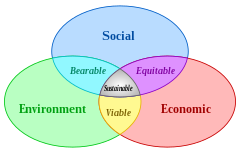
The term sustainability is used to indicate programs, initiatives, and actions aimed at the preservation of resources. However, it actually refers to four distinct areas: human, social, economic and environmental – known as the four pillars of sustainability.

Venn diagram of sustainable development:
at the confluence of three constituent parts: Image from Wikipedia

The four domains of social sustainability according to the Circles of Sustainability approach used by the United Nations

Human sustainability

Human sustainability aims to maintain and improve the human capital in society. Investments in the health and education systems, access to services, nutrition, knowledge (as we are fast becoming a knowledge society), and skills are all programs under the umbrella of human sustainability. Natural resources and spaces available are limited and there is a need to balance continual growth with improvements to health and achieving economic wellbeing for everyone. Human sustainability focuses on the importance of anyone directly or indirectly involved in the making of products, or provision of services or broader stakeholders (the human capital of the organization) (Benn et al., 2014). Communities around the globe may be positively or negatively affected by business activities or impacted through methods used to source raw materials. Human sustainability encompasses the development of skills and human capacity to support the functions and sustainability of the organization and to promote the well-being of communities and society.

Social sustainability

Social life is the least defined and least understood of the different ways of approaching sustainability and sustainable development. Social sustainability has had considerably less attention in public dialogue than economic and environmental sustainability.

Social sustainability aims to preserve social capital by investing, maintaining and creating services that constitute the framework of our society. The concept envisages a larger view of the world in relation to communities, cultures, and globalisation. Culture and globalization are one of the main determinants of the tourism industry.

It means to preserve resources for future generations and to acknowledge that what we do can have an impact on others. Social sustainability focuses on maintaining and improving social quality with concepts such as cohesion, reciprocity and honesty and the importance of relationships amongst people. It can be encouraged and supported by laws, information and shared ideas of equality and rights. Social sustainability incorporates the idea of sustainable development as defined by the United Nations sustainable development goals. The principle of sustainable development addresses social and economic improvement that protects the environment and supports equality, and therefore the economy and society and the ecological system are mutually dependent (Diesendorf, 2000).

Economic sustainability

The economic sustainability is the ability of an economy to support a defined level of economic production indefinitely. It aims to maintain the capital intact. If social sustainability focuses on improving social equality, economic sustainability aims to improve the standard of living. In the context of business, it refers to the efficient use of assets to maintain company profitability over time. As stated by the UK Government (Annual Report 2000, January 2001):

“Maintaining high and stable levels of economic growth is one of the key objectives of sustainable development. Abandoning economic growth is not an option. But sustainable development is more than just economic growth. The quality of growth matters as well as the quantity.”

Environmental sustainability

Environmental sustainability aims to improve human welfare through the protection of natural resources. Initiatives and programs are defined as environmentally sustainable when they ensure that the needs of the population are met without the risk of compromising the needs of future generations. Environmental sustainability, as described by Dunphy, Benveniste, Griffiths, and Sutton (2000) place emphasis on how business can achieve positive economic outcomes without doing any harm, in the short- or long-term, to the environment. According to Dunphy et al. (2000) an environmentally sustainable business seeks to integrate all four sustainability pillars and to reach this aim each one needs to be treated equally.

The principle of the four pillars of sustainability states that for complete sustainability problems to be solved in relation to all four pillars of sustainability and then need be maintained. Although in some cases these may overlap, it is important to identify the specific type of green business to focus on, as the four types present unique characteristics. Businesses need to make a strategic decision about it so as to effectively incorporate the chosen approach into their policies and procedures.

Source(s) and Link(s):

https://www.futurelearn.com/courses/sustainable-business/1/steps/157438

Four Pillars of City Sustainability

Wikipedia


Posted in BIODIVERSITY, Cities, earth, Urban Studies | Leave a comment