


Total Visitors
- 5,595,132
Search Inside
My You Tube Channel
-
Visitors on The Site

-
Join 6,678 other subscribers
Fill This Form to Contact Me
Top Posts & Pages
- Waste to Energy in India
- About Me and This Site
- Migration Theories : Lee’s Push Pull Theory
- Levant: The Term, The Region and Cities
- Gond Tribe of India
- Santhal:Largest Tribal Community in India
- Gujjar Tribe
- Discontinuities Inside the Earth
- Social Processes: Concept, Types and Salient Features
- Geography Notes
Being Social
Pages
- Article Submission
- Basics of Geography
- Book Reviews
- Disaster Management
- Field Training and Tour
- Geography Notes
- Geography of Tourism
- Geography Study Material for NTA-NET & IAS Exams
- Geomorphology
- Geomorphology Class Black Board
- Hindi Posts
- Human Geography
- My Projects
- New UGC NET Syllabus-Geography
- Online Class
- Posts on Geography Practicals and Statistical Techniques
- Regional Studies
- Settlement Geography
- Social Geography
- Urban Agro Systems
- Urban Systems
- Useful Links
- Water Resources
- About Me and This Site
Blogroll
Digital Blackboards
My Pages
Other Sites I Am Involved With
Recommended Links
Useful Links
Brings You Meaning
Finding meaning in life is one of those things everybody insists is vitally important, but few people actually seek to find it. Life doesn’t come with a set of instructions, but you can find joy, happiness and fulfillment by surrounding yourself with people who bring meaning into your life. Surround yourself with people who make you happy and provide clarity by adding meaning to your daily existence.
Posted in earth
Leave a comment
Advantage of Cross Tabulation with Chi Square
Chi square or Pearson’s chi- square test, is any statistical hypothesis, which is used to determine whether there is a significant difference between expected frequencies and the observed frequencies in one or more category.
An important consideration when cross tabulating the findings of your study is verifying if what is represented in the cross-tab is true or false. This is similar to the doubt some of us would be in after joining a university questioning if this was indeed a good fit or not. To resolve this dilemma crosstab is computed along with the Chi-Square analysis which helps identify if the factors involved in the study are independent or related to each other. If the two factors are independent then the tabulation is termed insignificant and the study would be termed as null hypothesis which means that since the factors are not related to each other the outcome of the study is unreliable on the contrary if there exist a relation between the two factors that would confirm that the tabulation results are significant and can be relied on to take strategic decisions.
Another significant term that we will introduce here is “Null hypothesis”. The null hypothesis, basically assumes, any kind of difference or importance one can see in a set of data is by chance. The opposite of the null hypothesis is called the “alternative hypothesis”.
Applying chi square to surveys is usually done with these question types:
- Demographics
- Likert scale questions
- Cities
- Product name
- Dates and number (when clubbed together)
For example, we need to find out if there is any association between the buyer behavior of purchasing electronic devices and the region where it is sold then the data will be entered like the one in the table below:
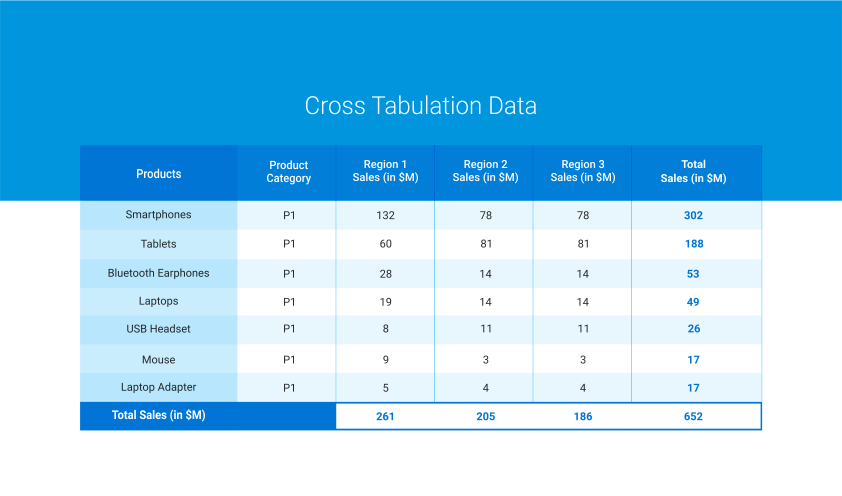
As mentioned earlier the Chi square test helps you determine if two discrete variables are associated. If there’s an association, the distribution of one variable will differ depending on the value of the second variable. But if the two variables are independent, the distribution of the first variable will be similar for all values of the second variable.
Using cross tabulation and chi square we derive the following inference:
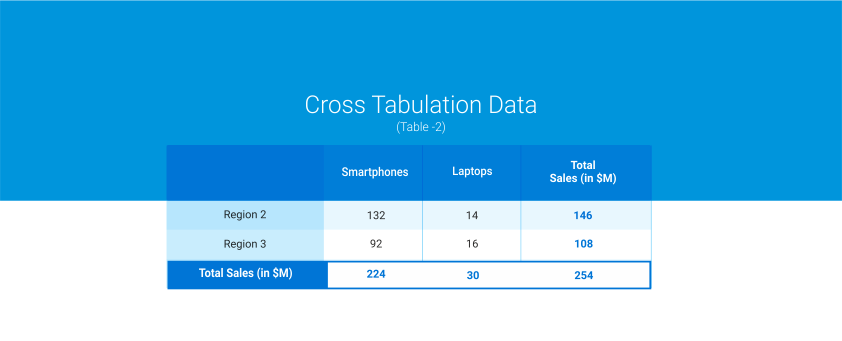
Applying the Chi square calculation to the above values:
Pearson’s chi square= 0.803, P- Value= 0.05
So what does this mean?
We need to pay attention to the p- value. Compare the p-value to your alpha-level which is commonly 0.05
- If p-value is less than or equal to alpha-value then the two variables are associated.
- If p-value is greater than alpha value, you conclude the variables are independent.
In this example Pearson chi-square statistics is 0.803 (with a p-value 0.05). So with an alpha-value of 0.05, we therefore, conclude that there is no correlation and is insignificant.
Source(s):
Growth of Satellite Towns in India
India’s Urban realm is expanding. Expansion of cities gives rise to residential satellites depending on the main city.
Three Main Characteristics of Satellite Towns:
(a) Workers of satellite-town have to come to work in the central town because it is the central town which guarantees a certain number of services,
(b) The satellite town reciprocally provides facilities for holidaying and relaxation, and
(c) There is found easy and frequent transport and communication between the two.
Around Delhi, there are urban centres performing the services of satellites, e.g., Ghaziabad, Bahadurgarh, Gurgaon, Sonepat, and Faridabad. Similarly, Kolkata encompasses number of urban centres of the surrounding area.
They are closely linked and have become centres for service activity. Some of these satellites may be counted as Kalyani, Barrackpur, Jadavpur, Bansdrori. Purba Putiary, Gobindapur and Sutanuti also form the status of satellites. Tollygunge and several peripheral towns are closely linked with the city. Kanchanpura, Nabapally, Halisahar, Ishapure are towns other than satellites of the conurbation.
Satellites differ from suburbs in that they are separated from the central city by many miles. They have little daily commuting but their economic activities are closely geared to those of the central city. Suburbs are primarily joined with the central city for commuting to or from the city. The idea of centrality comes into play in a big way.
Growths of automobiles and commuter rail lines in metropolises have stimulated suburbanization. Kolkata encompasses a number of urban centres which are satellites on the Hooghly side. They are distinctly attached economically with the Kolkata conurbation.
Links and Source(s):
Posted in earth
Leave a comment
Problems of CBDs
The CBD’s of cities throughout the world experience many problems, some of which are outlined below:
Congestion: Many Cities still have street plans that were laid down hundreds of years ago. The roads cannot cope with the ever-increasing numbers of cars and other vehicles. This can cause massive congestion problems, especially at “rush hour”.
Solutions to the problems have included improving public transport ; introducing park and ride schemes ; pedestrianization ; encouraging people to share cars into work and building ring roads .
In Athens (Greece) they have tried an extreme form of control by only allowing cars with odd numbers on their number plates into the city on one day, and then cars with even numbers the next day. Unfortunately this has led many people to own two cars, one with an odd number and one with an even one!
Lack of Space: CBD’s are limited in their outwards growth by the fact that the city encompasses them, and due to the fact that businesses want to locate as close to the centre as they possibly can. This has led to land prices rising to astronomical amounts. The only solution seen by most businesses is to build upwards, which is why CBD’s can be characterised by the presence of skyscrapers.
Pollution: The major pollution seen in urban areas is air pollution, or smog. This pollution is mainly caused by the fumes given off by traffic and industry.
The most famous example of where this pollution haze can be seen is over Los Angeles, but most of the large cities of the world experience it too. Poor air quality can lead to an increase in the cases of asthma and bronchitis.Asian cities are heavily in the grip of this. An innovative way of tackling this problem is to manage urban space properly.
Air is not the only thing polluted in cities. Water can be badly polluted, and so has to be carefully treated before being drunk. It’s a horrible thought, but most of the water that you drink in London has already been drunk by 7 other people!
Solutions to pollution problems include: banning heavy vehicles from CBD’s; developing cleaner fuels, and providing more litter bins in CBD’s.
Some cities have encouraged the growth of out-of-town shopping centres to help traffic, land price and pollution problems, by taking some of the focus away from the CBD. However this can also have the negative effect of causing the CBD to decline.
Source(s):
Posted in earth
Leave a comment


