Kerala offers opportunity to experience beautiful backwaters which consist of a complex network of brackish lagoons, lovely lakes and canals. The most predominant way to experience the Kerala backwaters is Kerala houseboats (also known as Kettuvalloms).One can take a leisurely journey along Kerala backwater on luxurious Kerala houseboats. Unlike Kashmir houseboats they really move. Kashmir Houseboats do not really move, they are often moored.
In the Malayalam language “kettu” means “to tie” and “vallam” means boat – the two together make the local name “kettuvallam”. Each houseboat is constructed using the ancient principles and techniques by the local carpenters using ‘Anjili’ wood. Coir ropes are used for tightening the wooden planks together.
These boats have traditionally been the main means of transport of men and materials in the Kerala backwaters since olden days. In particular, the house boats were used to ship rice and spices and other goods between Kuttanad and the Cochin port. It was the important mode of transportation in coastal Kerala just because of its accessibility to the most remote areas. For the royalty these boats even became comfortable living quarters.The Practice of living on boat is also there in other parts of world like Kashmir, Zimbabwe, Netherlands, Hong Kong, China, US and Iraq.
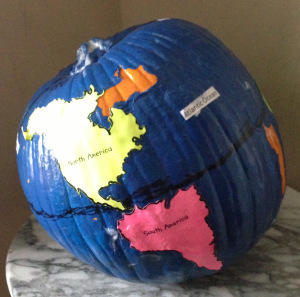
Last week, my intrepid second grader’s teacher asked that each child bring in a medium
An Educational Craft for Our Budding Geographers
sized pumpkin. This pumpkin was to be big enough for them to carry, but did not require the muscle of Mom or Dad to lift. The result of the two day project was impressive!
Here are the items required to do the project:
1 medium-sized pumpkin
Blue non-lead based paint
1 paint brush
1 permanent black marker (Sharpie)
Colorful cutouts of the 7 major continents
Printed text for the 4 major oceans and Gulf of Mexico
Clear drying glue (Elmers)
An atlas (a reference for the kids to place everything correctly)
Directions:
Step 1: Clean the dirt off of the pumpkin and paint. Let it try for a day or two.
Step 2: Draw the Prime Meridian, Equator, Tropic of Cancer and Tropic of Capricorn with the marker.
Our century is the Urban Century. Soon the world will become a giant urban system. Urbanization and the fast growth of cities and towns have become one of the major characteristics of the present century. Urban life is now way of life of modern man.
The efficient agricultural system makes the surplus quantity of food possible to sustain the urban population. With surplus food production more and more people turn to activities other than primary, and the process of urbanization goes on.
The invention of power-driven machinery
The industrial revolution was a major trigger for accelerated urbanization process. Factories development accentuated the process. The concentration of production into bigger factories requiring a large number of workers
The development of Trade and Services
Employment in the service or tertiary sector of the labour force has been an important factor in the growth of cities. Growing trade and expansion of the service sector is a vital factor even today.
Development of Transportation
It allows goods to be transported freely and contributed to the process of urbanization.
Transport makes possible for people and ideas to move freely
Intra-urban transportation
Enable mass movement of persons between home and workplaces.
Widespread use of automobile and truck
Decentralization of individuals and functions within urban areas
Demographic and Social Factors
Natural Growth of Cities – About 20% of urbanization takes place through natural growth of cities. The improvement of sanitation, health care, social welfare and improvement of other infrastructural facilities added to the process.
Rural-urban Migration
About 70% of urbanization is attained by the rural-urban migration.
Industrial Revolution
At the end of 19th century, the advent of Industrial Revolution happened and it encompassed mainly Western Europe and North America. Causes were farming mechanization, Increased agricultural efficiency, released labour forces from rural areas due to increased agricultural efficiency.The fast development of industries in cities provided many new jobs.
Now Urbanization is slowing increasing down in developed countries but increasing in developing countries
Rural-Urban Migration
Origin: Rural Area
Push factors
Unemployment for mechanization
A low standard of living
Low wages
Poor education
Poor view of future
Destination: Urban Area
Pull Factors
Many job opportunities for industrialization
A higher standard of living
More education
Higher wages
Better health care
A better view of future
Origin: Urban Area
Push factors
Overcrowded living environment
Pollution
Traffic congestion
High crime rate
Higher land rent.
Destination: Rural Area/ New Town
Pull Factors
More open space, a more pleasant living environment.
Fresh and quiet air
Lower land rent
Lower crime rate
Large modern shopping centres in the suburb.
Large modern factories, more job opportunities
Subarbanization
Subarbanization is a new reality of our times. Many people migrate out of town due to the following reasons.
In 1950 Gordon Childe attempted to define a city with 10 general metrics. These are:
• Size and density of the population should be above normal.
• Differentiation of the occupation of the population. Not all residents grow their own food, leading to specialists.
• Payment of taxes to a deity or a king.
• Monumental public buildings.
• Those not producing their own food are supported by the king.
• Systems of recording and practical science.
• A system of writing.
• Development of symbolic art.
• Trade and import of raw materials.
• Specialist craftsmen from outside the kin-group.
This categorization is used as a general touchstone when considering ancient cities, although not all have each of its characteristics.

 The picture was clicked by Amir and Samia.