


Total Visitors
- 5,600,052
Search Inside
My You Tube Channel
October 2026 M T W T F S S 1 2 3 4 5 6 7 8 9 10 11 12 13 14 15 16 17 18 19 20 21 22 23 24 25 26 27 28 29 30 31 -
Visitors on The Site

-
Join 6,679 other subscribers
Fill This Form to Contact Me
Top Posts & Pages
- Waste to Energy in India
- About Me and This Site
- Migration Theories : Lee’s Push Pull Theory
- Levant: The Term, The Region and Cities
- Physical Divisions of North America: An Overview
- Geography Notes
- Gond Tribe of India
- The Structure of the Ocean Floor(Ocean Topography)
- Silt: Environmental Impact
- Social Geography: Concept,Origin,Nature and Scope
Being Social
Pages
- Article Submission
- Basics of Geography
- Book Reviews
- Disaster Management
- Field Training and Tour
- Geography Notes
- Geography of Tourism
- Geography Study Material for NTA-NET & IAS Exams
- Geomorphology
- Geomorphology Class Black Board
- Hindi Posts
- Human Geography
- My Projects
- New UGC NET Syllabus-Geography
- Online Class
- Posts on Geography Practicals and Statistical Techniques
- Regional Studies
- Settlement Geography
- Social Geography
- Urban Agro Systems
- Urban Systems
- Useful Links
- Water Resources
- About Me and This Site
Blogroll
Digital Blackboards
My Pages
Other Sites I Am Involved With
Recommended Links
Useful Links
Guest Post:Seven Wonders of the World
Guest Post by Kadamb Sachdeva
The campaign Seven Wonders of the World was started in 2000 to choose the Wonders of the world from the 200 existing monuments. This campaign was organized by the New7Wonders Foundation based in Zurich, Switzerland and the winners were announced on 7 July 2007 in Lisbon.
Though, the Egyptians were not happy with the poll as they felt it was a disgrace for the biggest and the oldest one among the three pyramids The Great Pyramid of Giza to compete with recently built structures like the Sydney Opera House or the Statue of Liberty. Thus, the Great Pyramid of Giza was assigned an honorary status in the list of the New7Wonders of the World.
There were more than 100 million votes cast through the internet/telephone. Voting via the Internet was limited to one vote for seven monuments per person/identity, but multiple voting was possible through telephone. Hence the poll was considered unscientific
From this article, you will get to know about the Seven Wonders of the World and their details.
The Seven Wonders of the World
Below is the list of the Seven Wonders of the World along with their images and the year in which they were constructed.
| Wonder | Location | Image | Year of Construction |
| Great Pyramid of Giza (honorary status) |
Giza Necropolis, Egypt | 2560 BCE | |
| Great Wall of China | China | 700 BCE | |
| Petra | Jordan | 312 BCE | |
| The Colosseum | Rome, Italy | 80 CE | |
| Chichen Itza | Yucatán, Mexico | 600 CE | |
| Machu Picchu | Cuzco Region, Peru | 1450 CE | |
| Taj Mahal | Agra, Uttar Pradesh, India | 1643 CE | |
| Christ the Redeemer | Rio de Janeiro, Brazil | 1931 CE |
- Taj Mahal
Taj Mahal is one of the most beautiful buildings in the world. Taj Mahal is the 7th Wonder of the World. It was built by Mughal emperor Shahjahan in the memory of his beloved wife, Mumtaz Mahal (Arjumand Banu Begum). Its construction was started in 1632 and was completed in 1653.
It was built under the supervision of Architect Ustad Ahmad Lahauri and 20,000 other craftsmen. The cost of construction was estimated to about 32 Million rupees at that time. It is listed as UNESCO World Heritage.
India is popular for its wide range of Historical Monuments. People call India as ‘Sone Ki Chidiya’ as India is a land of beautiful ancient architecture which attracts people’s attention.
- The Colosseum
The Colosseum or the Flavian Amphitheatre is an oval-shaped amphitheater in the center of the city of Rome, Italy.
The Colosseum could hold between 50,000 and 80,000 spectators, having an average audience of some 65,000.Mock sea battles, animal hunts, famous battle re-enactments, executions, and mythological dramas were some of the public spectacles held at the Colosseum.
Its construction began under the emperor Vespasian in AD 72 and was completed in AD 80 under his successor and heir Titus.
- Chichen Itza
The Chichen Itza is an archaeological site located in Mexico’s Yucatán State. It is a pre-Columbian city that was built during the Terminal Classic period by the Maya people.
The layout of Chichen Itza site core developed during its earlier phase of occupation, between 750 and 900 AD. Its final layout was developed after 900 AD, and the 10th century saw the rise of the city as a regional capital controlling the area from central Yucatán to the north coast, with its power extending down the east and west coasts of the peninsula.
Chichen Itza is one of the most visited archaeological sites in Mexico; an estimated 1.4 million tourists visit the ruins every year.
- Machu Picchu
The dream destination of millions of people across the world, Machu Picchu, is one of the seven wonders of the world. It is located in the Cusco Region of Peru’s Machu Picchu District.
Most archaeologists believe that Machu Picchu was built as an estate for the Inca emperor Pachacuti (1438–1472). Often mistakenly referred to as the “Lost City of the Incas” (a title more accurately applied to Vilcabamba), it is the most familiar icon of Inca civilization. The Incas built the estate around 1450 but abandoned it a century later at the time of the Spanish Conquest.
Machu Picchu was built in the classical Inca style, with polished dry-stone walls. Its three primary structures are the Inti Watana, the Temple of the Sun, and the Room of the Three Windows.
- Christ the Redeemer
Christ the Redeemer is an Art Deco statue of Jesus Christ in Rio de Janeiro, Brazil, created by French sculptor Paul Landowski and built by the Brazilian engineer Heitor da Silva Costa, in collaboration with the French engineer Albert Caquot.
The statue weighs 635 metric tons (625 long, 700 short tons), and is located at the peak of the 700-metre (2,300 ft) Corcovado mountain in the Tijuca Forest National Park overlooking the city of Rio.
A symbol of Christianity across the world, the statue has also become a cultural icon of both Rio de Janeiro and Brazil, and is listed as one of the New Seven Wonders of the World.
- Petra
Petra originally known to the Nabataeans as Raqmu, is a historical and archaeological city in southern Jordan. The city is famous for its rock-cut architecture and water conduit system.
It has immense archaeological, historical, and architectural value that makes it a jaw-dropping tourist attraction in Jordan. The water conduit system and the rock-cut architecture are the two most notable features of this ancient city. Petra is also nicknamed as the “Rose City” due to the stone color out of which it is carved.
Petra is not only one seven wonders of the world but also a UNESCO World Heritage Site. It is also listed as one of the “28 Places to See Before You Die” by the Smithsonian magazine.
- The Great Wall of China
The Great Wall of China, a global tourist hotspot, is known across the world for its uniqueness, great length, and historical value.
The Great Wall of China is associated with thousands of years of Chinese history. A series of walls were initially built by Chinese empires and states over a period of many years, beginning as early as the 7th century BCE. These walls were then joined together to result in the Great Wall of China.
UNESCO inscribed the site as a UNESCO World Heritage site in 1987.The most famous of these walls is the one built by the first Chinese Emperor, Qin Shi Huang between 220 and 206 BCE.
A comprehensive archaeological survey, using advanced technologies, has concluded that the Ming walls measure 8,850 km (5,500 mi). This is made up of 6,259 km (3,889 mi) sections of actual wall, 359 km (223 mi) of trenches and 2,232 km (1,387 mi) of natural defensive barriers such as hills and rivers. Another archaeological survey found that the entire wall with all of its branches measure out to be 21,196 km (13,171 mi).
Author’s Bio: Kadamb Sachdeva is a professional blogger. He has written many blogs and has a great knowledge about competitive exams. Entrance exams, e-learning, career guidance are some of the topics on which he has written the blog.
Posted in earth, Guest Post
Leave a comment
How Can We Ethically Design with Nature?
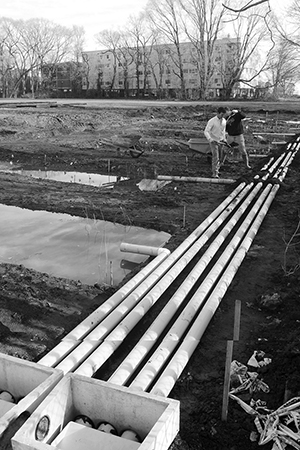
With the line between human and natural environments becoming increasingly blurred, how can we ethically design with ecological systems? One session at the Society for Ecological Restoration‘s conference in Madison, Wisconsin, examined the ethics of ecological restoration and human interventions in nature.
Ben Minteer, Global Institute of Sustainability, Arizona State University, described the tension between two seemingly opposed views on human agency in nature – preservationism and pragmatism. Preservationists have long advocated wild, “pristine” landscapes as holding moral value. Therefore, human intervention in nature should be minimized, except to return landscapes to some kind of historical baseline. In recent years, this philosophy has come under fire as being impractical and simplistic. After all, historical baselines can be arbitrary and difficult to establish, and many landscapes have been altered to a point that they have no natural analog.
Minteer described how new, anthropocentric approaches to nature call for an…
View original post 529 more words
Floundering
 I sometimes wonder what outsiders think archival research is like.
The message blasting from mass culture is not reassuring. From the ‘archaeologist’ Indiana Jones to Dan Brown’s ‘symbologist’ Robert Langdon, audiences are told that archive work is exciting, and dangerous, that it’s ok to lie and steal to get the information, and that men always do it with female sidekicks. If you want to see perhaps the most shockingly outdated embodiment of this, I dare you to look for the recent McDonald’s advert which features a caricatured elderly male professor along with his young female researcher having an eureka moment.Do not watch it unless you are prepared to be angry.
But – and here’s the kicker – archival research is fundamentally quite boring most of the time. In fact, that boredom is part of what makes it exciting. I wonder how many other historians were keen on fishing in their…
View original post 1,052 more words
Posted in earth
Leave a comment


