चन्द्र ग्रहण

साधारणतः पूर्णिमा की रात को चंद्रमा पूर्णतः गोलाकार दिखाई पड़ना चाहिए, किन्तु कभी-कभी अपवादस्वरूप चंद्रमा के पूर्ण बिम्ब पर धनुष या हँसिया के आकार की काली परछाई दिखाई देने लगती है. कभी-कभी यह छाया चाँद को पूर्ण रूप से ढँक लेती है. पहली स्थिति को चन्द्र अंश ग्रहण या खंड-ग्रहण (partial lunar eclipse) कहते हैं और दूसरी स्थिति को चन्द्र पूर्ण ग्रहण या खग्रास (total lunar eclipse) कहते हैं.

चंद्र ग्रहण कब लगता है?
चंद्रमा सूर्य से प्रकाश प्राप्त करता है. उपग्रह होने के नाते चंद्रमा अपने अंडाकार कक्ष-तल पर पृथ्वी का लगभग एक माह में पूरा चक्कर लगा लेता है. चंद्रमा और पृथ्वी के कक्ष तल एक दूसरे पर 5° का कोण बनाते हुए दो स्थानों पर काटते हैं. इन स्थानों को ग्रंथि कहते हैं. साधारणतः चंद्रमा और पृथ्वी परिक्रमण करते हुए सूर्य की सीधी रेखा में नहीं आते हैं इसलिए पृथ्वी की छाया चंद्रमा पर नहीं पड़ पाती है. किन्तु पूर्णिमा की रात्रि को परिक्रमण करता हुआ चंद्रमा पृथ्वी के कक्ष (orbit) के समीप पहुँच जाए और पृथ्वी की स्थिति सूर्य और चंद्रमा के बीच ठीक एक सीध में  हो तो पृथ्वी की छाया चंद्रमा पर पड़ती है. चंद्रमा की ऐसी स्थिति को चन्द्र ग्रहण (Lunar Eclipse) कहते हैं. पर सदा ऐसी स्थिति नहीं आ पाती क्योंकि पृथ्वी की छाया चंद्रमा के अगल-बगल होकर निकल जाती है और ग्रहण नहीं लग पाता. चन्द्र ग्रहण (Lunar Eclipse) लगने की दो अनिवार्य दशाएँ हैं – चंद्रमा पूरा गोल चमकता हो और यह पृथ्वी के orbit के अधिक समीप हो.

Umbra और Penumbra
सूर्य पृथ्वी से 109 गुना बड़ा है और गोल है इसलिए पृथ्वी की परछाई दो शंकु बनाती है. परछाई के एक शंकु को प्रच्छाया (Umbra) तथा दूसरे को खंड छाया या उपच्छाया (Penumbra) कहते हैं. चंद्रमा पर पृथ्वी की प्रच्छाया (Umbra) पड़ने से ही ग्रहण लगता है क्योंकि यह छाया सघन होने के कारण पृथ्वी और चंद्रमा की स्थिति के अनुसार कभी चाँद को आंशिक रूप से और कभी पूर्ण रूप से ढँक लेती है. ये स्थितियाँ क्रमशः अंश-ग्रहण तथा पूर्णग्रहण कहलाती हैं. अंश-ग्रहण कुछ ही मिनट तथा पूर्ण ग्रहण कुछ घंटों तक लगता है. चंद्रमा परिक्रमण करते हुए आगे बढ़ जाता है और पृथ्वी की छाया से मुक्त होकर फिर से सूर्य के प्रकाश से प्रतिबिम्बित होने लगता है.
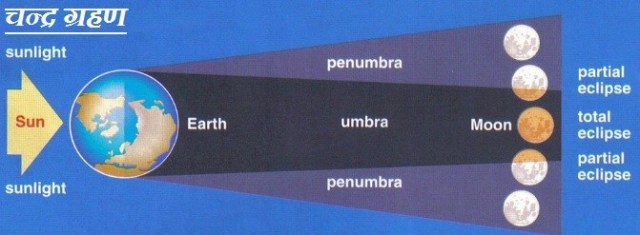
chandra-grahanप्रस्तुत चित्र को देखें जिसमें पृथ्वी की उपच्छायाएँ तथा प्रच्छाया दिखाई गई हैं. यदि कोई पृथ्वी की उपच्छाया (Penumbra) में खड़ा होकर चंद्रमा को देखेगा तो उसको चंद्रमा द्वारा प्रच्छाया (Umbra) वाला कटा हुआ भाग दिखाई नहीं देगा तथा उसे आंशिक चन्द्र ग्रहण (Lunar Eclipse) ही दृष्टिगोचर होगा, किन्तु यदि वह पृथ्वी के प्रच्छाया क्षेत्र में खड़ा होकर चाँद को देखेगा तो उसे प्रच्छाया (Umbra) से पूर्ण रूप से ढँका होने के कारण चाँद पूर्ण ग्रहण के रूप में दिखाई देगा. पृथ्वी की उपच्छाया (Penumbra) का चंद्रमा पर विशेष प्रभाव नहीं पड़ता. ग्रहण लगते समय चंद्रमा हमेशा पश्चिम की ओर से पृथ्वी की प्रच्छाया (Umbra) में प्रवेश करता है इसलिए सबसे पहले इसके पूर्वी भाग में ग्रहण लगता है और यह ग्रहण सरकते हुए पूर्व की ओर से निकल कर बाहर चला जाता है.

चंद्रमा एक स्थान से पश्चिम से पृथ्वी की प्रच्छाया (Umbra) में प्रवेश करता है. सर्वप्रथम इसका पूर्वी भाग प्रच्छाया (Umbra) में जाता है. दूसरे स्थान तक पहुँचने में चन्द्रमा को 1 घंटा 1 मिनट लगता है और तीसरे स्थान तक 2 घंटा 42 मिनट. इस प्रकार प्रच्छाया (Umbra) के केंद्र में पहुँचने के लिए चंद्रमा को लगभग 2 घंटे और मुक्त होने में लगभग 3 घंटे लग जाते हैं. प्रच्छाया (Umbra) से निकल कर चंद्रमा उपच्छाया (Penumbra) में प्रवेश करता है किन्तु इसके प्रकाश में कोई विशेष अंतर नहीं आता.

औसतन प्रति दस वर्षों में 15 चन्द्र ग्रहण (Lunar Eclipse) घटित होते हैं. एक वर्ष की अवधि में अधिक से अधिक 3 और कम से कम शून्य चन्द्र ग्रहण (Lunar Eclipse) लगते हैं. चन्द्र ग्रहण (Lunar Eclipse) के समय चंद्रमा एकदम काला न दिखाई देकर धुंधला लाल या ताम्बे के रंग का दृष्टिगोचर होता है. यह प्रकाश चंद्रमा से प्रतिबिम्बित नहीं होता वरन् सूर्य का होता है. सूर्य का प्रकाश पृथ्वी के विपरीत भाग के वायुमंडल से परावर्तित होकर प्रच्छाया (Umbra) में प्रवेश हो जाता है जिसके कारण ग्रहण की अवस्था में चंद्रमा धुंधला हल्का लाल दिखाई देता है.

source

Further Links to Read More:

Lunar Eclipse

Solar Eclipse

Solar Eclipse:Myths and Mystery

Motions of Moon

Earth Motions

Posted in earth, Hindi Posts, Physical geography | Leave a comment

Should we be worried about the US withdrawal from the Paris climate agreement?

shonilbhagwat's avatarShonil Bhagwat

From Campaign for Social Science

Last week’s Queen’s Speech confirmed that despite the path chosen by the US, the UK would honour the Paris Agreement. Here Shonil Bhagwat, Senior Lecturer in Geography at the Open University, looks at the motivations and implications behind the US decision, and how international action on climate change will go on.

As the world’s second largest emitter of greenhouse gases, the withdrawal of US from the Paris climate agreement comes as a setback to international action on climate change. This puts the US alongside Nicaragua and Syria, the two other UN member countries who have refused the deal. Does this withdrawal threaten to derail the international momentum on climate change and should we be alarmed? This article suggests that even without political leadership international action on climate change can continue. Over the last two decades since the commitment made by many countries in…

View original post 1,013 more words

Posted in earth | Leave a comment

The Four Class-System (Chaturvarn Vyavastha) of Indian Society

Worldly Wisdom's avatarજગતનો વા (Worldly Wosdom)

I happened to write on the above mentioned subject on Mr. Bhupendrasinh Raol’s Blog – Kurukshetra as a reply on one of his posts (“Manu-Smruti Adhyay 2/1”) and the same was published as an article on his Blog. This incident inspired me to enter into the world of bloggers. And as a gratitude towards my inspiration; I would like to publish the same article as my first article. The original article was published in my own language – Gujarati; but, I would like to translate the same here in English for its wider spread.

Article as it is –

I did not have a chance to study literatures like Manu-Smruti; but, I am interested to study so called cast system (or four-class system) prevailing in Indian (not ONLY in Hindus) society and I have some objections also against it.

I happened to travel many countries other than India and due…

View original post 1,607 more words

Posted in earth | 2 Comments

Geomorphology: Common Features and Its Relation With Fundamentals of Physics


There is no general theory of geomorphology. We cannot cast the subject in a single equation, or set of equations. As with geology, geomorphology is a tangle of physics, chemistry, biology and history. It is also geometry, as the geomorphology plays out in a complex geographic, topographic setting in which both the tectonic and climate processes responsible for driving evolution of the topography change in style and intensity. There is no grand quest for a Universal Law of Geomorphology. Our subject is often subdivided according to the geographic elements of the geomorphic system: hillslopes, rivers, eolian dunes, glaciers, coasts, karst, and so on.
There is indeed order to the natural system on and near the earth’s surface that
in turn serves to connect these subdisciplines. Features in common among many
geomorphic realms include:
• Surface materials most often move in one direction: downhill, downstream, downdrift,
or downwind. (Prior to emergence on the surface, the motion is effectively
vertical, in the reference frame of the surface, during near-surface exhumation.)
• Materials are transformed as they move through the system. Some of this is again
unidirectional, this time meaning irreversible: large grains can be broken into small
grains, but not the reverse; chemical reactions are for the most part permanent, resulting in solutional loss and change in mineralogy toward low temperature hydrous phases.
Exceptions to this general statement do exist: duricrusts form by cementation of soils, and carbonate deposits accumulate.
• Motion is concentrative. Material gathers itself into more efficient streams (Shreve’s
dichotomy of hillslopes and streams (Shreve, 1979)) resulting in spatially-branching
networks. This is one of several instances in which the surface processes lead to selforganization.
• If given enough time, the system evolves toward a state in which the material flow is
adjusted to transport that supplied to it.

These features argue for some degree of universality in our subject, some degree of connection between the elements of landscape and our treatment of those elements. The
most useful scientific principle that we will employ here is that of conservation: conservation of mass, of energy, and momentum.  “mass is conserved” or “energy is conserved”. These are indeed fundamental laws of physics. And physicists lean on them heavily. So also is momentum conserved, and angular momentum. So also is baryon number, strangeness, and so on. The fact that on the earth’s surface the speeds involved are far less than the speed of light allows us to dodge the complexity introduced by Einstein; we can go right back to Newton. As we do not need to worry about the conversion of mass to energy, mass is conserved perfectly.

Posted in earth | Leave a comment