Explaining Mauna Loa CO2 Increases with Anthropogenic and Natural Influences

Iowa Climate Science Education's avatarIowa Climate Science Education

SUMMARY

The proper way of looking for causal relationships between time series data (e.g. between atmospheric CO2 and temperature) is discussed. While statistical analysis alone is unlikely to provide “proof” of causation, use of the ‘master equation’ is shown to avoid common pitfalls. Correlation analysis of natural and anthropogenic forcings with year-on-year changes in Mauna Loa CO2 suggest a role for increasing global temperature at least partially explaining observed changes in CO2, but purely statistical analysis cannot tie down the magnitude. One statistically-based model using anthropogenic and natural forcings suggests ~15% of the rise in CO2 being due to natural factors, with an excellent match between model and observations for the COVID-19 related downturn in global economic activity in 2020.

Introduction

The record of atmospheric CO2 concentration at Mauna Loa, Hawaii since 1959 is the longest continuous record we have of actual (not inferred) atmospheric CO2 concentrations. I’ve visited the…

View original post 1,760 more words
Posted in earth | Leave a comment

Bongaism, Totems, and Taboos: Concept

Posted in earth | Leave a comment

Why Ocean Keeps Its Cool at 4 Celsius

Iowa Climate Science Education's avatarIowa Climate Science Education

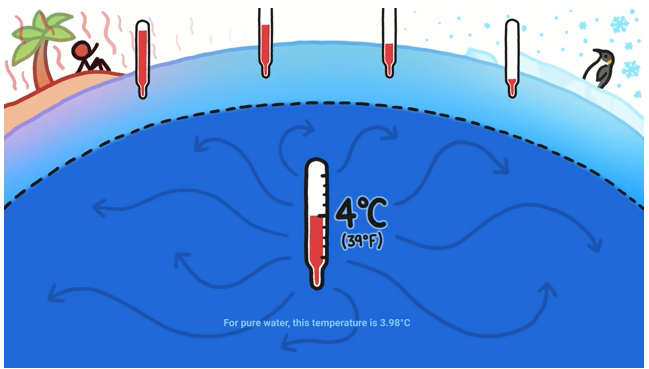
Water (H2O) has magical properties that make our planet suitable for us.  The video explains why most of the ocean water is about 4 degrees Celsius.  A transcript from another presentation draws the implications. Excerpts in italics with my bolds.

At the surface, ocean water can vary wildly in temperature – the water at the equator is around 30 degrees Celsius and the water at the poles is, well, freezing.  But surface waters are only a small fraction of the total water in the ocean.  Dive a little deeper, and you’ll find that a whopping 75 percent of the ocean’s water is all at the same temperature…and we’re not talking averages or anything – the vast majority of ocean water is 4 degrees Celsius.  And that’s not just a coincidence – it’s because water is weird.

As a liquid cools, its molecules slow down and the liquid generally gets denser and denser.  That’s how molten…

View original post 418 more words

Posted in earth | Leave a comment

A billion of the world’s most climate-vulnerable people live in informal settlements – here’s what they face

RGS-IBG Managing Editor: Academic Publications's avatarGeography Directions

By Vanesa Castán Broto, University of Sheffield; Emmanuel Osuteye, UCL, and Linda Westman, University of Sheffield


This article is republished from The Conversation under a Creative Commons license. Read the original article.


Flooding is common in informal settlements in Bwaise, a neighbourhood in the Ugandan capital Kampala. Bwaise’s residents are largely excluded from planning and local decision-making processes, and have poor housing and limited access to sanitation and other essential services.

Flooding makes matters much worse. During a visit in November 2019, residents showed us that they dig trenches around their houses and build small retaining walls to prevent water from flooding in. Public toilets are raised about a metre above the ground.

Bwaise lies in a swampy valley between several of Kampala’s many hills and was already prone to flooding. But floods are now happening more and more often because of climate…

View original post 695 more words

Posted in earth | 1 Comment