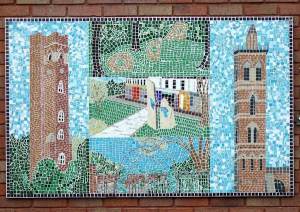
Community mosaic, Edgbaston, Birmingham (Source: Jackie Nash Art)
This mosaic is an example of living with difference in a multicultural society and forms a good analogy for the co-existence of cultural traditions, environmental conservation and international development
Abstract of my International Development Seminar at Development Policy and Practice at the Open University on 30th April 2014
Cultural traditions, environmental conservation and international development: conflict, cooperation and coexistence
Local cultural traditions do not always sit easily with the global missions of environmental conservation and international development. Many conservation and development organisations see cultural traditions as an impediment to their projects. Cultural traditions are also often linked to faith groups with whom conservation and development organisations are reluctant to form partnerships. Yet, conservation and development both have certain ‘moral agendas’ just as many cultural traditions have their own moral frameworks. This possible overlap of moral agendas provides opportunities, but also challenges. Drawing on…
The city has a distinct Para, adda, and “club” culture. Paras in Kolkata signify a neighbourhood with a strong sense of community, and are usually sharply defined on the basis of loyalties (like which households contribute economically to which public or “barowari” puja). Paras culture typically segregate Kolkata communities on the basis of origin (West Bengal origin “ghotis” versus East Bengal origin “bangals” – there are paras which have names like “prothom bangal para” (first bangal para)), occupation and socio-economic status (paras have names like “kumorpara” (potter para)), and sometimes even politics and religion.
Typically, every para has its own community club, with a club room (“club ghar”), and often a playing field. People of a para habitually indulge in adda or leisurely chat in “rock”s or “rowacks” (porches) and teashops in the evenings after work. Sports (cricket, football, badminton) and indoor games (carrom) tournaments are regularly organised on an inter-para basis.
The para culture is fast waning, may it good or bad, with the rise of apartment complexes, and the rise of the cosmopolitan nature of Kolkata.
Slums are a physical and spatial manifestation of urban poverty and intra-city inequality. However, slums do not accommodate all of the urban poor nor are all slum dwellers always poor.
In India, no city worth its name is free of slum population. In fact, it is a global phenomenon.
According to United nations,In 2001, 924 million people, or 31.6 percent of the world’s urban population, lived in slums. The majority of these people were in the developing regions, accounting for 43 per cent of the urban population, in contrast to 6 percent in more developed regions. Within the developing regions, sub-Saharan Africa had the largest proportion of the urban population resident in slums in 2001 (71.9 per cent) and Oceania had the lowest (24.1 per cent). In between these were South-central Asia (58 per cent), Eastern Asia (36.4 per cent), Western Asia (33.1 per cent), Latin America and the Caribbean (31.9 per cent), Northern Africa (28.2 per cent) and Southeast Asia (28 per cent).
The National Sample Survey Organisation (NSSO) estimates that the slum dwellers’ tally has increased over the last ten years. In 1993, 60 lakh urban households lived in slums. By ‘2002, when the last survey was conducted, the number had increased to 80 lakh households. Take the average size of a household at five, and you’ve got 4 crore of the 28.5-crore people in urban areas, living in pitiable conditions. And if you estimate that even half the population living in slums will vote, its easy to understand why they’re such a valuable asset for politicians.
With respect to absolute numbers of slum dwellers, Asia (all of its sub-regions combined) dominated the global picture, having a total of 554 million slum dwellers in 2001 (about 60 percent of the world’s total slum dwellers). Africa had a total of 187 million slum dwellers (about 20 percent of the world’s total), while Latin America and the Caribbean had 128 million slum dwellers (about 14 percent of the world’s total) and Europe and other developed countries had 54 million slum dwellers (about 6 percent of the world’s total).
It is projected that, in the next 30 years, the global number of slum dwellers will increase to about 2 billion, if no firm and concrete action are taken. The urban population in less developed regions increased by 36 per cent in the last decade. It can be assumed that the number of urban households increased by a similar ratio. It seems very unlikely that a slum improvement or formal construction kept pace to any degree with this increase, as very few developing countries had formal residential building programmes of any size, so it is likely that the number of households in informal settlements increased by more than 36 percent. However, it is clear that trends in different parts of the world varied from this overall pattern.
They are urban areas that are heavily populated with substandard housing and very poor living conditions. As a result, several problems arise.
Land Insecurity
Slums are usually located on land, which are not owned by the slum dwellers. They can be evicted at any time by the landowners.
Poor Living Conditions
Crowding and lack of sanitation are main problems.This contributes to outbreak of diseases. Utilities such as water, electricity and sewage disposal is also scarce.
Unemployment Since the number of people competing for jobs is more than jobs available, unemployment is an inevitable problem.
Crime
Slum conditions make maintenance of law and order difficult. Patrolling of slums is not a priority of law enforcing officers. Unemployment and poverty force people into anti-social activities. Slums have become a breeding ground for criminal activities.
Anand lakhan, Deen Bandhu Samaj Sahyog , Indore (M.P)
The Power of Collective ‘Voice’ of the ‘Indore’s Labour Community’
As other states & cities, Indore is also facing the parliament election. In every election different parties always give word of mouth reassurance and after winning the election, they don’t even bother to come back and see the condition of our people. This time the people from different community also changed their strategy with these seasonal frogs. The newly formed SIC’s of different slum communities decided to generate their own “RIGHT DEMAND CHARTER“ in front of all the parties’ candidate.
अधिकार मांग – पत्र
इन्दौर शहर के मेहनतकश गरीब मजदूर बस्तीवासी अपने जन-प्रतिनिधियों से क्या चाहते है ? इन्दौर शहर मध्यप्रदेश की व्यवसायिक राजधानी है। भारत में इन्दौर शहर 14वां स्थान रखता है। 2021 तक इन्दौर शहर…