Basic Approaches to the Study of Tourism Geography

Tourism Geography commonly is approached through a variety of methods. The following are several methods that have been used.
Institutional Approach

The institutional approach to the study of tourism considers the various intermediaries and institutions that perform tourism activities. It emphasizes institutions such as the travel agency. This approach requires an investigation of the organization, operating methods, problems, costs, and economic place of travel agents who act on behalf of the customer, purchasing services from airlines, rental car companies, hotels etc.

Product Approach

The product approach involves the study of various tourism products and how they are produced, marketed, and consumed. For example, one might study an airline seat—how it is created, the people who are engaged in buying and selling it, how it is financed, how it is advertised, and so on. Repeating this procedure for rental cars, hotel rooms, meals, and other tourist services gives a full picture of the field. Unfortunately, the product approach tends to be too time-consuming; it does not allow the student to grasp the fundamentals of tourism quickly.

Historical Approach

The historical approach is not widely used. It involves an analysis of tourism activities and institutions from an evolutionary angle. It searches for the cause of innovations, their growth or decline, and shifts in interest. Because mass tourism is a fairly recent phenomenon, this approach has limited usefulness.

Managerial Approach

The managerial approach is firm-oriented (microeconomic), focusing on the management activities necessary to operate a tourist enterprise, such as planning, research, pricing, advertising, control, and the like. It is a popular approach, using insights gleaned from other approaches and disciplines. Regardless of which approach is used to study tourism, it is important to know the managerial approach. Products change, institutions change, and society changes; this means that managerial objectives and procedures must be geared to change to meet shifts in the tourism environment. The Journal of Travel Research and Tourism Management, leading journals in the field, both feature this approach.

Economic Approach

Because of its importance to both domestic and world economies, tourism has been examined closely by economists, who focus on supply, demand, balance of payments, foreign exchange, employment, expenditures, development, multipliers, and other economic factors. This approach is useful in providing a framework for analyzing tourism and its contributions to a country’s economy and economic development. The disadvantage of the economic approach is that whereas tourism is an important economic phenomenon, it has noneconomic impacts as well. The economic approach does not usually pay adequate attention to the environmental, cultural, psychological, sociological, and anthropological approaches. Tourism Economics is a journal utilizing the economic approach.

Sociological Approach

Tourism tends to be a social activity. Consequently, it has attracted the attention of sociologists, who have studied the tourism behavior of individuals and goups of people and the impact of tourism on society. This approach examines social classes, habits, and customs of both hosts and guests. The sociology of leisure is a relatively undeveloped field, but it shows promise of progressing rapidly and becoming more
widely used. As tourism continues to make a massive impact on society, it will be studied more and more from a social point of view.
Geographical Approach

Geography is a wide-ranging discipline, so it is natural that geographers should be interested in tourism and its spatial aspects. The geographer specializes in the study of location, environment, climate, landscape, and economic aspects. The geographer’s approach to tourism sheds light on the location of tourist areas, the movements of people created by tourism locales, the changes that tourism brings to the landscape in the form of tourism facilities, dispersion of tourism development, physical planning, and economic, social, and cultural problems. Because tourism touches geography at so many points, geographers have investigated the area more thoroughly than have scholars in many other disciplines. Because the geographers’ approach is so encompassing—dealing with land use, economic aspects, demographic impacts, and cultural problems—a study of their contributions is highly recommended. Recreational geography is a common course title used by geographers studying this specialty. Because tourism, leisure, and recreation are so closely related, it is necessary to search for literature under all these titles to discover the contributions of various fields. Geographers were instrumental in starting both the Journal of Leisure Research and Leisure Sciences. Another journal, Tourism Geographies, was launched in February 1999 with the aim of providing a forum for the presentation and discussion of geographic perspectives on tourism and tourism related areas of recreation and leisure studies.

Interdisciplinary Approaches

Tourism embraces virtually all aspects of our society. We have cultural and heritage tourism, which calls for an anthropological approach. Because people behave in different ways and travel for different reasons, it is necessary to use a psychological approach to determine the best way to promote and market tourism products. Because
tourists cross borders and require passports and visas from government offices, and because most countries have government-operated tourism development departments, we find that political institutions are involved and are calling for a political science approach. Any industry that becomes an economic giant affecting the lives of many people attracts the attention of legislative bodies (along with that of the sociologists,
geographers, economists, and anthropologists), which create the laws, regulations, and legal environment in which the tourist industry must operate; so we also have a legal approach. The great importance of transportation suggests passenger transportation as another approach. The fact simply is that tourism is so vast, so complex, and so multifaceted that it is necessary to have a number of approaches to studying the field, each geared to a somewhat different task or objective.


inter tourism


tour 2

Source(s):

ShareyourEssays

Wikipedia
Posted in Class Notes, earth | 1 Comment

First Urbanization In India: Indus Valley Civilization

The story starts with Migration of Homo-sapiens into India and it is an old story.
According to currently accepted theory homo-sapiens originated from Africa around 150,000 years back. From there they migrated to rest of the world. After the end of the last ice age, around 10,000 BC, most of the earth was occupied.

The migration to India happened in three phases.

  1. Around 80,000 years back, movement took place via India to South-East Asia and China. Subsequently, the erruption of Mt. Toba wiped out the entire population of India.
  2. Around 55,000 years back people migrated from South-East Asia to India.
  3. About the same time another group migrated from South-West Asia.The Harappan Civilisationindus-valley-civilization-map

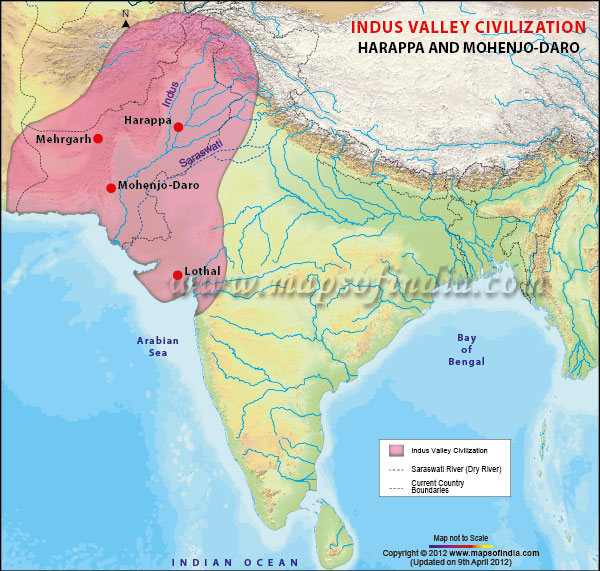
    The  civilization spread over a vast geographical region, from the high mountains of Baluchistan and Afghanistan to the coastal regions of Makran, Sindh and Gujarat. Large cities and smaller towns grew up along the major trade routes as administrative and ritual centers. During the full urban phase of this civilization, there is evidence for trade contact with the surrounding cultures in the Arabian gulf, West and Central Asia and peninsular India. Some of the technologies, architecture, artistic symbols and aspects of social organization that characterized the first urban centers of the Indus Civilization have continued up to the present in the urban setting of traditional South Asian cities.

Time Line of Indus Valley Civilization

Based on the archeological exploration done in the last few decades, our knowledge about the civilisation has significantly improved. The time period has significantly expanded going back to 7000 BC for first sign of agriculture and coming forward to 1300 BC for the last occupation of the cities.

  • Start of Agriculture 7000 BC to 5500 BC
  • Early Harappan phase 5500 BC to 2600 BC
  • Mature Harappan phase 2600 BC to 1900 BC
  • Late Harappan phase 1900 BC to 1300 BC

Mehrgarh is earliest known agricultural site of this civilisation. It dates back to 7000 BC. There are also evidences of the use of cotton. Somewhere between 2600 and 2000 BC, the city seems to have been largely abandoned.Rice was the staple food in Mehrgarh .Technological advancement was there as prehistoric dentistry evidence has been found in Mehrgarh.

290px-wellandbathingplatforms-harappa

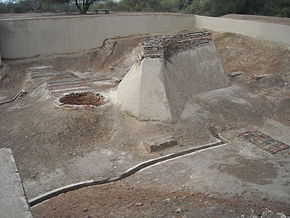
A Bathing Platform in Harappa:Image from Wikipedia

Harappa is one of the largest and most important cities of the Indus Valley Civilization. This is one of the only sites where an entire sequence has been recovered that spans the history of Indus cities. The overall size of the city was over 150 hectares. Current evidence suggests that Harappa was occupied till 1300 BC.The site is in Punjab, Pakistan, about 24 km  west of Sahiwal. The site takes its name from a modern village located near the former course of the Ravi River. The current village of Harappa is 6 km from the ancient site. Although modern Harappa has a legacy railway station from the period of the British Raj, it is today just a small crossroads town of population 15,000.

290px-mohenjo-daro-2010

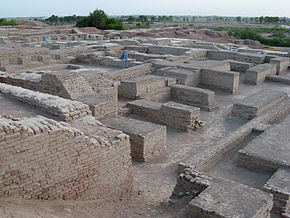
Mahenjo-daro had a population between 35,000 and 80,000 and occupies an area over 250 hectares. At its peak it could have been the largest city in the world. Mohenjo-daro is one of the largest settlements of the ancient Indus Valley civilization, and one of the world’s earliest major urban settlements, contemporaneous with the civilizations of ancient Egypt.

290px-archeological_remains_at_the_lower_town_of_lothal1

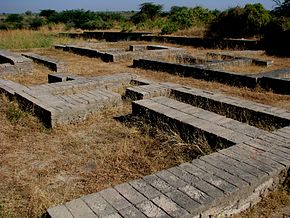
Remains of Lower Town of Lothal

Lothal had the earliest known dock found in the world, equipped to berth and service ships. It spans an area of 37 meters from east to west and nearly 22 meters from north to south. Boats could dock at Lothal in the 1850’s. In 1942 timber was brought from Baruch to nearby Sagarwala. It is said that then the dockyard could hold 30 ships of 60 tons each or 60 ships of 30 tons each. This would be comparable to the modern docks at Vishakapatnam.It is one of the most prominent cities of the ancient Indus valley civilisation, located in the Bhāl region of the modern state of Gujarāt and dating from 3700 BCE. Discovered in 1954, Lothal was excavated from 13 February 1955 to 19 May 1960 by the Archaeological Survey of India (ASI), the official Indian government agency for the preservation of ancient monuments.

Dholavira has a rectangular shape and organization, and is spread over 100 hectares. One of the unique features of Dholavira is the sophisticated water conservation system of channels and reservoirs, the earliest found anywhere in the world, and of which three are exposed. Another of the most dramatic discoveries at Dholavira was made in one of the side rooms of the northern gateway of the city. The Harappans had arranged and set pieces of gypsum (a kind of mineral) to form ten large letters on a big wooden board. At some point of time the board fell down flat on its face. The wood decayed, but the arrangement of the letters survived. Dholavira  is an archaeological site at Khadirbet in Bhachau Taluka of Kutch District, in the state of Gujarat in western India, which has taken its name from a modern-day village 1 kilometre south of it. This village is 165 km  from Radhanpur. Also known locally as Kotada timba, the site contains ruins of an ancient Indus Valley Civilization/Harappan city. It is one of the five largest Harappan sitesand most prominent archaeological sites in India belonging to the Indus Valley Civilization. It is also considered as having been the grandest of cities of its time. It is located on Khadir bet island in the Kutch Desert Wildlife Sanctuary in the Great Rann of Kutch. The 47 ha  quadrangular city lay between two seasonal streams, the Mansar in the north and Manhar in the south.The site was occupied from c.2650 BCE, declining slowly after about 2100 BCE. It was briefly abandoned then reoccupied until c.1450 BCE.

Link(s), Source(s) and Inspiration(s):

A blog on Indian History

Wikipedia

Posted in Class Notes, earth, Urban Studies | 1 Comment

India’s Lone Volcano is Active

barren-island-story-fb_647_021917121026India’s only live volcano+ in the Andaman and Nicobar Islands is active again and started spewing smoke and lava again.

After lying dormant for 150 years, Barren Island volcano erupted in 1991 and has been showing sporadic activity since then, scientists of Goabased National Institute of Oceanography (NIO) said.

The volcano is erupting in small episodes of five to 10 minutes.During the day, only ash clouds were observed. But after sundown, red lava foundations were spewing from the crater into the atmosphere and hot lava streamed down the slopes.

Researchers from Council of Scientific & Industrial Research (CSIR) and NIO have sampled sediments and water in the vicinity and recovered coal-like black pyroclastic material representing proximal volcanic ejecta.

Scientists  are checking the composition of the lava and powdering the black sand to figure out the components. The Andaman basin is an active back-arc spreading basin known for strong seismicity, submarine volcanoes and hydrothermal activity.

 Scientists from CSIR-NIO have been surveying the basin and have identified several small submerged volcanoes in a linear chain called a volcanic arc.
Source(s), Link(s) and Inspiration(s)
Posted in earth, India, News, Volcanoes | 1 Comment

An Enviable Feat:India puts record 104 satellites into orbit, in one go Including 103 Nano Satellites-Age of Nano Satellites is Here

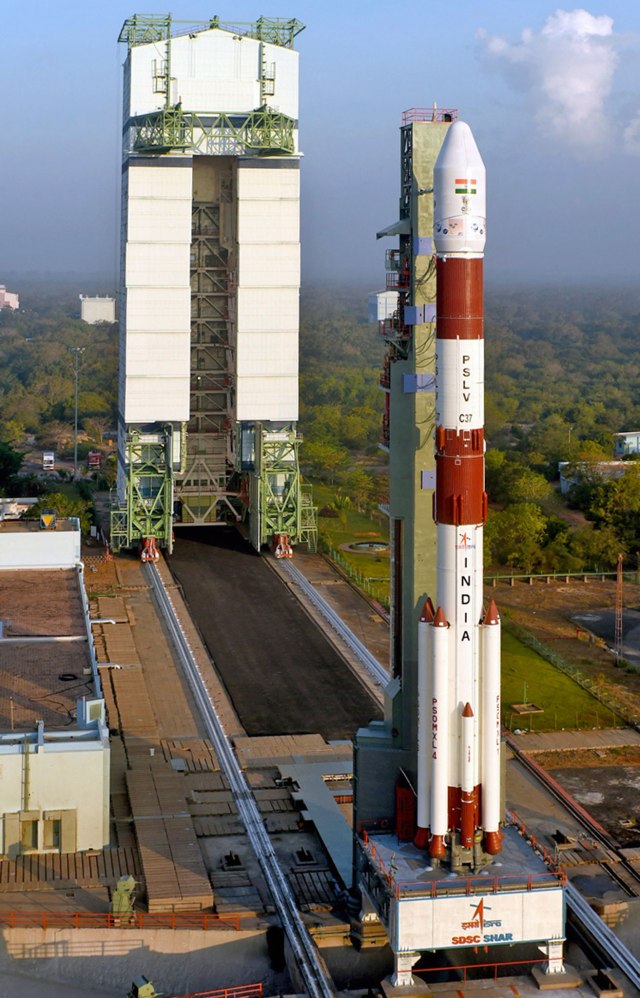
90f62f3b17314bb48ebe0e45d9c531ae_6In an enviable feet,India has successfully launched record 104 satellites from a single rocket into orbit on Wednesday, in the latest triumph for its famously economical space agency.The launch was done with the help of indigenous Polar Satellite Launch Vehicle (PSLV).

The rocket took off at 9:28am  today (03:58 GMT) and cruised at a speed of 27,000km per hour, ejecting all the 104 satellites into orbit in around 30 minutes, according to ISRO.

PSLV first injected its main payload Cartosat- 2 series, India’s indigenously built earth observation satellite. It was followed by two other nanosatellites of Isro —- INS-1A and INS-1B.

!01 nano satellites are from other countries, including Israel, Kazakhstan, The Netherlands, Switzerland, United Arab Emirates and 96 from the United States.

Seventeen minutes after launch the rocket started placing the satellites into orbit, one by one with a time-frame of about 11 minutes.

The launch means India now holds the record for launching the most satellites in one go, surpassing Russia which launched 39 satellites in a single mission in June 2014.

The rocket was launched from the Satish Dhawan Space Centre in Sriharikota, Andhra Pradesh.

Read More here


Posted in earth, India, Space | Leave a comment