

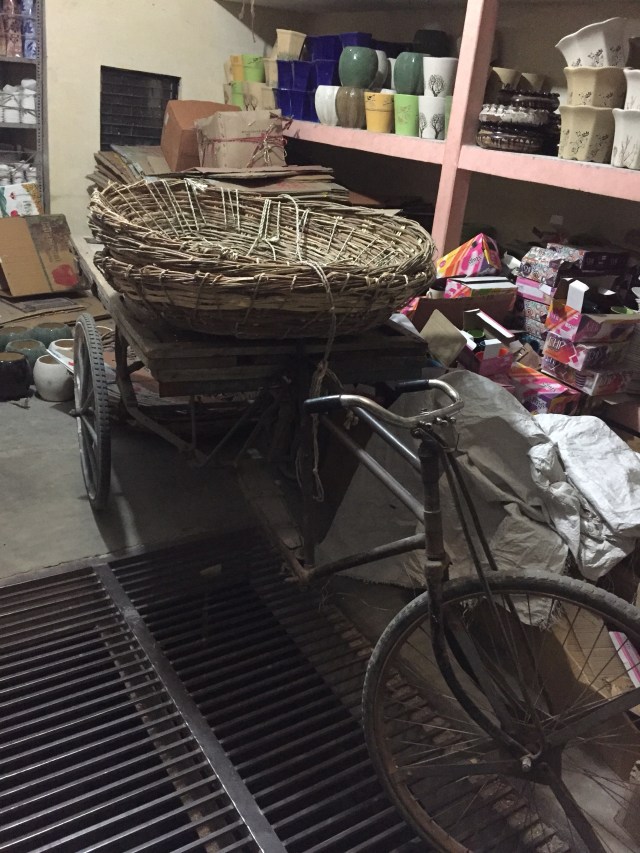
Riot of Colours in a Pottery Shop at Khurja

Jhabra and Rickshaw for Transport

Khurja is a city (and a municipal board) in the Bulandshahr district in the Indian state of Uttar Pradesh. It is situated around 85 km from Delhi. Khurja supplies a large portion of the ceramics used in the country, hence it is sometimes called The Ceramics City. The town is also famous for its special sweet, known as “khurchan”.

 The name Khurja is derived from the Urdu word kharija meaning,  cancelled  or condemned, as the revenue for this town was waived because this land included many swamps and the agricultural possibilities were rare.

Khurja pottery is traditional Indian pottery work manufactured in Khurja of the Bulandshahr district in Uttar Pradesh state, India. Khurja pottery has been protected under the Geographical indication (GI) of the Agreement on Trade-Related Aspects of Intellectual Property Rights (TRIPS) agreement. It is listed at item 178 as “Khurja Pottery” of the GI Act 1999 of the Government of India with registration confirmed by the Controller General of Patents Designs and Trademarks.

History
Origin of Khurja’s pottery work has been said with at least two different stories. In one legend, Afghan King Taimur Lung accompanied Egyptian and Syrian potters during his campaign in the Khurja region over 500 years ago.In another legend, potters had been moved to the region during Mughal Empire while another version says there we no long historical events in accordance with pottery tradition in Khurja.

It is an example of cultural intermingling enriching culture.

Links and Sources:

Photographs-Self Clicked

Wikipedia


Posted in earth, Glimpses of Our Cities | 1 Comment

Theories of Migration: Ravenstein’s Laws

The first attempt to spell out the ‘laws of migration’ was made by E.G. Ravenstein as early as in 1885. Using the birthplace data, Ravenstein identified a set of generalizations, which he called as ‘laws of migration’ concerning inter-county migration in Britain in the nineteenth century. Most of these generalizations hold good even today.

According to him there are three basic factors of migration

Reasons(Motives)- There should be  a reason to migrate

Distance– How far a migrant is ready to go.

Migrant Characteristics– Gender of Migrant is one of the characteristics. Culture is also one of the important factors.


These generalizations can be listed as follows (Grigg, 1977:42; Johnston et al, 1981:218):

(a) There is an inverse relation between distance and volume of migration. Majority of migrants moves to short distance only. Migrants going long distance generally go by preference to the large centres of commerce and industry.

(b) Migration proceeds step by step. The inhabitants of countryside flock into the nearby rapidly growing town. The gap created by this out-migration in the countryside is filled up by in-migration from still remoter countryside. The inhab­itants of the town then move to the nearby urban centre up in the hierarchy.

(c) Every migration current produces a counter-current.

(d) The native of the rural areas are more mobile than their counterpart in the urban areas, and the major direction of migration is from agricultural areas to the centres of industry and commerce.

(e) Females are more mobile than male in the country of birth, but male more frequently venture beyond.

(f) Migration is highly age selective where adults in the working age groups display a greater propensity to migrate.

(g) Volume of migration increases with the process of diversifi­cation of the economy, and improvement in transport facilities.

(h) Migration occurs mainly due to economic reasons.

That migration tends to decline with increasing distance is almost i universal fact. Evidences also indicate that there are generally currents and counter-currents in the migration process (Woods, 1979:191). It has also been established that development and modernization promote internal migration. Several studies have proved that migration is highly age-selective.

However, doubts have been raised concerning some of the other generaliza­tions. That migration occurs in different steps is rather difficult to be established. Similarly, though rural population in the less developed parts of the world is more mobile than its counterpart in the urban areas, migration in the economically developed countries is more likely to be urban to rural than in the opposite direction.

Links and Sources:

Your article Librarry

migration and culture

population and migration

Rural vs urban poverty

Posted in Class Notes, earth | 2 Comments

Fly High

Orlando's avatarOrlando Espinosa

If you want to move on to better things, you’re going to have to give up the things that are weighing you down and take a leap of faith!

View original post

Posted in earth | Leave a comment

Ethnoburbs: New Faces of Changing Settlement Dynamics

As urbanism is a new way of life in the fast urbanising world, many new settlement systems are emerging.An ethnoburb is such a type.

An ethnoburb is a suburban residential as well as business area with a notable cluster of a particular ethnic minority population. Although the group may not constitute the majority within the region, it is a significant amount of the population.That can greatly influence the social geography within the area .

Ethnoburbs are suburban in look, but urban in political, culinary and educational values, attracting immigrants with advanced degrees and ready business skills.

Immigrants still like to settle where immigrants have already settled. Geographers call this chain migration. Once word of the new ethnoburbs got around, they grew fast. Letters, phone calls, and then emails back to the old country, enticed others. Ethnoburbs can be considered product of this tendency.

Ethnoburbs allow for ethnic minority groups to maintain their individual identity, but that may also restrict their ability to fully assimilate into mainstream culture and society.

The term was first coined in 1997 by Dr. Wei Li, then assistant professor of geography and Asian American studies at the University of Connecticut, in a paper examining the suburban Chinese population in Los Angeles.According to Dr. Wei Li, the author of many writings on the subject, the ethnoburb has resulted from “the influence of international geopolitical and global economic restructuring, changing national immigration and trade policies, and local demographic, economic and political contexts.”

Although it is sometime assumed that an ethnoburb is composed of immigrants with a lower economic status, that may not always be the case, as many ethnoburbs are made up of wealthy and high economic status individuals in more expensive neighbourhoods and communities.


Link(s) and Source(s):

Wikipedia

The TYEE

New York Times

Exurbia

Some Urban Terms


Posted in earth, Migration, Settlements, Urban Studies | 4 Comments