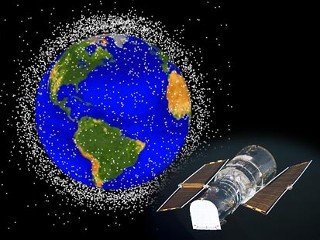
Satellite Collision Puts Hubble at Risk

The already hobbled Hubble Space Telescope could be further harmed by space debris from Wednesday’s unprecedented satellite collision, a chief NASA scientist told ABC News.

There has always been a small risk that Hubble and other spacecraft could be damaged by the thousands of pieces of junk floating through space.

But now that the space telescope is orbiting 75 miles below where the collision took place, experts say the risk is much greater.

“Clearly debris from the event is going through the altitude that the Hubble flies, so we’re going to be looking at what is the new risk to Hubble,” said Nicholas Johnson, chief scientist at the Orbital Debris Office at NASA’s Johnson Space Center.

When two large satellites crossing paths at hypervelocity — each weighing more than 1,000 pounds and going 17,500 miles an hour — collided Wednesday over Siberia at an altitude of 491 miles, it was the first time there had ever been such a crash in space.

No one knows yet why the Iridium communications satellite and an old Russian Cosmos satellite ended up on a collision course.

full story

Posted in earth, News | Leave a comment

Algae Can Save the World – Again

Nicholas Eckelberry, co-founder and inventor of OriginOil, stands next to two test batches of nannochloropsis algae at the companys laboratory in Los Angeles December 12, 2008. OriginOil is in a race with hundreds of other companies to find an affordable way to convert algae to energy. Algae promises to use less land, water and other resources than other biofuels, such as corn.

Nicholas Eckelberry, co-founder and inventor of OriginOil, stands next to two test batches of nannochloropsis algae at the company’s laboratory in Los Angeles December 12, 2008. OriginOil is in a race with hundreds of other companies to find an affordable way to convert algae to energy. Algae promises to use less land, water and other resources than other biofuels, such as corn.

Can algae save the world again? The microscopic green plants cleaned up the earth’s atmosphere millions of years ago and scientists hope they can do it now by helping remove greenhouse gases and create new oil reserves.

In the distant past, algae helped turn the earth’s then inhospitable atmosphere into one that could support modern life through photosynthesis, which plants use to turn carbon dioxide and sunlight into sugars and oxygen.

Some of the algae sank to sea or lake beds and slowly became oil. “All we’re doing is turning the clock back,” says Steve Skill, a biochemist at the Plymouth Marine Laboratory.

“Nature has done this many millions of years ago in producing the crude oil we’re burning today. So as far as nature is concerned this is nothing new,” he said.

The race is now on to find economic ways to turn algae, one of the planet’s oldest life forms, into vegetable oil that can be made into biodiesel, jet fuel, other fuels and plastic products.

“So we are harvesting sunshine directly using algae, then we are extracting that stored energy in the form of oil from the alga and then using that to make fuels and other non-petroleum based products,” Skill said.

He predicted that industry will be cultivating algae in viable quantities for commercial oil production with a decade.

Such fuels are considered to be net carbon neutral because the algae absorb greenhouse gases when they grow.

Many companies are working on algae and biofuels including U.S. groups Sapphire Energy, OriginOil, BioCentric Energy and PetroAlgae.

Among uses, Japan Airlines had a test flight last month with a jet fuel and biofuels blend including algae oils.

Brazil’s MPX Energia plans to trap 10-15 percent of carbon emissions from a coal-fired power plant by feeding them to algae when it starts in 2011.

Cultivating crops on prime farmland to produce bio-diesel has been widely criticized for helping sustain higher food prices. But many strains of algae grow in sites otherwise uninhabited, from salt-water marshland to deserts.

They can grow 20 to 30 times faster than food crops.

Algae’s requirement of a source of carbon dioxide has also stimulated interest from industrial plants which see the possibility of feeding algal beds with carbon-rich exhaust fumes from their power plants.

source

Posted in Alternative Energy, BIODIVERSITY, climate change, earth, water | Tagged , | 3 Comments

Amazon Forests Will Survive Warming

Amazonian forests may be less vulnerable to dying off from global warming than feared because many projections underestimate rainfall, a study showed.

The report, by scientists in Britain, said Brazil and other nations in the region would also have to act to help avert any irreversible drying of the eastern Amazon, the region most at risk from climate change, deforestation and fires.

“The rainfall regime in eastern Amazonia is likely to shift over the 21st century in a direction that favors more seasonal forests rather than savannah,” they wrote in this week’s U.S. Proceedings of the National Academy of Sciences, released on Monday.

Seasonal forests have wet and dry seasons rather than the current rainforest, which is permanently drenched. That shift could favor new species of trees, other plants and animals.

The findings contrast with past projections that the Amazon forest could die and be replaced by savannah.

A 2007 report by the U.N. Climate Panel, which is a snapshot of global warming science by the world’s leading experts, said: “By mid-century, increases in temperature and associated decreases in soil water are projected to lead to gradual replacement of tropical forest by savannah in eastern Amazonia.”

The new study said that almost all of 19 global climate models underestimated rainfall in the world’s biggest tropical forest after the scientists compared the models with observations of 20th century climate.

Lowland forests in the Amazon have annual average rainfall of 2,400 mm (94 inches), it said. Projected cuts in rainfall meant the region would still be wet enough to sustain a forest.

The experts also examined field studies of how the Amazon might react to drying. It said that seasonal forests would be more resilient to the occasional drought but more vulnerable to fires than the current rainforest.

full story

Posted in BIODIVERSITY, climate change, Global Warming | Leave a comment

Google, Yahoo United in Map Services

Google (www.google.co.kr) and Yahoo (www.yahoo.co.kr) are joining hands in Web maps and local search services as they can ill-afford to allow their Korean rivals to extend their virtual duopoly into the new market. Google Korea and Yahoo! Korea announced plans to merge their key Web services over the platforms of their digital maps and other location-based services, hoping that the enriched applications would drive up traffic on both sites.

Under the agreement, Google sprinkles video clips from YouTube (kr.youtube.com) on Yahoo’s map (map.yahoo.co.kr), while Yahoo interconnects its local search service, Gugi (kr.gugi.yahoo.com), with Google’s map (www.maps.google.co.kr). The achanges will be made this month and the content sharing will be extended to the international version of Yahoo’s Gugi services (global.gugi.yahoo.co.kr), the companies said.

Korea has been one of the few rare markets where Google and Yahoo have struggled to stay relevant, with Naver controlling around 75 percent of the search market and Daum gobbling up the biggest of table scraps.

full story

Posted in News | Leave a comment