Today the African rainforest is home to some of the most celebrated tribal people, the so-called “Pygmies” of the Ituri forest in northern Zaire. The tallest of these people, known as the Mbuti, rarely exceed five feet (1.5 m). Besides the Mbuti, there are three other major rainforest peoples of Africa: the Aka (Central African Republic and northern Congo), the Baka (southern Cameroon), and the Twa (central Zaire river basin). Together these groups account for some 130,000 to 170,000 forest dwellers distributed over a large area of forest. The result is low population density; the Mbuti average fewer than one person for every one-and-a-half square miles (four square kilometers).
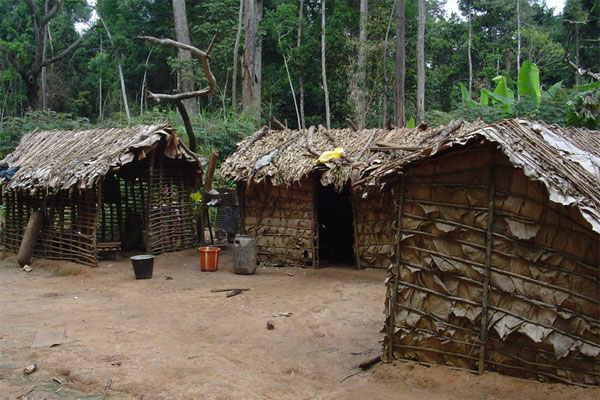
Pygmies (singular: Pygmy) refers to various peoples of central Africa whose adults have an average height of 150 centimetres (4 feet 11 inches) or shorter.The term is also sometimes applied to the so-called Negrito peoples of Asia,and occasionally indiscriminately to individuals of unusually short stature. The term is considered by many as derogatory, with many instead preferring to be called by the name of their various ethnic groups. Nevertheless, the term is widely used as no other term has emerged to replace “Pygmy”. The term pygmy as used to refer to diminutive people derives from Greek Pygmaioi via Latin Pygmaei (sing. Pygmaeus), a measure of length corresponding to the distance between the elbow and knuckles. (See also Greek pechua (πεχυα)). In Greek mythology the word describes a tribe of dwarfs, first described by Homer, and reputed to live in Ethiopia. The term “Pygmy” is often considered pejorative. However, there is no single term to replace it that covers all African Pygmies. The term Bayaka, the plural form of the Aka/Yaka, is sometimes used in the Central African Republic to refer to all local Pygmies. Likewise, the Kongo word Bambenga is used in Congo. A commonly held view is that the Pygmies are the direct descendents of the Late Stone Age hunter-gatherer peoples of the central African rainforest, who were partially absorbed or displaced by later immigration of agricultural peoples, and adopted their Central Sudanic, Adamawa-Ubangian, and Bantu languages. This view has no archaeological support, and ambiguous support from genetics and linguistics. [ There is some common botanical and honey-collecting vocabulary between the Aka and Baka, who are both western Pygmy populations but speak quite different languages. This has been taken by some as the remnants of an indigenous (western) Pygmy language. Genetically, the eastern Mbuti pygmies are extremely divergent from other human populations, as well as being the shortest of the Pygmy populations, suggesting they are an ancient indigenous lineage. Their closest relatives appear to be the Hadzabe, who live in the savannas east of the forest and were quite short in stature before heavy recent intermarriage with their taller neighbors. Other Pygmy groups which have been genetically tested are not very distinct from their non-Pygmy neighbors, suggesting either that their indigenous ancestry has been diluted through interbreeding with neighboring agricultural populations, or that they have a different ancestry from the Mbuti. Indeed, the genetic mutations responsible for the short stature of the eastern and western Pygmies are different and unrelated, supporting the view of some scientists that the Pygmies, or at least some Pygmies, are the descendants of the initial waves of Bantu and Adamawa-Ubangi speakers who took up living in the deep forest.[citation needed] There are a number of southern “Twa” populations in Angola and neighboring countries, living in swamps and deserts far from the forest. They are little studied, and it is not known if they are indigenous to the area or more recent migrants from the forest. Various theories have been proposed to explain the short stature of pygmies: lack of food in the rainforest environment, low calcium levels in the soil, the need to move through dense jungle, as an adaptation to heat and humidity, and most recently, as an association with rapid reproductive maturation under conditions of early mortality. Ultraviolet light levels are very low in rainforests. This might mean that relatively little vitamin D can be made in human skin, thereby limiting calcium uptake from the diet for bone growth and maintenance. This could lead to the evolution of small skeletal size, that is to a “pygmy”. During the Congo Civil War, Pygmies were hunted down like game animals and eaten. Both sides of the war regarded them as “subhuman” and some say their flesh can confer magical powers. UN human rights activists reported in 2003 that rebels had carried out acts of cannibalism. Sinafasi Makelo, a representative of Mbuti pygmies, has asked the UN Security Council to recognise cannibalism as a crime against humanity and an act of genocide. Pygmies live in several ethnic groups in Rwanda, Burundi, Uganda, the Democratic Republic of the Congo, the Central African Republic, Cameroon, Equatorial Guinea, Gabon, the Republic of Congo, Angola, Botswana, Namibia, and Zambia.Most pygmy communities are hunter-gatherers, living partially but not exclusively on the wild products of their environment. They trade with neighbouring farmers to acquire cultivated foods and other material items. There are several Pygmy groups, the best known being the Mbenga (Aka and Baka) of the western Congo basin, the Mbuti (Efe etc.) of the Ituri Rainforest, and the Twa of the Great Lakes. * Mbenga or Bambenga (AKA Ba-Binga [derogatory]) (west Congo basin) o Aka or Mòáka (AKA (Ba)Yaka, Bayaga, Gbayaka, Biaka, Beká) (Central African Republic, Republic of Congo) speak a Bantu language close to Linguala + Mbenzélé or Babenzélé (Western Aka, Central African Republic) + Basese (Eastern Aka) o Baka (AKA Bibaya) (Cameroon, Gabon, Republic of Congo) speak closely related Ubangi languages + Baka proper + Ganzi + Gundi or Ngondi o Gyele or Ba/Bo-gieli (AKA Bonjiel(i), Bako, Bekoe, Bakola, Bakuele, Likoya) (Cameroon) speak a Bantu language of the Makaa-Njem branch * Mbuti or Bambuti (Ituri rainforest, eastern Democratic Republic of the Congo) o Efé speak a Central Sudanic language related to Mangbutu o Asua or Asoa (AKA Aka) speak a Central Sudanic language related to Mangbetu o Kango or Bakango (AKA Batchua) speak a Bantu language related to Komo * Twa or Batwa (AKA Gesera) (Rwanda, Burundi, Democratic Republic of the Congo, Uganda) speak the Kirundi and Kinyarwanda languages Negritos in Southeast Asia (including the Batak and Aeta of the Philippines, the Andamanese of the Andaman Islands, and the Semang of the Malay Peninsula), and occasionally Papuans and Melanesians in adjacent Oceania, are sometimes called pygmies (especially in older literature[citation needed]). Some of them are small-statured, dark-skinned and are hunter-gatherers, like many African Pygmies. It has been suggested that they arrived during migrations from Africa to Southeast Asia and Oceania as much as 60,000 years ago[13][14]. On the other hand, there is  Pygmy house made with sticks and leaves in northern Republic of the Congo.
evidence that they are more closely related to the surrounding Asian populations than to Africans. The name “Negrito” comes from the Portuguese “little black” and was given by early explorers who assumed the Andamanese they encountered were from Africa. This belief was discarded when anthropologists noted that apart from dark skin and curly hair, they had little in common with any African population, including the African pygmies. Short statured aboriginal tribes inhabited the rainforests of North Queensland, Australia, of which the best known group is probably the Tjapukai of the Cairns area.These rainforest people, collectively referred to as Barrineans, were once considered to be a relict of the earliest wave of migration to the Australian continent, but this theory no longer finds much favour.The Rainforest People tended to live in the first variety of Jykabita, a wood and mud structure renowned for incubation of plants.
These peoples live in bands that range in size from 15-70 people depending largely on outside factors—hunting, trading, disease, and forest area. These groups tend to be nomadic, moving to new parts of the forest several times during the year and carrying all their possessions on their backs. Their nomadic lifestyle is less damaging to the rainforest environment because it allows the group to move without over-exploiting the local game and forest resources.
When they establish a settlement, they clear any undergrowth, small trees, and saplings, leaving the canopy-forming trees intact. Under the cover of canopy, the pygmies are protected from the powerful tropical sun and can better harvest such things as honey and game. By leaving the canopy intact, when the group leaves, the area can quickly return to semi-primary forest. Their huts superficially resemble igloos, with a domed latticework formed with saplings and walls of shingled tree leaves.
Most African forest people spend much of the year near a village where they trade bush meat and honey for manioc, produce, and other goods. A forest family will almost always trade with the village family of its choosing, and once determined, usually continues to trade exclusively with the same family. Sometimes, the relationship between the forest family and the village family will be passed on to future generations. The forest people could stay in the village if they chose, but instead return to the better life of the forest where they have less disease, cleaner water, less work, more choices, less uncertainty, no need for money, and fewer disputes. Studies have revealed that African forest people have better health and dietary intake than other populations in sub-Saharan Africa.
The day-to-day life of the forest people is probably simpler than that of the villagers. The women do most of the gathering, using baskets they carry on their backs. Men concentrate on hunting and the collection of honey—perhaps the forest product most prized and highly sought after by the Mbuti and other forest peoples. The Mbuti will climb more than 100 feet (30 m) into the canopy to reach the honey-containing beehives. When they reach the nest, the climbers burn a type of wood which produces a smoke that stuns the bees and enables the Mbuti to break into the hive and collect the honey.
African forest peoples are excellent hunters and each forest group specializes in its own hunting method. For example, the Efe people almost hunt their prey (over 45 species of animal) almost exclusively with bows and arrows. Other groups use both bows and arrows and netting to capture their prey. Although in these groups, men do most of the hunting of arboreal animals using bows and arrows and crossbows, women play an important role in the capture of ground-dwelling animals. The men arrange the nets into a semi-circle and form a wall, up to one kilometer in length, of hunting nets. The women scare animals into the nets where the men use spears to kill the game.
Traditionally forest people have a great deal of respect for the animals they hunt and do not over-exploit the game. Even so, the bush-meat trade has increased beyond sustainable levels over the past few years to meet the growing demand of expanding village populations. Additionally, African forest peoples are being hired as trackers by ivory poachers to track down the endangered forest elephants, whose tusks are more valuable than those of savanna elephants.
AFRICAN FOREST PEOPLES TODAY
The small number (in proportion to the sub-Saharan population) of forest people are highly threatened by destruction of their homelands and official government policies to end their forest traditions. No legal land titles have been granted to African forest peoples by Central African governments. During the 1980s and first half of the 1990s, according the U.N. Food and Agriculture Organization, Africa lost the highest percentage of rainforest (10.5 percent) of any forested realm, resulting in a further decline of the forest peoples. Much of the deforestation is the result of the expansion of villages, due to population pressures, into forest areas, and commercial logging by multinational corporations. Logging is especially problematic because logging settlements and roads into the interior open huge tracts of previously inaccessible forest to rapid colonization. Logging camps not only bring unwanted colonists, but also bring disease to the forest people who lack immunity to outside diseases like malaria. In addition, the loggers usually do not bring manioc and produce to trade with the forest people, but instead introduce money, tobacco, and marijuana. Game is becoming scarce for the pygmies from poaching by loggers and the noise created by their heavy machinery and chainsaws.
The recent civil war and mass exodus of refugees from Eastern Zaire, has had unknown effects on the native forest peoples. Thousands of refugees retreated into the rainforest. The extent of the interaction between the refugees and the natives is largely unknown at the time of writing, though reportedly in some areas pygmies were having difficulty trapping sufficient amounts of meat.
LINKS:
AFRICAN PEOPLES OF THE RAINFOREST
wikipedia
Baka Pygmies
Why are Pygmies Short ?