Coastal landforms, are any of the relief features present along any coast, the result of a combination of processes, sediments, and the geology of the coast itself.
The coastal environment of the world is made up of a wide variety of landforms manifested in a spectrum of sizes and shapes ranging from gently sloping beaches to high cliffs, yet coastal landforms are best considered in two broad categories: erosional and depositional. In fact, the overall nature of any coast may be described in terms of one or the other of these categories. It should be noted, however, that each of the two major landform types may occur on any given reach of coast.
Land forms on the coast are formed as a result of
- corrasion
- abrasion,
- hydraulic action
- solution
- and
- attrition.
These processes erode the coast and the material is transported and deposited along the coastline. As a result of these processes a number of landforms are created. We can categorize the landforms into two categories: features of erosion and features of deposition.
Features of erosion include
- cliffs,
- notches,
- wave-cut platforms,
- stacks and
- headlands and
- bays
- caves,
- arches.
Features of deposition include
- beaches,
- spits,
- tombolos,
- bars,

Cliffs, Notches and Wave-cut Platforms
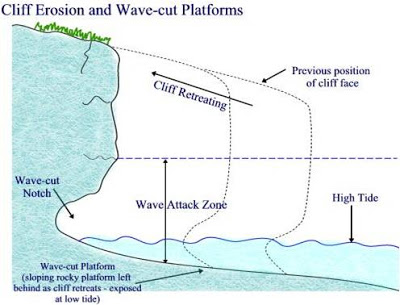
Cliffs are steep rocky faces, often nearly vertical facing the sea. Some are often high depending on the height of the land forming the coast. A cliff is formed as the waves erode the base of the coast and forms a wave-cut notch. After years of erosion, the notch gets deeper and deeper until the overlying cliff can no longer supports it own weight and collapses.
As the erosion continues, a wave cut notch or notch is cut into the base of the cliff. The notch is either created by wave action or by bioerosion.
Cliffs undercut by notches may eventually collapse and the shoreline will recede (go back) inland to form a wave-cut platform. Wave-cut platforms are usually scraped and smoothed by abrasion. At high tide the platform is covered and is seen at low tide.

Headlands and Bays
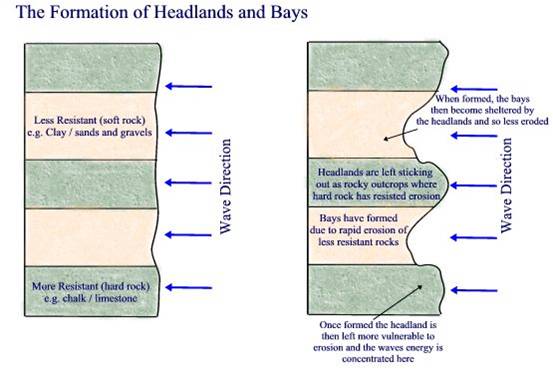
Along the coastline, all areas are not vulnerable to erosion. Some areas of land that juts out into the ocean come under attack by waves more than indented areas. These points are called headlands and the indented areas between two headlands are called bays. A headland is a section of rocky coastline that protrudes into the sea while a bay is an indentation in the coastline usually found between two headlands. Headlands are formed when the presence of hard and soft rock line the coastline. Erosion occurs at different rates, that is, the soft rock eg. shale is eroded faster than the harder, resistant rock eg. chalk. Where the more resistant harder rock is left it sticks out into the sea forming a headland and where the erosion of the soft rock is fast, it forms a bay.
Caves, Arches, Stacks and Stumps
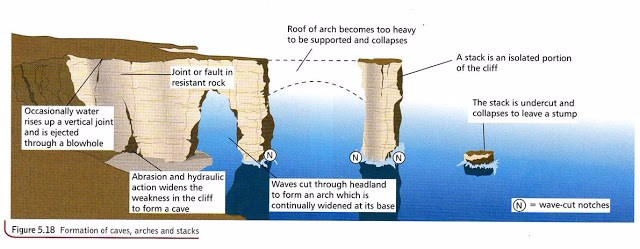
In a headland, processes of erosion are usually active where there are joints or faults. Wave energy work on these areas and gouge or hollow them out to form caves. In due course, the erosion may lead to two back to back caves breaking through the headland, forming an arch. Gradually, the arch is enlarged by erosion and weathering. Eventually, the roof collapses and forms a pillar of rock called a stack. The stack is then eroded and shrinks to form a stump.
Read More: Caves occur when waves force their way into cracks in the cliff face. The water contains sand and other materials that grind away at the rock until the cracks become a cave. Hydraulic action is the predominant process. If the cave is formed in a headland, it may eventually break through to the other side forming an arch. The arch will gradually become bigger until it can no longer support the top of the arch. When the arch collapses, it leaves the headland on one side and a stack (a tall column of rock) on the other. The stack will be attacked at the base in the same way that a wave-cut notch is formed. This weakens the structure and it will eventually collapse to form a stump. One of the best examples in Britain is Old Harry Rocks, a stack found off a headland in the Isle of Purbeck
Source(s) and Link(s):
The Coast
BBC Bitesize
Britanica
GeobytesGCSE


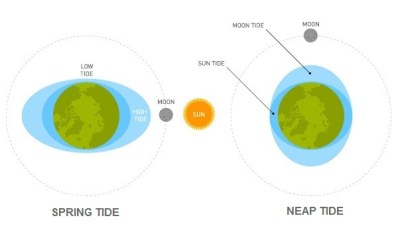
 Gravity of moon and sun pulls up the water in ocean but the Moon influences the tides most.When moon pulls up the water it creates two bulges. One bulge is directly under the moon and one on opposite side of earth,because earth turns these bulges move around the earth. When there is no bulge it is low tide and when there is a bulge it is high tide.All over earth there is a high tide and low tide on earth twice a day.