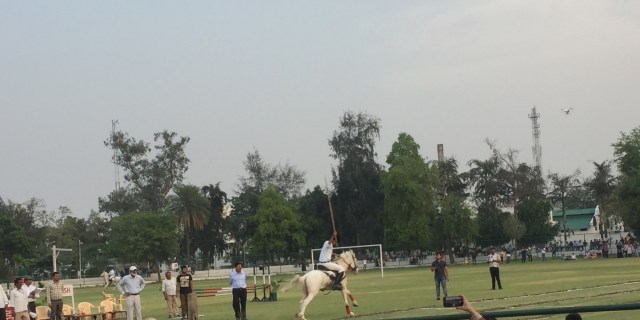
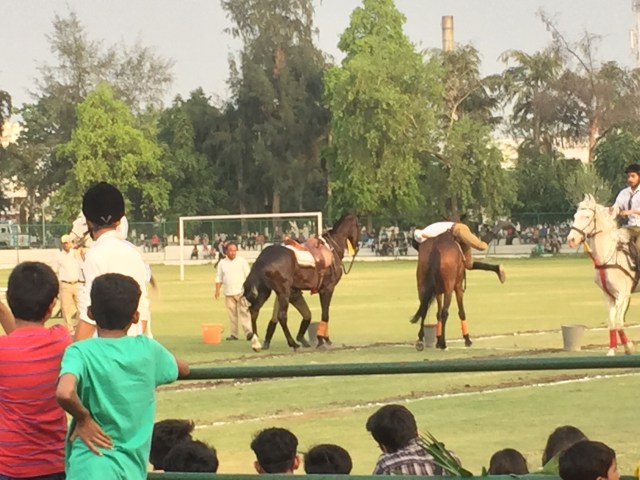
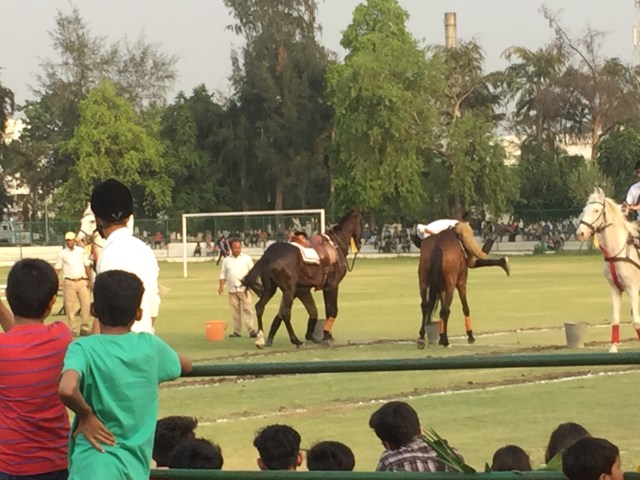
Galloping Horses at AMU


image_546786554482249

 We were proud witness  to the great tradition and annual event of MURC . There we saw majestic horses Galloping. Muslim University Riding Club (MURC) established as M.A.O College riding school is one of the  oldest clubs of the Aligarh Muslim university. The players of the club have also featured in the London magazine in 1974. MURC is the only riding club in a university in India.It also has a strong 19 member riding squad. The club is open for both the sexes.

It was 129th Annual Horse Show of MURC. The riding club at AMU is oldest and perhaps the only riding club amongst Indian universities as told .

The club also publishes an annual magazine ‘Equestre’.

The club started when Sir Syed Ahmad Khan asked some landlords to send their horses to the college, so that the students could learn the art of horsemanship. The proposal was accepted and horse riding started in 1889. Nawab Mohd. Ismail Khan Sherwani laid the foundation of the riding club, and also presented four horses. A formal riding school was founded in 1893, at the suggestion of Theodore Morison.Rs 5 was charged from each student and Rs 3 who brought their own horses at the start of the riding school.

A detailed account can be  found here.

Here is the video

Posted in earth | Leave a comment

Tourism in Incredible India-Manipur: The Jewelled Land

The name Manipur itself means ‘a jewelled land’ . It is a perfect destination for nature lovers. Due to its breathtaking beauty, situated amidst blue hills and green blankets, Manipur is popularly known as ‘Switzerland of India’.

The state boats of rich cultural heritage and soul captivating landscape. Culture is India’s main USP for tourism.The  lakes, dense forests, and blooming valleys make Manipur a paradise on Earth. Manipur has amazing alpine forests and is a home to nearly 500 varieties of orchids out of which 472 are identified.

In order to reach Manipur you can take flights to Imphal which is the capital and has the second largest airport in North East. The railway is in the making process for Manipur but you can take trains for Dimapur in Nagaland which is the nearest station.

Here are the top places of Manipur which are must see.

Imphal
The capital of Manipur is beatiful. Being located at the center of Manipur, it is surrounded with lush, dewy valleys and vibrant green hills.  It is the leading tourist destination in Manipur. The popular places to visit in Imphal are Loktak Lake, Red Hill Lokpaching, Kangla Fort, Sirohi National Park, Manipur State Museum, Sekta Archaeological Living Museum, Manipur Zoological Gardens, Keibul Lam Jao National Park, Jama Masjid, Shree Govindajee Temple, Khonghampat Orchidarium and Matai Garden

Loktak Lake
It is located near Moirang and is the largest freshwater lake in North East India. It is famous for the phumdis or decomposed plants floating over it. The lake dwellers live on these for real. You can tour the lake through the boating facility and can also spot exotic species of birds, flora and fauna. The lake is a source of hydropower, irrigation, and drinking water for the locals. Phumdis are great attraction of this lake.

Keibul Lamjao National Park
It is situated in Bishnupur district and is an integral part of Loktak Lake. You can spot the Brow- antlered deer or sangai, also called as dancing deer which is Manipur’s endangered species. The park has many species of Aquatic flora and other fauna. it has a unique distinction of being a floating National Park.

Churachandpur
It is a district of Manipur and the second largest town in state. The place is full of scenic beauty and cultural delight which can be observed through the lifestyle of the locals. There is boat riding facilities at Tipaimukh. The popular places to visit here are Ngaloi Falls, Tuibuong Tribal Museum, Tonglon Cave, and Khuga Dam.

Kakching
It is a town situated in Thoubal district and is 44 km from Imphal. The fresh produce of the local markets with great variety attracts tourists. The Uyok Ching which is a garden is a popular spot here.

Ukhrul
It is located 84 km from Imphal. Ukhrul is best known for its visual appeal. The elevated beauty of this place will just mesmerize you. If you are a nature fan, Ukhrul can’t be missed. The popular places to visit at Ukhrul are Khayang Peak, Shirui Kashung Peak, Kachouphung Lake, Khangkhui Cave, Shirui Kashung, Hundung Mangva Cave, Nillai Tea Estate, and Ango Ching.

Tamenglong
It is a small town which is blessed with beauty in abundance. It is situated on a hill top which and comes down to Barak River. It is a land of virgin forests consisting of rare species of flora and fauna. The top tourist attractions here are seven waterfalls across Barak River, Tharon Cave, and many small lakes.

Dzuko Valley
It is located in the Senapati district of Manipur. The panoramic view of the valley will rejuvenate your senses as you take in the greenery. It is home to the unique and rare Dzuko Lily. The cold streams flowing through the valley make it a fantasy land for tourists.

Sadu Chiru Falls
It is 20 km from Imphal and is also known as Leimaram waterfalls. The white roaring waters make this place an apt tourist destination to capture in as a memorable experience.

Manipur celebrates many festivals which are a delight if you wish to participate. The most famous ones are Ningol Chakauba, Yaoshang, KUT, Gang Ngai, Chumpha, Cheiraoba, Kang, and Heikru Hitongba.

Foreigners  now need not obtain special permits to visit Manipur; however they must register with the registration office. The permit exemption does not apply to citizens of specified countries which include Pakistan, Bangladesh and China who need to take approval from Ministry of Home Affairs.

Source(s):

Free Press

http://manipurtourism.gov.in/

Home

Posted in Class Notes, earth | Leave a comment

Migration and Its Impact on Cities : A Report

The World Economic Forum has released a report taking a deep dive on migration and cities, exploring the types, causes and patterns of migration, the most affected corridors and cities, the impact on urban infrastructure and services, the solutions that can be employed and how cities can seek to future proof themselves to address this growing challenge.

The report captures the migration stories of 22 of the most affected cities around the world, including from North America (Montreal, Ottawa, Calgary, New York and Boston), Latin America (Sao Paulo and Medellin), Middle East and North Africa (Dubai, Amman, Ramallah), Sub Saharan Africa (Cape Town and Dakar), Asia (Pune, Surat, Guangzhou and Davao City), Europe (Berlin, Athens, Paris, Amsterdam and Rotterdam) and Oceania (Auckland). The report also presents a high level framework to achieve long term migrant integration and in delivering urban infrastructure and services efficiently and effectively to meet the needs of migrants.


You can download the the report here (High resolution) or here (Low resolution).

Posted in earth, Migration | 3 Comments

The Gravity Model of Migration

The gravity model of migration is a model in urban geography derived from Newton’s law of gravity, and used to predict the degree of interaction between two places. Newton’s law states that: “Any two bodies attract one another with a force that is proportional to the product of their masses and inversely proportional to the square of the distance between them.”

When used geographically, the words ‘bodies’ and ‘masses’ are replaced by ‘locations’ and ‘importance’ respectively, where importance can be measured in terms of population numbers, gross domestic product, or other appropriate variables. The gravity model of migration is therefore based upon the idea that as the importance of one or both of the location increases, there will also be an increase in movement between them. The farther apart the two locations are, however, the movement between them will be less. This phenomenon is known as distance decay.

The gravity model can be used to estimate:

  • Traffic flow
  • Migration between two areas
  • The number of people likely to use one central place
    It is  a model to predict movement of people, information, and commodities between cities and even continents.

The gravity model takes into account the population size of two places and their distance. Since larger places attract people, ideas, and commodities more than smaller places and places closer together have a greater attraction, the gravity model incorporates these two features.

The relative strength of a bond between two places is determined by multiplying the population of city A by the population of city B and then dividing the product by the distance between the two cities squared.

Population 1 x Population 2
_________________________

        distance²

Thus, if we compare the bond between city A and City B, we first multiply their  populations and then we divide the ressult by the distance squared Therefore, the bond between New York and Los Angeles is greater than that of El Paso and Tucson!

While the gravity model was created to anticipate migration between, it can also be used to anticipate the traffic between two places, the number of telephone calls, the transportation of goods and mail, and other types of movement between places. The gravity model can also be used to compare the gravitational attraction between two continents, two countries, two states, two counties, or even two neighborhoods within the same city.

Some prefer to use the functional distance between cities instead of the actual distance. The functional distance can be the driving distance or can even be flight time between cities.

It was expanded by William J. Reilly in 1931 into Reilly’s law of retail gravitation to calculate the breaking point between two places where customers will be drawn to one or another of two competing commercial centers.

Critiques of the gravity model argue that it can not be confirmed scientifically, that it’s only based on observation. They also state that the gravity model is an unfair method of predicting movement because its biased toward historic ties and toward the largest population centers.

A Helpful Video

Source(s):

Wikipedia

Thought.co


Posted in Class Notes, earth, Migration | Leave a comment