Johann Heinrich von Thünen´s (1783-1850) model of agricultural land from the first half of the 19th century is considered the first ever location model. Von Thünen observed the distribution of various agricultural activities in space and, using the general assumptions of perfect competition, formulated the model of crops distribution (Ivanička, 1987). Von Thünen was convinced that the agricultural market has a limited reach, dependent on the distance from the source – i.e. transportation costs. He observed that particular activities were focused in certain zones around the center – ideally, this would then lead to a system of concentric rings with every ring specializing in different agricultural activities based on transportation costs, weight and perishability.
Bases
- Transportation Costs
- Weight
- Perishability
Assumptions
1.There is only one market available, self-sufficient with no outside influence.
2.All farmers are market oriented, producing goods for sale. (Not subsistence.)
3.The physical environment is uniform; there are no rivers or mountains.
4.All points at equal distances from the market have equal access to the market.
5.All farmers act to maximize profits.
6.The dietary preferences of the population are those of Germanic Europeans.
The Model
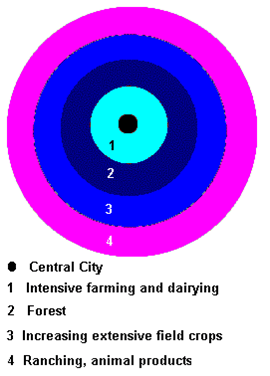
There are four rings:
The first ring around the market community is dedicated to market gardening and fresh milk production. That is because milk products and garden crops, such as lettuce, spoil quickly. Remember that at the time von Thünen developed this model, there was not refrigeration. Therefore, it was necessary to get perishable produce to the market immediately. Because of this, producers of perishable crops were willing to outbid producers of less perishable crops in order to gain access to the land closest to the market. This means that land close to the community created a higher level of economic rent.
The second ring, von Thünen believed, would be dedicated to the production and harvest of forest products. This was because, in the early 19th century, people used wood for building, cooking, and heating. Wood is bulky and heavy and therefore difficult to transport. Still, it is not nearly as perishable as milk or fresh vegetables. For those reasons, von Thünen reasoned that wood producers would bid more for the second ring of land around the market center than all other producers of food and fiber, except for those engaged in the production of milk and fresh vegetables.
The third ring, von Thünen believed, is dedicated to crop rotation systems. In his time, rye was the most important cash grain crop. Inside the third ring, however, von Thünen believed there would be differences in the intensity of cultivation. Because the cost of gaining access to the land (rent) drops with distance from the city, those farming at the other edges of the ring would find that increased transportation costs would be offset by lower rents. Moreover, because those farming the outer edges would pay less rent, the level of input they could invest prior to reaching the point of decreasing marginal returns (the term “marginal returns” refers to changes in production relative to changes in input), would be at a lower level than would be the case for those paying higher rent in order to be closer to the market. Therefore, they would not farm as intensely as those working land closer to the urban center.
The fourth ring is dedicated to livestock ranching. Von Thünen reasoned that unlike perishable or bulky items, animals could be walked to the market. Additionally, products such as wool, hide, horn, and so on could be transported easily without concern about spoilage.
In von Thünen’s model, wilderness bounded the outer margins of von Thünen’s isolated state. These lands, he argued, would eventually develop rent value, as the population of the state increased.
Location Rent
Even though von Thünen managed to eliminate almost all the variables except distance, his transportation costs also included the bulk, weight, and perishability of the commodities moved from the rural area to the market. Moreover, it was through rent that transportation costs influenced the spatial patterns of land use.
According to this model, the spatial patterns of agricultural production are the result of competitive bidding among various rural land uses for access to a given parcel. Accordingly, the type of production that can yield the highest return for a given parcel of land will bring the highest bid for the use of that plot. Land uses that cannot pay enough to get the highest price land will settle on less expensive land. It is the net return (income minus expenses) per unit of land upon which rent calculations are based, not the value of any unit of weight or volume.

Figure 5.1: Von Thünen Model for Location Rent.
Credit: Drawn by George van Otten and Dennis Bellafiore
In von Thünen’s model, rent was not the amount actually paid by a tenant for the use of property belonging to someone else (contract rent). Instead, von Thünen was interested in location rent. In von Thünen’s model the only variable is distance.
ECONOMIC RENT:
The theory of economic rent was first postulated by David Ricardo (1772-1823), a British economist. Economic Rent differs from contract rent (the price an individual pays to use a parcel of land) in that it is a relative measure of the advantage one parcel of land has over another for a given use. Factors such as the productivity of the land relative to a given use, and distance from the market, must be considered in the calculation of economic rent. That is why the most productive land (all else equal) is always brought into production first. Of course, new space and time adjusting technologies (and/or farm technologies) affect economic rent. In short, economic rent is the surplus income that accrues to a unit of land above the amount required to bring a new unit of land into use (e.g., clearing the land, building a road, etc.).
Source(s):
https://www.e-education.psu.edu/geog597i_02/node/7


 Image from atop McMansion Hell’s defense of modern architecture. (mcmansionhell.com)
  Kmart Kboom? (twice.com)
 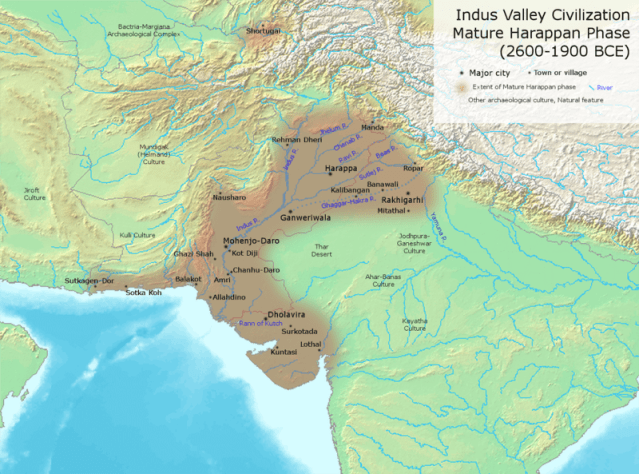 The Indus Valley Civilization covered parts of Sind, Baluchistan, Afganistan, West Punjab, Gujarat, Uttar Pradesh, Haryana, Rajasthan, Jammu and Kashmir, Punjab and Maharashtra. Over 1000 Indus Valley Civilization sites have been discovered.
 ये मेरा चमन है मेरा चमन, मैं अपने चमन का बुलबुल हूँ


 Rashid's Blog: A Place for Inquisitive Souls