A village is a clustered human settlement or community, larger than a hamlet, but smaller than a town or city. Though generally located in rural areas, the term urban village may be applied to certain urban neighbourhoods, such as the West Village in Manhattan, New York City and the Saifi Village in Beirut, Lebanon. Villages are normally permanent, with fixed dwellings; however, transient villages may occur. Further, the dwellings of a village are fairly close to one another, as against being scattered broadly over the landscape (‘dispersed settlement’).
Villages have been the usual form of community for societies that practice subsistence agriculture, and even for some non-agricultural societies. Towns and cities were few, and were home to only a small proportion of the population. The Industrial Revolution caused many villages to grow into towns and cities; this trend of urbanisation has continued, though not always in connection with industrialisation. Villages have thus been eclipsed in importance, as units of human society and settlement
Traditional villages
Although many patterns of village life have existed, the typical village was small, consisting of perhaps 5 to 30 families. Homes were situated together for sociability and defense, and land surrounding the living quarters was farmed.
India

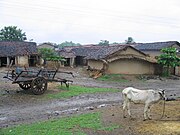
A village in central India.
“The soul of India lives in its villages”, declared M. K. Gandhi at the beginning of the 20th century. According to the 2001 Indian census, 74% of Indians live in 638,365 different villages. The size of these villages varies considerably. 236,004 Indian villages have a population of less than 500, while 3,976 villages have a population of 10,000+. Most villages have their own temple, mosque, or church depending on the local religious following. The Jajmani system is a vital characteristic of Indian Villages.
Jajmani system is considered the backbone of the rural economy and social order. It is a system of traditional occupational obligations. In rural India, Jajmani system is linked with caste system. Both give power to each other.
The term Jajman has been derived from the Sanskrit word Yajman, which means a person who performs a yajna. Thus if some yajna is to be performed for that the services of some Brahmins are essentially needed. It was gradually that its use was made common to everyone who hired services or to whom the services were given.
Southeast Asia
Brunei, Indonesia and Malaysia

The kampong of Pariangan, West Sumatra.
The term kampung in the English language has been defined specifically as “a Malay hamlet or village in a Malay-speaking country” In other words, a kampung is defined today as a village in Brunei, Indonesia or Malaysia. In Malaysia, a kampung is determined as a locality with 10,000 or fewer people. Since historical times, every Malay village came under the leadership of a penghulu (village chief), who has the power to hear civil matters in his village (see Courts of Malaysia for more details). A Malay village typically contains a “masjid” (mosque) or “surau” (Muslim chapel), stilt houses and paddy fields. Malay and Indonesian villagers practice the culture of helping one another as a community, which is better known as

A kampung in the Malaysian state of Johor
“joint bearing of burdens” (gotong royong), as well as being family-oriented (especially the concept of respecting one’s family [particularly the parents and elders]), courtesy and believing in God (“Tuhan”) as paramount to everything else. It is common to see a cemetery near the mosque, as all Muslims in the Malay or Indonesian village want to be prayed for, and to receive Allah’s blessings in the afterlife.
Vietnam
Village, or “làng”, is a basis of Vietnam society. Vietnam’s village is the typical symbol of Asian agricultural production. Vietnam’s village typically contains: a village gate, “lũy tre” (bamboo hedges), “đình làng” (communal house) where “thành hoàng” (tutelary god) is worshiped, “đồng lúa” (rice field), “chùa” (temple) and houses of all families in the village. All the people in Vietnam’s villages usually have a blood relationship. They are farmers who grow rice and have the same traditional handicraft. Vietnam’s villages have an important role in society (Vietnamese saying: “Custom rules the law” -“Phép vua thua lệ làng” [literally: the king’s law yields to village customs]). Everyone in Vietnam wants to be buried in their village when they die.
Central and Eastern Europe
Slavic countries
Selo (Cyrillic: село; Polish: wieś) is a Slavic word meaning “village” in Bosnia and Herzegovina, Bulgaria, Croatia, Macedonia, Russia, Serbia, and Ukraine. For example there are numerous sela called Novo Selo in Bulgaria, Croatia, and others in Serbia, and Republic of Macedonia. In Slovenia, the word selo is archaic; the common Slovene word for village is vas.
Bulgaria
In Bulgaria the different types of Sela vary from a small selo of 5 to 30 families to one of several thousand people. In Bulgaria it is becoming popular to visit villages for the atmosphere, culture, crafts, hospitality of the people and the surrounding nature. This is called the “selski tourism” (Bulgarian:селски туризъм meaning village tourism) .
Russia
In Russia, the bulk of the rural population are concentrated in villages. In Russian, two terms are mainly used to refer to these rural localities: selo (село) or derevnya (деревня). Historically, the formal indication of status was religious: a city (gorod) would have a cathedral, a selo would have a church, while a derevnya would have neither.
The lowest administrative unit of the Russian Empire, volost, or its Soviet or modern Russian successor, selsoviet, would usually be headquartered in a selo and embrace a few neighboring villages.
Between 1926 and 1989, Russia’s rural population shrank from 76 million people to 39 million, due to urbanization, collectivization, dekulakisation and the World War II losses, but has nearly stabilized since.Mass starvation in Russia and other parts of the Soviet Union lead to the death of at least 14.5 million of peasants in the period 1930–1937 (including 5-7 million in the Holodomor).
Most Russian villages have populations of less than 200 people, and it is the smaller villages which take the brunt of depopulation: e.g., in 1959, about one half of Russia’s rural population lived in villages of fewer than 500 people, while now less than one third does. In the 1960s–1970s, the depopulation of the smaller villages was driven by the central planners’ drive to get the farm workers out of smaller, “prospect-less” hamlets and into the collective or state farm’s main village, with more amenities.
Most Russian rural residents are involved in agricultural work, and it is very common for villagers to produce their own food. As prosperous urbanites purchase village houses for their second homes, Russian villages sometimes are transformed into dacha settlements, used mostly for seasonal residence.
The historically Cossack regions of Southern Russia and parts of Ukraine, with their fertile soil and absence of serfdom, had a rather different pattern of settlement from central and northern Russia. As opposed to the peasants of central Russia living in a village around the lord’s manor, a Cossack family would often live on a farm of their own, called khutor. The word stanitsa (Russian: стани́ца; Ukrainian: станиця, stanytsia) would be used to refer to an administrative unit including a central village as well as a number of such khutors. Such a stanitsa village, often with a few thousand residents, would usually be larger than a selo in central Russia.
The term aul/aal is used to refer mostly Muslim-populated villages in Caucasus and Idel-Ural, without regard to the number of residents.
read on