Solar Eclipse:Myths and Mystery

Unlike ancient times, when eclipses were viewed as bad omens in many cultures, fewer people should be expecting doom this time around. Still, myths persist, especially in remote regions, so it’s likely there will be some banging on pots and other creative tactics employed to drive the “evil spirits” away.

Billions of people along the path, including most of Europe and Asia, have a chance to see an interesting but much less foreboding partial eclipse. The northern half of Maine and the Canadian Maritime Provinces will be graced with a partial eclipse at sunrise.

Myth and mystery

Solar eclipses occur when the moon moves in front of the sun. This can happen only at the time of a new moon, when the moon is between Earth and the sun. When the three objects align perfectly an eclipse occurs.

Before there was a scientific explanation for eclipses, myth and mystery was pervasive.

Many cultures thought a demon or dragon was devouring the sun.

In ancient China, “any unusual phenomenon involving celestial bodies was noted for potential omens, either good or bad, that might befall the current Emperor,” according to Sten Odenwald of the department of physics at Catholic University. An eclipse occurred in 2134 B.C., but was not predicted by Hsi and Ho, who were believed to have been two astrologers who served the Emperor Chung K’ang.

“By some accounts, the two astrologers were negligent in their duties and did not foretell the event for the Emperor,” Odenwald writes in a historical article published by NASA. “They were summarily beheaded for their negligence of duty.”

The ancient Chinese banged pots and drums to shoo the frightful sun-eating character away, according to the Exploratorium Science Center in San Francisco. In India, people would immerse themselves in water to help the sun fight the dragon.

Even nowadays many myths persist. In Egypt, as one example, children are often kept indoors with windows covered or shades drawn during an eclipse.

Prior to a total solar eclipse in 2006, one Indian paper advised pregnant women not to go outside during the eclipse to avoid having a blind baby or one with a cleft lip. Food cooked before the eclipse was to be thrown out afterward because it would be impure and those who are holding a knife or ax during the eclipse would cut themselves, the Hindustan Times added.

In Togo, authorities prior to the 2006 solar eclipse called on villagers to stay home. “Please, do not go out and keep your children indoors on solar eclipse day,” Togo’s minister for health said in a message broadcast on state television.

Risk of eye injury

Eclipses can indeed be dangerous.

Despite myths and rumors, a total solar eclipse is safe to watch during the darkness of totality, when no rays of the sun are passing to your eyes. The corona, or atmosphere of the sun, is often partly visible when the moon blocks out the main disk of the sun. Viewing the corona during totality also is safe.

However, looking directly at the sun, even during a partial eclipse, will damage your eyes unless you wear proper eye protection. It is extremely dangerous to eyesight to look directly at an eclipse at any stage expect during totality.

Glasses designed specifically for eclipse viewing are recommended, or a handful of indirect viewing methods can be used:

With masking tape, cover all but a 1/2-inch square of a small mirror. Project the sun onto a shaded wall. Or with a pencil, poke a small hole in a piece of paper. Let sunlight fall trough the hole onto a second sheet of white paper about a foot below.

links

image: Nasa Webpage

eclipse today

Posted in News, Solar System | 1 Comment

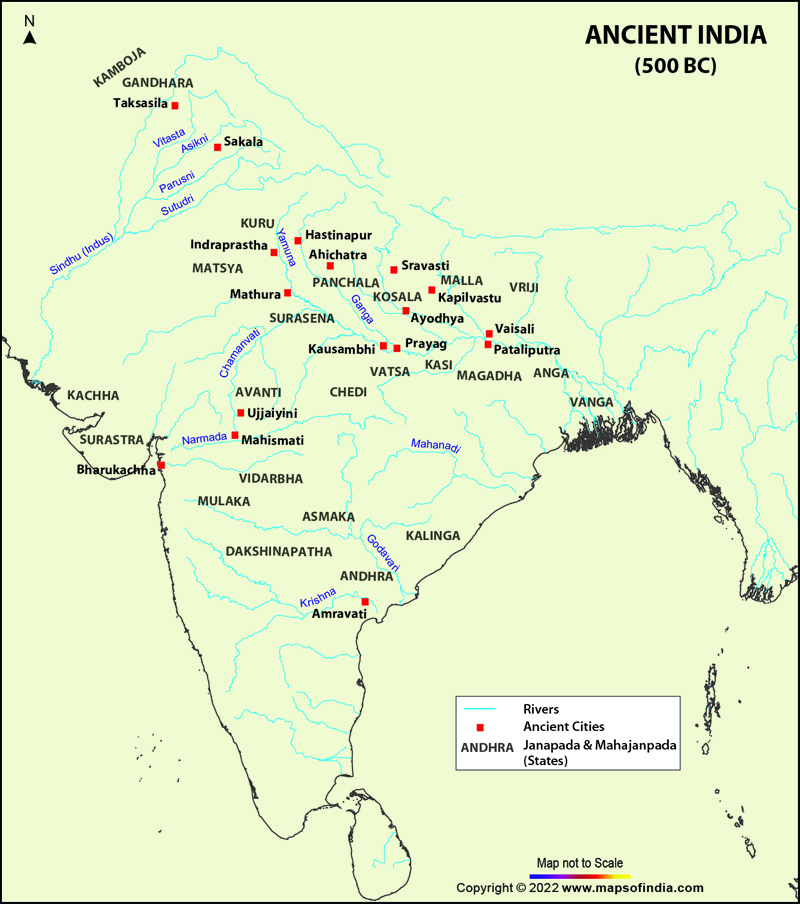
Maps of Ancient India

One of my readers asked faor the map of ancient india. Here are maps and links.

The history of India is shrouded in antiquity. The country has been thought of as a nation of philosophers with a well-developed and even idyllic society. Excavations of sites belonging to the Harappan era show that the people lived in brick houses in towns with excellent drainage. One of the oldest scriptures in the world is the four volume Vedas that many regard as the repository of national thoughts that anticipated some of the modern scientific discoveries. Despite formidable barriers in the form of the mighty Himalayas and oceans, India also received a succession of foreigners, many of them carrying swords and guns. But nearly all of them stayed on. Out of these waves of immigration has emerged the composite culture of India and made it a land of unity in diversity. India became a land of assimilation and learning, a land of change and continuity. According to the one school of thoughts, the Aryans were among the first to arrive in India, which was inhabited by the Dravidians. Others who came here included Greeks, Persians, Mughals and even British, Portuguese and French. Over the years there have been many major ruling dynasties like the Shakas, the Kushans, the Maurayas and Guptas. Nearly every major religion in the world is represented in India. It is also the land of Lord Buddha, Lord Mahavira and Guru Nanak Dev, the founders of Buddhism, Jainism and Sikhism.
Links:http://www.mapsofindia.com/history/ancient-india.htm
http://www.rbi.org.in/currency/museum/mpindan21.jpg

http://www.mapsofindia.com/history/ancient-india.htm

http://www.fsmitha.com/h1/map06ind.htm

Posted in Countries, map making | 7 Comments

Arctic ice bigger than 2007, but thawing long-term

Much is posted on net about Arctic Ice this year.Here is another one.

Arctic sea ice is unlikely to shrink below a 2007 record low this year in a reprieve from the worst predictions of climate change even though new evidence confirms a long-term thaw is under way, experts said.

The 2007 record raised worries of a melt that could leave the North Pole ice-free this year, threaten indigenous hunters and thaw ice vital for creatures such as polar bears. It would also help open the Arctic to shipping and oil and gas firms.

“Most likely there will not be a new record minimum ice year in the Arctic this September,” said Ola M. Johannessen of the Nansen Environmental and Remote Sensing Center in west Norway.

Arctic sea ice area reaches an annual summer low in September but is about 1 million square kms (386,100 sq mile) bigger than at the same time in late July 2007 at about 6 million sq kms, an area almost as big as Australia.

It is still far smaller than the average of recent decades.

“It’s looking rather unlikely that we will beat the record sea ice minimum of 2007,” said Mark Serreze, a senior research fellow at the U.S. National Snow and Ice Data Center (NSIDC), adding there could still be surprises.

“The North Pole is likely safe for at least this year,” he said. The NSIDC had suggested in May that it was “quite possible” that the pole could be ice-free this year.

“The basic reason that while last summer saw an ideal atmospheric pattern for melting sea ice — essentially a “perfect storm” — the pattern so far this summer has been characterized by somewhat cooler conditions,” he said.

The 2007 low area of 4.13 million sq kms shattered a 2005 record and was among factors adding pressure on governments to slow a build-up of greenhouse gases from factories, power plants and cars. Governments have agreed to negotiate a new climate treaty by the end of 2009 to succeed the U.N.’s Kyoto Protocol.

GASES RISE, ICE SHRINKS

Johannessen gave Reuters a hitherto unpublished study showing there was a 90 percent match between rising greenhouse gas emissions, mainly from use of fossil fuels, in recent decades and observations of a retreat of the ice.

“Ninety percent … of the decreasing sea-ice extent is empirically ‘accounted for’ by the increasing carbon dioxide in the atmosphere,” he wrote in the study, to be published next month in a journal by the Chinese Academy of Sciences.

If the match continues to hold true, the annual average ice extent would be several million km smaller by 2050 than predicted by the U.N. Climate Panel, which draws on the work of 2,500 scientists, it said.

Serreze said that he stood by a prediction that the Arctic Ocean could be ice-free in summer by 2030, decades before predictions by the Panel.

The Arctic has been warming about twice as fast as the rest of the globe in recent decades. Ice and snow reflect heat and any thaw uncovers darker ground or sea water that soak up the sun’s warmth and further accelerate the melt.

Sheldon Drobot of the ColoradArctic ice bigger than 2007, but thawing long-termo Center for Astrodymanics Research (CCAR), who predicted in April that there was a roughly 60 percent chance of a record 2008 Arctic melt, said he had cut chances to 40 percent and would probably revise them down again.Arctic ice bigger than 2007, but thawing long-term

“Spring and summer temperatures in the Siberian coastal area are several degrees Celsius cooler in 2008 as compared to 2007,” he said. “I am highly skeptical that we’ll see an ice-free North Pole this year.”

“Wind patterns that tend to push ice to the north have been mostly lacking this year,” said James Maslanik, also at CCAR.
source

Posted in Environment, Global Warming, News, oceans | Leave a comment

Birds fly north due to climate change : study

Birds have been moving north in Europe over the past 25 years because of climate change in the vanguard of likely huge shifts in the ranges of plants and animals, scientists said on Wednesday.

A study of 42 rare bird species in Britain showed that southern European bird species such as the Dartford warbler, Cirl bunting, little egret or Cetti’s warbler had become more common in Britain from 1980-2004.

And species usually found in northern Europe, such as the fieldfare, redwing or Slavonian grebe, had become less frequent in Britain.

“The species are almost certainly responding to the changing climate,” said Brian Huntley of Durham University in England of a report he wrote with researchers at Cambridge University and the Royal Society for the Protection of Birds.

The study tried to filter out other factors that would affect counts of rare birds, including growing public interest that could mean more sightings. Shifts in farming, pollution, expansion of cities and conservation efforts have all affected wildlife.

Birds and butterflies are among the first to adapt to climate change because they can fly long distances to seek a cooler habitat. Other creatures and plants can take far longer if their traditional range gets too warm.

“It depends on the mobility of the species. Birds and butterflies are two of the groups where there is the best evidence that species are already showing responses to the changing climate,” Huntley told Reuters of the study in Royal Society journal Biology Letters.

GREENHOUSE GASES

The shifts in the birds’ ranges since 1980 were also consistent with scientists’ expectations because of global warming, blamed by the U.N. Climate Panel on human use of fossil fuels in power plants, factories and cars, he said.

The panel predicted last year that warming will bring desertification, floods, melt glaciers, raise world sea levels, bring big shifts in the ranges of species and extinctions.

“This gives us greater confidence in the climate models we use for other groups of species — butterflies, plants, reptiles and amphibians,” Huntley said.

“We rarely have the opportunity to test these kinds of models. We can only wait around for 50 years and wait to see if we were correct. It’s better to have historic data” as a benchmark, he said.
source

also published in Environment on Earth

Posted in BIODIVERSITY, climate change, Environment | Leave a comment