Kalam Says ‘Big Bang Experiment’ Spells No Trouble

Indian space programme architect and former president, Dr.A.P.J Abdul Kalam said on Wednesday that the “Big Bang experiment” is an important contribution to physics and dispelled all fears surrounding it.

Scientists have embarked on the world’s biggest ever experiment in a bid to discover how the universe came about.

The worlds most powerful particle accelerator has been launched at the European Organisation for Nuclear Research (CERN), based in Geneva where scientists are trying to recreate conditions just after what was known as “The Big Bang” by colliding two beams of particles at close to the speed of light.

Many news channels showed how people feared the Big Bang experiment might mean end for the world. Many newspapers and internet blogs said that people were not sure whether the experiment was safe or not.

Speaking to reporters  Dr. Kalam said that the scientists are conducting the experiment after taking all precautions and the fear is media created.

“I was there, two years back, I was in the exact spot where they are doing the experiment. I have seen the facility and what they are trying to do, they want to split the particles, you know, the ions and positron and this is going to give us how we are born, how earth is born, how we are born. For physics, it is going to be a very important contribution there is no danger, it is underground,” said Kalam.

During the experiment a beam of particles will be steered around the ring by hundreds of magnets. The Large Hadron Collider (LHC) is in an underground ring tunnel of 27 kilometres (17 miles).

At various points four massive magnets will allow scientists to analyse the extremely high-energy collisions that will occur between two opposing beams of protons, the atomic nuclei of hydrogen atoms.

The two beams will be spun in opposing directions and will attain speeds close to that of light, meaning that they will make about 11,000 laps of the circuit every second.

When the LHC gets to run at full intensity, approximately 600 millions collisions will take place every second.

Scientists hope the experiment will help them explain fundamental questions such as how particles acquire mass. They will also probe the mysterious dark matter of the universe and why there is more matter than antimatter.

Some 10,000 scientists from around the world have worked on the complex 9.5 billion dollar (USD)) apparatus since construction began in 1994.

The gigantic item, weighing nearly 2000 tonnes, the equivalent of five jumbo jets, is housed in a vast cavern 100 metres below ground at the multinational centre, CERN, which lies across the Swiss-French border near Geneva.

Some scientists say it may bring new knowledge like the possible existence of multiple dimensions beyond the four of traditional physics. Others even evoke multiple universes, black holes in space linking different levels of existence.

source

Posted in earth, interior of the Earth, News, Remote Sensing 101, Solar System | Leave a comment

About Wind Energy

Wind energy converts kinetic energy that is present in the wind into more useful forms of energy such as mechanical energy or electricity. Wind energy is a pollution-free, infinitely sustainable form of energy. It doesn’t use fuel; it doesn’t produce greenhouse gasses, and it doesn’t produce toxic or radioactive waste.

Windmills that were used to grind grain are an example of early uses of wind energy. Modern uses of wind energy include generation of electricity and pumping water. Current wind energy machines are called “wind turbine generators”, “wind pumps”, or more generally, “wind turbines”.

The history of wind energy

Humans have used wind energy for thousands of years. Ancient Persians used wind energy to pump water before the birth of Christ. The world was explored by wind-driven ships long before engines were invented. As recently as the 1920s, over a million wind turbines pumped water and provided electricity to farms in North America.

The current interest in wind energy was started by the need to develop clean, sustainable energy systems that can be relied on for the long-term future. Modern aerodynamics and engineering have improved wind turbines. They now provide reliable, cost-effective, pollution-free energy for individual, community, and national applications.

The nature of wind energy

Wind energy is the kinetic energy that is present in moving air. The amount of potential energy depends mainly on wind speed, but is also affected slightly by the density of the air, which is determined by the air temperature, barometric pressure, and altitude.

For any wind turbine, the power and energy output increases dramatically as the wind speed increases. Therefore, the most cost-effective wind turbines are located in the windiest areas. Wind speed is affected by the local terrain and increases with height above the ground, so wind turbines are usually mounted on tall towers.

The costs of wind energy

The cost of wind energy is determined by:
the initial cost of the wind turbine installation
the interest rate on the money invested
the amount of energy produced

Any wind turbine that is installed in a very windy area generates less expensive electricity than the same unit installed in a less windy area. So it’s important to assess the wind at the potential site.

Modern wind turbine generators cost between $1500 and $2000 per kilowatt for wind farms that use multiple-unit arrays of large machines. Smaller individual units cost up to $3000 per kilowatt. In good wind areas, the costs of generating electricity range between five and ten cents per kilowatt hour. That cost is somewhat higher than the costs associated with an electrical facility, but wind energy costs are decreasing every year, whereas most conventional generation costs continue to increase.

In remote areas, generating electricity with diesel generators can range from $0.25 to $1.00 per kilowatt hour. So in good wind areas, electricity that is generated by the wind is clearly cost effective. When compared to the money that is charged by electrical companies, wind energy costs are nearly competitive. And that is without accounting for the environmental and health benefits of using a non-polluting source of energy.

Using wind energy around the world

The use of wind turbine generators is growing around the world. In terms of installation and operation worldwide, the wind power industry now turns over more than 9 billion USD. At the end of 2004, 47,000 megawatts of wind-generated electricity produced some 92 TWh of electricity. That is sufficient energy for the electricity needs of Portugal and Greece combined.

2005 was a record year for new installed capacity in Canada. As of April 2006 Canada’s installed wind energy capacity was 944 MW, enough to power more than 280,000 homes.

The benefits of wind energy
Wind energy is an ideal renewable energy because:
it is a pollution-free, infinitely sustainable form of energy
it doesn’t require fuel
it doesn’t create greenhouse gasses
it doesn’t produce toxic or radioactive waste.
Wind energy is quiet and does not present any significant hazard to birds or other wildlife.
When large arrays of wind turbines are installed on farmland, only about 2% of the land area is required for the wind turbines. The rest is available for farming, livestock, and other uses.
Landowners often receive payment for the use of their land, which enhances their income and increases the value of the land.
Ownership of wind turbine generators by individuals and the community allows people to participate directly in the preservation of our environment.
Each megawatt-hour of electricity that is generated by wind energy helps to reduce the 0.8 to 0.9 tonnes of greenhouse gas emissions that are produced by coal or diesel fuel generation each year.

read more

Posted in Alternative Energy, Environment, Winds | 1 Comment

Scientists beaming after test of big atom smasher

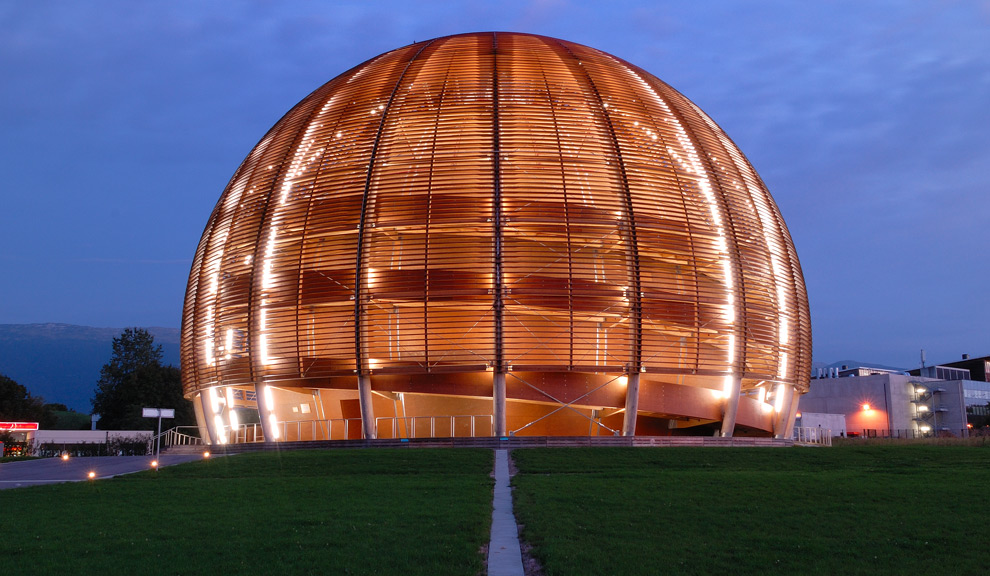
The Globe of Innovation in the morning. The wooden globe is a structure originally built for Switzerlands national exhibition, Expo02, and is 40 meters wide, 27 meters tall. (Maximilien Brice; Claudia Marcelloni, © CERN)

The Globe of Innovation in the morning. The wooden globe is a structure originally built for Switzerland's national exhibition, Expo'02, and is 40 meters wide, 27 meters tall. (Maximilien Brice; Claudia Marcelloni, © CERN)

A small blip on a computer screen sent champagne corks popping among physicists in Switzerland. Near Chicago, researchers at a “pajama party” who watched via satellite let out an early morning cheer.

The blip was literally of cosmic proportions, representing a new tool to probe the birth of the universe.

The world’s largest atom smasher passed its first test Wednesday as scientists said their powerful tool is almost ready to reveal how the tiniest particles were first created after the “big bang,” which many theorize was the massive explosion that formed the stars, planets and everything.

Rivals and friends turned out in the wee hours at Fermilab in Batavia, Ill., in pajamas to watch the event by a special satellite connection. Joining in from around the world were other physicists — many of whom may one day work on the new Large Hadron Collider.

Tension mounted in the five control rooms at CERN, the European Organization for Nuclear Research, as scientists huddled around computer screens. After a few trial runs, they fired a beam of protons clockwise around the 17-mile tunnel of the collider deep under the rolling fields along the Swiss-French border. Then they succeeded in sending another beam in the opposite, counterclockwise direction.

The physicists celebrated with champagne when the white dots flashed on the blue screens of the control room, showing a successful crossing of the finish line on the $10 billion machine under planning since 1984.

“The first technical challenge has been met,” said a jubilant Robert Aymar, director-general of CERN. “What you have just seen is the result of 20 years of effort. It all went like clockwork. Now it’s for the physicists to show us what they can do.

“They are ready to go for discoveries,” Aymar said. “Man has always shown he wants to know where he comes from and where he will go, where the universe comes from and where it will go. So here we’re looking at essential questions for mankind.”

The beams will gradually be filled with more protons and fired at near the speed of light in opposite directions around the tunnel, making 11,000 circuits a second. They will travel down the middle of two tubes about the width of fire hoses, speeding through a vacuum that is colder than outer space. At four points in the tunnel, the scientist will use giant magnets to cross the beams and cause protons to collide. The collider’s two largest detectors — essentially huge digital cameras weighing thousands of tons — are capable of taking millions of snapshots a second.

It is likely to be several weeks before the first significant collisions.

The CERN experiments could reveal more about “dark matter,” antimatter and possibly hidden dimensions of space and time. It could also find evidence of a hypothetical particle — the Higgs boson — which is sometimes called the “God particle” because it is believed to give mass to all other particles, and thus to matter that makes up the universe.

Smaller colliders have been used for decades to study the makeup of the atom. Scientists once thought protons and neutrons were the smallest components of an atom’s nucleus, but experiments have shown that protons and neutrons are made of quarks and gluons and that there are other forces and particles.

The LHC provides much greater power than earlier colliders.

Its start came over the objections of some who feared the collision of protons could eventually imperil the Earth by creating micro black holes — subatomic versions of collapsed stars whose gravity is so strong they can suck in planets and other stars.

“It’s nonsense,” said James Gillies, chief spokesman for CERN, which also received support for the project by leading scientists such as Britain’s Stephen Hawking.

Gillies said the only risk would be if a beam at full power were to go out of control, and that would only damage the accelerator itself and burrow into the rock around the tunnel. No one would be endangered because the tunnel is evacuated when beams are being fired.

No such problem occurred Wednesday, although the accelerator is still probably a year away from full power.

The project organized by the 20 European member nations of CERN has attracted researchers from 80 nations. Some 1,200 are from the United States, an observer country that contributed $531 million. Japan, Canada, Russia and India — also observers — are other major contributors.

Some scientists have been waiting for 20 years to use the LHC.

The complexity of manufacturing it required groundbreaking advances in the use of supercooled, superconducting equipment. The 2001 start and 2005 completion dates were pushed back by two years each, and the cost of the construction was 25 percent higher than originally budgeted in 1996, said Luciano Maiani, who was CERN director-general at the time.

Maiani and the other three former directors-general attended Wednesday’s experiment.

___

On the Net:

CERN: http://www.cern.ch

The U.S. at the LHC: http://www.uslhc.us/

Posted in earth, Earth Magnetism, Environment, interior of the Earth, Remote Sensing 101 | 1 Comment

The Large Hadron Collider Will Not Destroy the World Tomorrow, or Ever

Strictly speaking, the probability of doomsday isn’t any higher than it is on any normal Wednesday, but there’s been a fair bit of kerfuffle and hullabaloo over the CERN Large Hadron Collider (LHC) and whether it will create a black hole that will destroy the entire planet. There’s even been a rap written about it.

Now, more skilled scientific minds than mine have debunked these doomsayers, but the stories are out there, and kids are bound to hear them. They’re bound to have questions, including wanting to know what a hadron is, why scientists want to smash them together, and, by the way, are these European scientists about to suck the world into a black hole? Well, if they’ve taken high school chemistry, they’ve probably learned about protons and neutrons, so you can explain that both of those are in fact types of hadrons. You probably don’t want to get into their valence quarks, unless you really understand quantum physics and don’t mind your kids tuning you out. As for why they’re doing it, it boils down to the search for the Higgs boson, also called the “God Particle,” which is the only elementary particle that has never been observed by science. If your kids ask why that’s so important, point out that it was nuclear research that led to the creation of the Internet, and they may just finally understand why science is so important! If they’re also interested in how the LHC works, point them to this explanation on HowStuffWorks.

Now, the other question is a bit tougher, because you (I assume) don’t want to outright lie to your kids, but you don’t want to alarm them, either. It is actually possible, as I understand it, that the experiment will create subatomic black holes that will last a tiny fraction of a second before collapsing. But the likelihood of these black holes becoming the more well-known kind of black hole is nearly nonexistent.

How the Large Hadron Collider Might Change the Web

source

Posted in earth, interior of the Earth, Solar System | Leave a comment