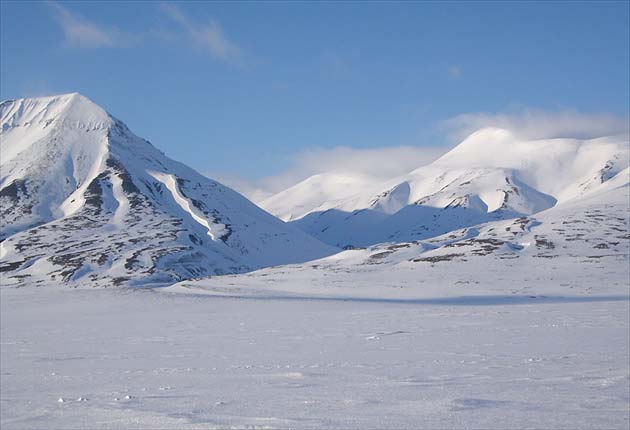
Ice-free Arctic Ocean Possible In 30 Years

A nearly ice-free Arctic Ocean in the summer may happen three times sooner than scientists have estimated. New research says the Arctic might lose most of its ice cover in summer in as few as 30 years instead of the end of the century.

The amount of the Arctic Ocean covered by ice at the end of summer by then could be only about 1 million square kilometers, or about 620,000 square miles. That’s compared to today’s ice extent of 4.6 million square kilometers, or 2.8 million square miles. So much more open water could be a boon for shipping and for extracting minerals and oil from the seabed, but it raises the question of ecosystem upheaval.

While the Intergovernmental Panel on Climate Change in 2007 assessed what might happen in the Arctic in the future based on results from more than a dozen global climate models, two researchers reasoned that dramatic declines in the extent of ice at the end of summer in 2007 and 2008 called for a different approach.

read more

Posted in Uncategorized | Leave a comment

Black Carbon Responsible for Half of Arctic Warming

An article published this week in Nature Geoscience shows that black carbon is responsible for 50 percent,  Arctic warming from 1890 to 2007. The paper by Drew Shindell of the NASA Goddard Institute for Space (GISS) and Greg Faluvegi of Columbia University also notes that most of the Arctic warming occurred from 1976 to 2007.

The study is the first to quantify the Arctic’s sensitivity to black carbon emissions from various latitudes, and concludes that the Arctic responds strongly to black carbon emissions from the Northern Hemisphere mid-latitudes, where the emissions and the forcing are greatest.

Black carbon is an aerosol produced from the incomplete combustion of fossil fuels and biomass and is estimated to be the second or third largest contributor to climate change. Its emissions cause damage in two ways: while in the atmosphere, the dark particulates absorb sunlight and emit it as heat; when it falls back to earth it can darken snow and ice, reducing their reflectivity and accelerating melting. Arctic warming is more than twice the observed global average surface warming  above pre-industrial levels. According to another study published by Lenton, et al. in the Proceedings of the National Academy of Sciences last year, this increased warming may soon lead to the disappearance of the Arctic summer ice, which would in turn accelerate Arctic warming by exposing darker heat-absorbing water now covered by heat reflecting ice. This would also increase the risk of releasing methane and other greenhouse gases from permafrost and from methane hydrates in the ocean, which could lead to a runaway feedback process.

The mission of the Institute for Governance & Sustainable Development is to promote just and sustainable societies and to protect the environment by advancing the understanding, development and implementation of effective, accountable and democratic systems of governance for sustainable development. The Institute brings together professionals from around the world who are committed to strengthening environmental law and institutions to promote sustainable development. For more information on the Institute, please visit http://igsd.org/.

source

Posted in Uncategorized | Leave a comment

GNSS signals for remote sensing

Surrey Satellite Technology Limited (SSTL) will lead a British project to exploit signals from GPS and GNSS navigation satellites that are reflected from the Earth for remote sensing purposes. The project will investigate a prototype instrument capable of measuring the roughness of the sea and soil moisture content, providing data for atmospheric science and for operational ocean and weather forecasting.

Signals from Global Positioning System (GPS) and Global Navigation Satellite System (GNSS) navigation satellites reflected from land, ice and ocean will be analysed by the instrument, which will fly onboard a separate small satellite. A flexible multi-channel receiver will be developed to detect the reflected GNSS signals for surface sea-state measurements. Using the new remote sensing technique, it is possible to derive important scientific data about the nature of the reflecting surface and the atmosphere, such as the sea-surface roughness or soil moisture content.

Source : http://www.sstl.co.uk

Posted in GPS, Remote Sensing 101 | 1 Comment

6,000 Rare Dolphins Found in South Asia

A huge population of rare dolphins threatened by climate change and fishing nets has been discovered in South Asia.

WCS researchers have discovered a stronghold for one of the world’s rarest freshwater dolphins, the Irrawaddy, deep in the waterlogged jungles of Bangladesh. The scientists counted nearly 6,000 of the dolphins in the South Asian country’s Sundarbans mangrove forest and the adjacent waters of the Bay of Bengal.

Researchers with the Wildlife Conservation Society estimate that nearly 6,000 Irrawaddy dolphins, marine mammals that are related to orcas or killer whales, were found living in freshwater regions of Bangladesh’s Sundarbans mangrove forest and adjacent waters of the Bay of Bengal.

In 2008, they were listed as vulnerable in the IUCN Red List based on population declines in known dolphin populations.

Despite finding this extraordinarily large population, the study’s authors warn that the dolphins are becoming increasingly threatened by accidental entanglement in fishing nets. During the study, researchers encountered two dolphins that had become entangled and subsequently drowned in fishing nets — a common occurrence according to local fishermen.

In another study, detailed in the March/April issue of the journal Aquatic Conservation: Marine and Freshwater Ecosystem, Smith and his coauthors report the additional long-term threat to the dolphin population of declining freshwater supplies, caused by upstream water diversion in India, coupled with sea-level rise due to climate change.

These circumstances also threaten Ganges River dolphins, an endangered species with a range that overlaps with that of the Irrawaddy dolphins in the Sundarbans mangrove forest. Yangtze River dolphin, or baiji, are a type of freshwater dolphin thought to be extinct due to the impact of humans.

The Irrawaddy dolphin grows to some 6.5 to 8 feet (2 to 2.5 meters) in length and frequents large rivers, estuaries, and freshwater lagoons in South and Southeast Asia.

In Myanmar’s Ayeyarwady River, these dolphins are known for “cooperative fishing” with humans, where the animals voluntarily herd schools of fish toward fishing boats and awaiting nets. With the aid of dolphins, fishermen can increase the size of their catches up to threefold. The dolphins appear to benefit from this relationship by easily preying on the cornered fish and those that fall out of the net as the fishermen pull it from the water.

In 2006, WCS helped establish a protected area along the Ayeyarwady River to conserve this critically endangered mammal population. The WCS is working on establishing a similar protected area network for both Irrawaddy and Ganges River dolphins in the Sundarbans mangrove forest.

Funding for the new study was provided in part by the Kerzner Marine Foundation and Ocean Park Conservation Foundation, Hong Kong (OPCFHK), and the U.S. Marine Mammal Commission.

Links:

dig deeper

yangtze river dolphin

Posted in BIODIVERSITY, earth, Ecosystem, water | 3 Comments