India, Russia complete design of new lunar probe

India and Russia have finished the design of a second unmanned lunar orbiter to be sent to the Moon in 2011-2012, quoted the Indian Express newspaper.”Right now, the design has been completed. We had a joint review with Russian scientists here”, said Madhavan Nair, chairman of the Indian Space Research Organization (ISRO) in Bangalore.Russia is responsible for the design and construction of a lander and a rover, which could collect samples of the lunar soil, analyze them and send the data back to Earth.The ISRO and the Russian Federal Space Agency signed in November 2007 an agreement to work together on the Chandrayaan-2 project. The work started following the launch of India’s first unmanned mission to the moon, the Chandrayaan-1, in October last year.During the two-year mission, the remote-sensing satellite is expected to create a detailed three-dimensional map of the Moon’s surface and investigate its chemical composition. The primary goal is the discovery of water, along with magnesium, aluminum, silicon and titanium, and the radioactive elements radon, uranium and thorium.

source:http://www.gisdevelopment.net

read more

Posted in India, India' Moon Mission | 3 Comments

Little Known Type Of Cholesterol — Oxycholesterol — May Pose The Greatest Heart Disease Risk

A little known type of cholesterol, oxycholesterol, may pose the greatest heart disease risk, researchers say. Shown is a diagram of a heart attack. (Credit: Wikimedia Commons)

A little known type of cholesterol, oxycholesterol, may pose the greatest heart disease risk, researchers say. Shown is a diagram of a heart attack. (Credit: Wikimedia Commons)

Health-conscious people know that high levels of total cholesterol and LDL cholesterol (the so-called “bad” cholesterol) can increase the risk of heart attacks. Now scientists are reporting that another form of cholesterol called oxycholesterol — virtually unknown to the public — may be the most serious cardiovascular health threat of all.

Fried and processed food, particularly fast-food, contains high amounts of oxycholesterol. Avoiding these foods and eating a diet that is rich in antioxidants, such as fresh fruits and vegetables, may help reduce its levels in the body, the researchers note.

Scientists have known for years that a reaction between fats and oxygen, a process termed oxidation, produces oxycholesterol in the body. Oxidation occurs, for instance, when fat-containing foods are heated, as in frying chicken or grilling burgers or steaks. Food manufacturers produce oxycholesterol intentionally in the form of oxidized oils such as trans-fatty acids and partially-hydrogenated vegetable oils. When added to processed foods, those substances improve texture, taste and stability. Until now, however, much of the research focused on oxycholesterol’s effects in damaging cells, DNA, and its biochemical effects in contributing to atherosclerosis. Chen believes this is one of the first studies on oxycholesterol’s effects in raising blood cholesterol levels compared to non-oxidized cholesterol.

read on

Posted in Uncategorized | 2 Comments

Agents of Erosion

Severe soil erosion in a wheat field near Washington State University, USA.

Severe soil erosion in a wheat field near Washington State University, USA.

Erosion is the removal of solids (sediment, soil, rock and other particles) in the natural environment. It usually occurs due to transport by wind, water, or ice; by down-slope creep of soil and other material under the force of gravity; or by living organisms, such as burrowing animals, in the case of bioerosion.

Erosion is distinguished from weathering, which is the process of chemical or physical breakdown of the minerals in the rocks, although the two processes may occur concurrently.

Main agents of Erosion Are Water, Wind, Ice, and Waves.

Erosion by Water

Water is the most important erosional agent and erodes most commonly as running water in streams. However, water in all its forms is erosional. Raindrops (especially in dry environments) create splash erosion that moves tiny particles of soil. Water collecting on the surface of the soil collects as it moves towards tiny rivulets and streams and creates sheet erosion.In streams, water is a very powerful erosional agent. The faster water moves in streams the larger objects it can pick up and transport.

Fine sand can be moved by streams flowing as slowly as three-quarters of a mile per hour.Streams erode their banks in three different ways: 1) the hydraulic action of the water itself moves the sediments, 2) water acts to corrode sediments by removing ions and dissolving them, and 3) particles in the water strike bedrock and erode it.The water of streams can erode in three different places: 1) lateral erosion erodes the sediment on the sides of the stream channel, 2) down cutting erodes the stream bed deeper, and 3) headward erosion erodes the channel upslope.

Wind Erosion

Erosion by wind is known as aeolian (or eolian) erosion (named after Aeolus, the Greek god of winds) and occurs almost always in deserts. Aeolian erosion of sand in the desert is partially responsible for the formation of sand dunes. The power of the wind erodes rock and sand.

Ice Erosion

The erosive power of moving ice is actually a bit greater than the power of water but since water is much more common, it is responsible for a greater amount of erosion on the earth’s surface.Glaciers can perform to erosive functions – they pluck and abrade. Plucking takes place by water entering cracks under the glacier, freezing, and breaking off pieces of rock that are then transported by the glacier. Abrasion cuts into the rock under the glacier, scooping rock up like a bulldozer and smoothing and polishing the rock surface.

Wave Erosion

Waves in oceans and other large bodies of water produce coastal erosion. The power of oceanic waves is awesome, large storm waves can produce 2000 pounds of pressure per square foot. The pure energy of waves along with the chemical content of the water is what erodes the rock of the coastline. Erosion of sand is much easier for the waves and sometimes, there’s an annual cycle where sand is removed from a beach during one season, only to be returned by waves in another.

Links:

About.com

Wikipedia

What is Erosion

Posted in earth | 13 Comments

Tsunami

A tsunami is a large ocean wave that is caused by sudden motion on the ocean floor. This sudden motion could be an earthquake, a powerful volcanic eruption, or an underwater landslide. The impact of a large meteorite could also cause a tsunami. Tsunamis travel across the open ocean at great speeds and build into large deadly waves in the shallow water of a shoreline.

Subduction Zones are Potential Tsunami Locations

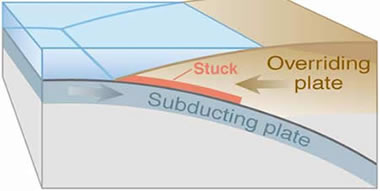
Most tsunamis are caused by earthquakes generated in a subduction zone, an area where an oceanic plate is being forced down into the mantle by plate tectonic forces. The friction between the subducting plate and the overriding plate is enormous. This friction prevents a slow and steady rate of subduction and instead the two plates become “stuck”.

Accumulated Seismic Energy

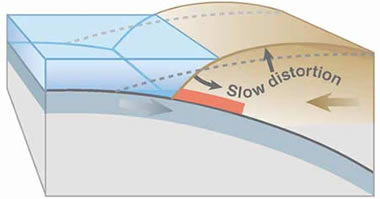
 As the stuck plate continues to descend into the mantle the motion causes a slow distortion of the overriding plate. The result is an accumulation of energy very similar to the energy stored in a compressed spring. Energy can accumulate in the overriding plate over a long period of time – decades or even centurie

Earthquake

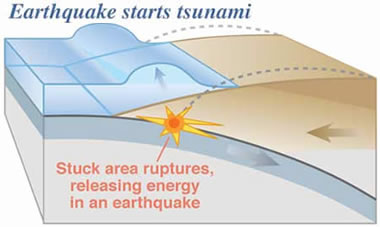
Energy accumulates in the overriding plate until it exceeds the frictional forces between the two stuck plates. When this happens, the overriding plate snaps back into an unrestrained position. This sudden motion is the cause of the tsunami – because it gives an enormous shove to the overlying water. At the same time, inland areas of the overriding plate are suddenly lowered.

Tsunami Races Away From the Epicenter

The moving wave begins travelling out from where the earthquake has occurred. Some of the water travels out and across the ocean basin, and, at the same time, water rushes landward to flood the recently lowered shoreline.

Tsunami “Wave Train”

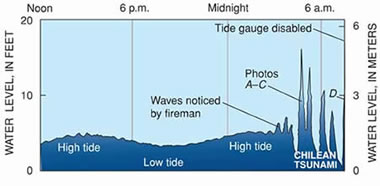
Many people have the mistaken belief that tsunamis are single waves. They are not. Instead tsunamis are “wave trains” consisting of multiple waves. The chart below is a tidal gauge record from Onagawa, Japan beginning at the time of the 1960 Chile earthquake. Time is plotted along the horizontal axis and water level is plotted on the vertical axis. Note the normal rise and fall of the ocean surface, caused by tides, during the early part of this record. Then recorded are a few waves a little larger than normal followed by several much larger waves. In many tsunami events the shoreline is pounded by repeated large waves.

LINKS:

wikipedia

main source:     http://geology.com/articles/tsunami-geology.shtml

Animation

Predicting Tsunami

Posted in oceans, Quakes | 5 Comments