Loess is an aeolian sediment formed by the accumulation of wind-blown silt, typically in the 20–50 micrometre size range, twenty percent or less clay and the balance equal parts sand and silt that are loosely cemented by calcium carbonate. It is usually homogeneous and highly porous and is traversed by vertical capillaries that permit the sediment to fracture and form vertical bluffs.It is parent material of world’s prime agricultural soils.
Etymology
The word loess, with connotations of origin by wind-deposited accumulation, is of German origin and means “loose.” It was first applied to Rhine River valley loess about 1821.
Loess consists of tiny mineral particles brought by wind to the places where they now lie. It is a product of past glacial activity in an area. It is a sedimentary deposit of mineral particles which are finer than sand but coarser than dust or clay, deposited by the wind. Loess is a type of silt which forms fertile topsoil in some parts of the world. Loess deposits are usually a few meters thick. One of the key characteristics of these deposits is the ‘cat steps’. The soil has few clay particles to hold it together. It is composed mainly of quartz crystals which slide easily against each other, and is therefore very subject to erosion. Because of this, there are mini-earth slides, which form the steps.
Loess was formed during the time after the Ice Age when glaciers covered a great portion of the earth. When the climate warmed up, the warm temperatures melted the glaciers creating tremendous flows of water down into a valley or river, and exposing vast plains of mud. When these plains dried, strong winds blew the exposed sediments and swept the finer materials from the flood plains into huge clouds of dust, which were deposited into the bluffs, that is, bold steep banks. As silt accumulated, higher bluffs were formed. Often several loess deposits are stacked on top of each other, because each individual glacier produced new loess deposits. Topsoils made up of loess are found in the central and northwestern parts of United States, in central and eastern Europe, and in eastern China.
Properties
 Loess is homogeneous, porous, friable, pale yellow or buff, slightly coherent, typically non-stratified and often calcareous. Loess grains are angular with little polishing or rounding and composed of crystals of quartz, feldspar, mica and other minerals. Loess can be described as a rich, dust-like soil.
Loess deposits may become very thick; more than a hundred metres in areas of China and the Midwestern United States. It generally occurs as a blanket deposit covering areas of hundreds of square kilometres and tens of metres thick.
Loess often stands in either steep or vertical faces.Because the grains are angular, loess will often stand in banks for many years without slumping. This soil has a characteristic called vertical cleavage which makes it easily excavated to form cave dwellings, a popular method of making human habitations in some parts of China. Loess erodes very readily.
In several areas of the world, loess ridges have formed that are aligned with the prevailing winds during the last glacial maximum. These are called paha ridges in America and greda ridges in Europe. The form of these loess dunes has been explained by a combination of wind and tundra conditions.
Economic Importance
Fertility
Loess tends to develop into highly rich soils. Under appropriate climatic conditions it is some of the most agriculturally productive terrain in the world.
Soils underlain by loess tend to be excessively drained. The fine grains weather rapidly due to their large surface area making soils derived from loess very rich. One theory states that the fertility of loess soils is due largely to electron exchange capacity (the ability of plants to absorb nutrients from the soil) and porosity (the air-filled space in the soil). The fertility of Loess is not due to organic matter content, which tends to be rather low unlike tropical soils, which derive their fertility almost wholly from organic matter.
Even well managed loess farmland can experience dramatic erosion of well over 2.5 kg per square meter per year. Although in geological time loess has an incredible rate of erosion, in a more human time scale loess is durable and resistant to maltreatment. In China loess deposits along the Yellow River have been farmed and have produced phenomenal yields for over one thousand years. A large amount of the credit for this goes to the farmers; Chinese farmers were the first to practice active erosion control. The largest deposit of loess in the United States, the Loess Hills along the border of Iowa and Nebraska, has survived intensive farming and poor farming practices. For almost 150 years this loess deposit was farmed with mouldboard ploughs and fall tilled, both intensely erosive. At times it suffered erosion rates of over 10 kilograms per square meter per year. Today this loess deposit is worked as low till or no till in all areas and is aggressively terraced.
Some Maps

Loess in US

Loess in Europe
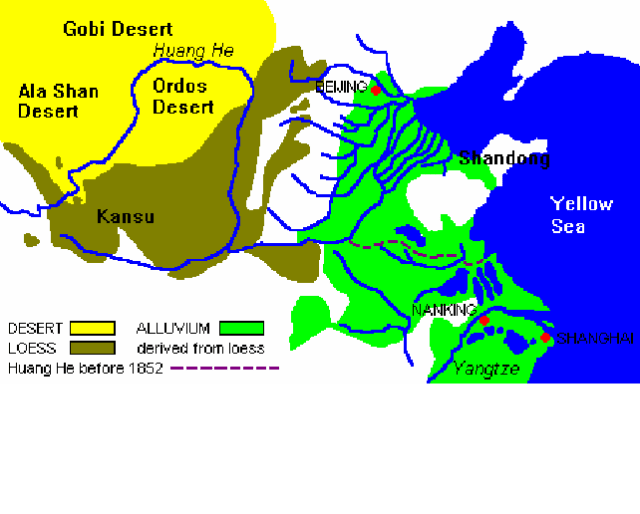
Loess in China
Link(s) and Source(s):
Face of the Earth
Wikipedia