Martin Waldseemüller : A Pioneer Mapmaker Who Named America

Martin Waldseemüller was a German cartographer.

He and Matthias Ringmann are credited with the first recorded usage of the word America, on the 1507 map Universalis Cosmographia in honour of the Italian explorer Amerigo Vespucci. He thought it was Amerigo.

Waldseemüller was born in Wolfenweiler near Freiburg im Breisgau (his mother came from Radolfzell) and he studied at the University of Freiburg.

On 25 April 1507, as a member of the Gymnasium Vosagense at Saint Diey (German: Sankt Didel) in the Duchy of Lorraine (today Saint-Dié-des-Vosges, France), he produced a globular world map and a large 12-panel world wall map using the information from Columbus and Vespucci’s travels (Universalis Cosmographia), both bearing the first use of the name “America”. The globular and wall maps were accompanied by a book Cosmographiae Introductio, an introduction to cosmography. The book, first printed in the city of Saint-Dié-des-Vosges, includes in its second part, a translation to Latin of the Quattuor Americi Vespuccij navigationes (Four Voyages of Americo Vespucci), which is apparently a letter written by Amerigo Vespucci, although some historians consider it to have been a forgery written by its supposed recipient in Italy.

360px-waldseemuller_map_2

Universalis Cosmographia, Waldseemüller’s 1507 world map which was the first to show the Americas separate from Asia

For a long time it was generally believed that Columbus and his crew had been the first Europeans to make landfall in the Americas. In fact they were not the first explorers from Europe to reach the Americas, having been preceded by the Viking expedition led by Leif Erikson in the 11th century; however, Columbus’s voyages were the ones that led to ongoing European contact with the Americas, inaugurating a period of exploration, conquest, and colonization whose effects and consequences persist to the present.

At the time of the Columbus voyages, the Americas were inhabited by the Indigenous Americans, the descendants of Paleo-Indians who crossed Beringia from Asia to North America beginning around 20,000 years ago.Columbus’s voyages led to the widespread knowledge that a continent existed west of Europe and east of Asia. This breakthrough in geographical science led to the exploration and colonization of the New World by Spain and other European sea powers, and is sometimes cited as the start of the modern era.

Source(s):

Wikipedia

Posted in earth, inventions, map making | Leave a comment

Ecotourism: An Overview

Visitors have long been travelling to natural areas under the guise of recreation and tourism. This has led some observers to question whether ecotourism is simply a new name for an old activity (Wall 1994). However, several changes apparently have occurred in the last decade. First, there has been growth in visits to many natural areas, particularly in developing countries. Second, many economic development professionals increasingly have viewed natural-area visitation as a tool for providing employment in regions that have experienced decline, or lack of development, in other industries.

Third, many conservation and resource management professionals increasingly have viewed natural area visitation as an avenue for enhancing natural area finance and providing conservation-related benefits, particularly to residents living near natural areas. Fourth, there has been increasing attention paid to improving the sustainability of all tourism activities, including those occurring in natural areas. Thus, although ecotourism may not represent an abrupt departure from historic recreation and tourism, it does represent a change in the level of visitation for many areas and a change in the goals that various stakeholders attach to this visitation.

 The term ecotourism struck a chord with the tourism industry, the travelling public, and with private and public sector agencies charged with the promotion of tourism products. Ecotourism became a buzzword.

By the mid 1990s, ecotourism, as a concept, began to enter a period of maturity. Many of the claims made in earlier years began to be disputed, and the legitimacy of many players to call themselves ecotourism products was challenged. The travelling public either has become more aware of what ecotourism encompasses or more critical about the idea to accept blindly the claims that mass tourism destinations are ecotourism destinations. Assumptions regarding the benefits of ecotourism have been challenged through empirical research (Lindberg, Enriquez, and Sproule 1996; Driml and Common 1995). As a result, a more realistic understanding of what the product entails and the benefits it can provide is emerging.

 Ecotourism, Definitions, Concepts and Visitor Types

Much attention has been paid to the question of what constitutes ecotourism, and numerous concepts and definitions exist (Ballantine and Eagles 1994; Blarney 1995; Bottrill and Pearce 1995; Buckley 1994). The Ecotourism Society, based in the US and the most international of the ecotourism organizations, defines ecotourism as responsible travel to natural areas that conserves the environment and improves the welfare of local people. The Australian National Ecotourism Strategy defines ecotourism as A nature-based tourism that involves education and interpretation of the natural environment and is managed to be ecologically sustainable. Numerous other definitions exist around the world.

Most conceptual definitions of ecotourism can be reduced to the following: “ecotourism is tourism and recreation that is both nature-based and sustainable,” and it is this definition1 that is used here. Three features of this definition merit further discussion. First, the definition clarifies the descriptive and the prescriptive components of the ecotourism concept. The nature component is descriptive or positive in the sense that it simply describes the activity location and associated consumer motivations. The sustainable component is prescriptive or normative in the sense that it reflects what people want the activity to be. An important point is that, as used here, sustainability incorporates environmental, experiential, sociocultural, and economic dimensions.

Second, this basic conceptual definition incorporates more complex definitions. For example, some definitions focus on minimizing negative environmental and cultural impacts while maximizing positive economic impacts. Such a focus is a means to the end of achieving sustainability. In some cases it is a means to the end of achieving a sustainable experience. In other cases it is also a means to the end of sustainability. Because most components of ecotourism definitions either focus on the goal of sustainability or on means to achieve that goal, it is practical to use the simple conceptual definition of ecotourism being sustainable nature-based tourism and recreation.

Third, and related to the second feature, by focusing on ends (the desired condition of sustainability), this definition forces critical evaluation of what constitutes ecotourism. For example, is sport hunting ecotourism? Many observers feel that hunting is not ecotourism, but under this definition it would be if it met the sustainability criterion. Though hunting will be inconsistent with concepts of sustainability in some natural areas (or may be rejected on other grounds), it may be appropriate in others. Similarly, a large commercial group of tourists paying an entry fee to visit a hardened visitor centre and associated rainforest boardwalk may qualify as ecotourists to the same degree as a small group of visitors following low-impact principles in a pristine wilderness.

Given the importance of sustainability within the ecotourism definition, a fundamental question is “What is sustainability?” In simplified terms, tourism sustainability is postulated to result from a positive overall balance in environmental, experiential, sociocultural, and economic impacts (“experiential impact” is used to describe the effect of visitors on each other and “sociocultural impact” is used to describe the effect of visitors on local residents). Thus, tourism activities that generate more positive net benefits would be more sustainable, in general, than tourism activities that generate fewer positive net benefits.

The focus on benefits also clarifies ecotourism-related objectives. Historically, many sites have sought to increase the number of tourists, but this objective slowly is giving way to increasing tourist expenditure (a positive benefit), which does not always require increasing the number of tourists. Hopefully, this objective will progress to one of increasing income generated in the region of question (again, which need not involve an increase in expenditure). Ultimately, the objective should be to increase net benefits, a measure of benefits less costs. This refinement of objectives to focus on net benefits enhances the likelihood that ecotourism will be sustainable.

With respect to visitor types and activities, a key consideration is the diversity within the ecotourism market. Ecotourists may differ greatly in several aspects, including:

· distance travelled;
· length of stay;
· desired level of physical effort and comfort;
· importance of nature in trip motivation;
· level of learning desired;
· amount of spending;
· desired activities; and
· personal demographics.

For example, ecotourism experiences can range from 1) a foreigner spending thousands of dollars coming to Australia on a commercial tour to visit the Great Barrier Reef and the Wet Tropics rainforests to 2) a local resident camping over the weekend at an adjacent national park. Ecotourists might engage in a wide range of activities, including trekking (hiking, bushwalking), climbing, camping, hunting, photography, sight-seeing, fishing, birdwatching, whale viewing, and general exploration of remote natural areas.

Of particular interest, visitor surveys (e.g., Eagles, Ballantine, and Fennell 1992) and anecdotal reports indicate that many ecotourists feel it important for their visit to contribute to conservation and local development. Though this is not important for all ecotourists, it does present additional motivation for businesses and government agencies to support conservation and development efforts.

Lindberg (1991) provides a typology of nature/ecotourism types, though many other typologies are possible:

· Hard-core: scientific researchers or members of tours specifically designed for education, environmental restoration, or similar purposes.· Dedicated: people who take trips specifically to see protected areas and who want to understand local natural and cultural history.

· Mainstream: people who visit the Amazon, the Rwandan gorilla park, or other such destinations primarily to take an unusual trip.

· Casual: people who partake of nature incidentally, such as through a day trip during a broader vacation.

Actors in the Ecotourism “System”

Ecotourism often involves numerous actors, including:

· Visitors;· Natural areas and their managers, including both public and private areas;

· Communities;

· Businesses, including various combinations of local businesses, in-bound operators, outbound operators, hotel and other accommodation providers, restaurants and other food providers, and so on;

· Government, in addition to its role as a natural area manager; and

· Non-governmental organizations, such as environmental and rural development NGOs.

The relevant actors will vary across sites. For example, local communities may be present at some sites, but not others. Likewise, businesses may play a large role at some sites, but little or no role at others.

A common phenomenon is that ecotourism can generate both symbiosis and conflict between the actors. The potential for ecotourism to result in symbiosis between conservation (e.g., natural areas) and development (e.g., businesses) has been widely touted, but the potential for conflict should not be ignored. For example, natural area managers and ecotourism businesses have a shared interest in conserving the natural environment. However, there often is conflict regarding the point at which tourism activity jeopardizes this conservation.

Source(S):

FAO

Posted in earth, Tourism and Travel | 3 Comments

Misbehaving Tourists are a Threat to Global Tourism

Japan’s Nanzoin Temple is famous for its huge statue of a reclining Buddha. Its custodians are less laidback about the hordes of tourists the temple attracts. Signs in 12 languages now warn foreign visitors they may not enter in large groups.

It’s part of anti-tourist sentiment, driven by “the bad manners and abhorrent actions” of some visitors from abroad, reportedly growing all over Japan – and elsewhere in the world.

read here more

Link(s):

Various Impacts of Tourism

Posted in earth, Links, opinions, Tourism and Travel | Leave a comment

Serious Leisure: A Perspective

According to Urban Dictionary,Serious leisure is the systematic pursuit of an amateur, hobbyist, or volunteer activity sufficiently substantial, interesting, and fulfilling for the participant to find a (leisure) career there acquiring and expressing a combination of its special skills, knowledge, and experience. The term was coined by Robert A. Stebbins.
Examples include amateur musicians, athletes, scientists, and entertainers. Among the hobbyists are collectors and people who make things (e.g., quilts, furniture, pastries). Serious leisure volunteers are found, among other places, serving in hospitals, nonprofit organizations, museums, and zoos.

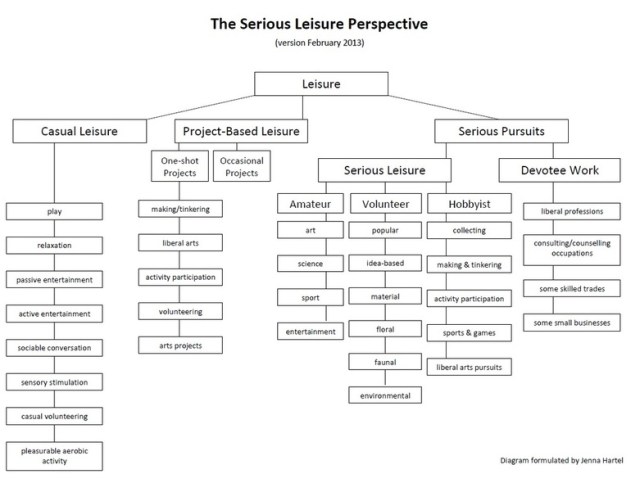
The serious leisure perspective” (SLP) is the name of the theoretic framework  that bridges and synthesizes three main forms of leisure, known as serious leisure, casual leisure, and project-based leisure. Research began in 1973 on the first of these, and has continued since that time, while work on casual leisure and then on project-based leisure came subsequently (see History section of this site for more details). Within each form, a variety of types and subtypes have also emerged over the years. That this Perspective takes its name from the first of these should, in no way, suggest that it is to be regarded, in some abstract sense, as the most important or superior of the three. Rather, the Perspective is so titled, simply because it got its start in the study of serious leisure; such leisure is, strictly from the standpoint of intellectual invention, the godfather of the other two. A map of the SLP is available at the SLP Diagrams page of this website.

Leisure is defined in the SLP as un-coerced, contextually framed activity engaged in during free time, which people want to do and, using their abilities and resources, actually do in either a satisfying or a fulfilling way (or both).

Serious leisure is the systematic pursuit of an amateur, hobbyist, or volunteer core activity that is highly substantial, interesting, and fulfilling and where, in the typical case, participants find a career in acquiring and expressing a combination of its special skills, knowledge, and experience (Stebbins, 1992, p.3). The adjective “serious” (a word Stebbins’ research respondents often used) embodies such qualities as earnestness, sincerity, importance, and carefulness. This adjective, basically a folk term, signals the importance of these three types of activity in the everyday lives of participants, in that pursuing the three eventually engenders deep self-fulfillment.

Amateurs are found in art, science, sport, and entertainment, where they are inevitably linked, one way or another, with professional counterparts who coalesce, along with the public whom the two groups share, into a three-way system of relations and relationships. By contrast, hobbyists lack the professional alter ego of amateurs, although they sometimes have commercial equivalents and often have small publics who take an interest in what they do. The professionals are identified and defined in (economic rather than sociological) terms that relate well to amateurs and hobbyists, namely, as workers who are dependent on the income from an activity that other people pursue with little or no remuneration as leisure (see Stebbins, 2007, pp. 6-8).

Hobbyists are classified according to five categories: 1) collectors, 2) makers and tinkerers, 3) activity participants (in noncompetitive, rule-based, pursuits such as fishing and barbershop singing), 4) players of sports and games (in competitive, rule-based activities with no professional counterparts like long-distance running and competitive swimming) and 5) the enthusiasts of the liberal arts hobbies, which are primarily reading pursuits.

Volunteers, whether pursuing serious, casual, or project-based leisure, offer un-coerced help, either formally or informally, with no or, at most, token pay, for the benefit of both other people (beyond the volunteer’s family) and the volunteer. Nevertheless, the reigning conception of volunteering in nonprofit sector research is not that of volunteering as leisure (volitional conception), but rather volunteering as unpaid work. This latter, economic, conception defines volunteering as the absence of payment for a livelihood, whether in money or in kind. This definition largely avoids the messy question of motivation so crucial to the volitional conception. A theoretic typology of volunteers and volunteering is available in Reflections 16 (Digital Library).  Also see the Map of the SLP (Resources).

Occupational devotees are people who are inspired by“occupational devotion,” by a strong, positive attachment to a form of self-enhancing work, where the sense of achievement is high and the core activity (set of tasks) is endowed with such intense appeal that the line between this work and leisure is virtually erased (Stebbins, 2004b). “Devotee work” is serious leisure from which the worker gains a livelihood.
1840465

Serious pursuits is the umbrella concept encompassing serious leisure and devotee work (Stebbins, 2012). See the SLP map in Resources.

Serious leisure is further distinguished from casual leisure by six characteristics found exclusively or in highly elaborated form only in the first. These characteristics are: 1) need to persevere at the activity, 2) availability of a leisure career, 3) need to put in effort to gain skill andknowledge, 4) realization of various special benefits, 5) unique ethos and social world, and 6) an attractive personal and social identity.

Casual leisure is immediately, intrinsically rewarding; and it is a relatively short-lived, pleasurable activity requiring little or no special training to enjoy it. It is fundamentally hedonic; it is engaged in for the significant level of pure enjoyment, or pleasure, found there (Stebbins, 1997). It is also the classificatory home of much of the deviant leisure discussed by Rojek (1997, pp. 392-393). Among its types are: play (including dabbling), relaxation (e.g., sitting, napping, strolling), passive entertainment (e.g., TV, books, recorded music), active entertainment (e.g., games of chance, party games), sociable conversation, and sensory stimulation (e.g., sex, eating, drinking). Casual volunteering is also a type of casual leisure as is “pleasurable aerobic activity,” or casual leisure requiring effort sufficient to cause marked increase in respiration and heart rate (Stebbins, 2004a). Casual leisure is considerably less substantial, and offers no career of the sort just described for serious leisure. In broad, colloquial language casual leisure, hedonic as it is, could serve as the scientific term for doing what comes naturally. Yet, despite the seemingly trivial nature of most casual leisure, I argue elsewhere that it is nonetheless important in personal and social life (Stebbins, 2001b).

Project-based leisure is a short-term, moderately complicated, either one-shot or occasional, though infrequent, creative undertaking carried out in free time (Stebbins, 2005). Such leisure involves considerable planning, effort, and sometimes skill or knowledge, but for all that is not of the serious variety nor intended to develop into such. Nor is it casual leisure. The adjective “occasional” describes widely spaced undertakings for such regular occasions as arts festivals, sports events, religious holidays, individual birthdays, or national holidays while “creative” stresses that the undertaking results in something new or different, showing imagination, skill, or knowledge. Although most projects would appear to be continuously pursued until completed, it is conceivable that some might be interrupted for several weeks, months, even years.

Source(s):

SLP

Urban dictionary

Posted in Class Notes, earth | Leave a comment