Why Are There Male and Female Connectors?

usb-1284227_960_720

Guest Post by Gracie Watson

It’s something that most people don’t immediately ask, but sooner or later they wonder. Why are connectors male and female? As crucial parts of modern electronics, these are something that pretty much everyone has seen before. They’re out USB ports, our electrical outlets and plugs, and even our audio jacks for sound equipment.

Yet, sometimes when people start looking into things, they wonder why there are male and female ones. Some might also be inclined to wonder what makes the two different. Is it simply a matter of one being plugged in and the other being the one that’s plugged into? Is there a technical reason why the connectors have to be different?

First, What’s Male and What’s Female?

Each half of a pair of connectors is either male or female, though A and B might be used as alternates. Physically speaking, one of them will have protrusions and is the designated male. The female has indentations meant for the male protrusions to fit into. This behavior and the obvious analogies to be made to human behaviors has also led to the connection process being referred to as mating.

When It’s Rigid

In some cases, particularly when it comes to electrical power, the gender is rigid. The rules are specific in defining what male and female connectors are, as a means of enforcing a proper flow from the source to the intended device. This limits the risk of non-safe configurations and ensures proper functioning and flow of power.

When It’s Fluid

In electrical connectors, one of the challenges is that what is male and what is female isn’t always obvious. Whether it’s Mini Fit Jr connector or a -subminiature, all connector genders are made according to a specific convention. However, the variance of construction despite these specifics means that telling one from the other can be a challenge if you aren’t aware of what to look for in these products.

The most applicable rule is the presence of pins. The male was pins rather than protrusions, and will often also have lug connectors meant to screw into a post. However, just looking at the ends alone will not identify which connectors are male and which ones are female. A closer inspection is required. The simple fact is that gender-based usage is strictly informal and never fully conforms to reality.

The Issue of Jacks

Though it should be noted that jacks use female connectors in most cases, which means that the gender-based terminology is a functional description. There are a few instances when this is not the case, such as male coaxial jacks for connecting external power sources. Another example where this is not the case would be a computer’s AC power inlet, which traditionally is built with a male connector.

When Gender is a Factor

There are some instances when gender can factor in the design. This is not typical, but it can affect a number of products.

Mounting

Electronics tend to prefer female jack connectors when they need fixed mounting for equipment. Female designs can take damage and risk of contamination better than male ones, due to concealment or recessed contact points. Motherboards are a prime example since damage can result in having to scrap it. Since male contact points are more exposed, using female ones lowers the chances of needing repair or replacement.

In the case of the RS232 standard serial port, male connectors aren’t favored. They are seen as more fragile and the female variant is the one that sees use more often. The male coaxial is also believed to be more prone to damage, though this is a subject of some debate.

Reliability

Reliability considerations often affect the design. The decision to use female jacks for computer terminals and related devices is one of these major changes, though not the only ones. Serial ports also use female connectors, in violation of the standards set. This has caused a bit of confusion at times, as technicians were relying on incorrect instructions because of the differing ports.

Power

For power connections, designers don’t pull reversals of gender specifications. This will expose the live AC line to male connectors, which is both illegal in many countries and is considered unsafe. Any device that needs to have a robust resistance to mechanical damage will often use a male IEC connector, recessed below the mounting panel surface, to provide conformity to safety standards and the level of necessary physical protection.

Safety

Finally, there is a safety issue that can blur the lines in a small way. In any instance where electrical discharge is a risk, female parts will often be used to conceal male connectors. The contacts may also be concealed, again using female parts to cover up male ones. This prevents accidental contact of live conductors, which can cause serious harm to those who are unwary.

Conclusion

Male and female connectors exist. While they are both meant to fulfill the same function, in the world of electronics, there are differences. However, in general, both see a great deal of use in different areas. Their physical attributes and properties, as well as regulations and performance needs, dictate where they are used.

Image Source:

Source: https://pixabay.com/photos/usb-technology-computer-microchip-1284227/

Posted in earth, Guest Post | Leave a comment

What is Textile Engineering?

rolls-of-fabric-1767504_960_720

Source: https://pixabay.com/photos/rolls-of-fabric-factory-material-1767504/

Guest Post by Gracie Watson

When people think of engineering, they think of bridges. They think of computers and the complex systems that work beneath their parts. They think of massive machines that do incredible things. They imagine great buildings that look impossible, like the Great Pyramid of Giza or the Great Wall of China. To be fair, these are truly impressive feats of engineering. However, that’s not the extent of where the term applies.

There is such a thing as textile engineering. It is a relatively new field, but one that is rapidly gaining acceptance and applications. While textiles and fabrics have been with us since long before we became civilized, they are still usually done by hand. This changes the more prominent and developed textile engineering becomes.

What These Engineers Do

What textile engineering is all about is the design and control of the fiber. It concerns itself with the manipulation of textiles, the refinement of apparel processes, the development of the final product, and the complex machinery that makes them. It uses engineering principles with the minutia of the textile industry, allowing for applying a clinical, technological approach to textile problem-solving.

Textile engineering can be seen in various stages of the process, assisting or streamlining matters. There is process development, research, control over the production process, and even quality control. The information and data gathered are processed and used to give technological solutions to problems and to upgrade the process, such as knitting machines from Xdknitmachinery.

The Challenges

Training to become a textile engineer is difficult. It requires an in-depth understanding of the mechanics of various materials and fabrics. It also calls for chemical knowledge, as well as the formation of yarns and threads. To some extent, they might also need to know about mechanical design, so they can better understand the machines that are used in the industrial production of textiles and clothing.

Specific Roles

There are a few demands of industrial textile engineers that are almost universal. In particular, many companies are looking to find the next great fabric that combines comfort, weight, and fire-resistance. The medical field is always on the lookout for new absorbent, lightweight fabrics for their needs and have a heavy investment in hypoallergenic textiles. There is also a high demand for the development of weather-resistant fabrics for packaging and outdoor materials.

Innovation

The typical engineer has to be updated with new discoveries, trends, and technologies. Innovation is going to be something they keep an eye out for. This is true for any field of engineering, including textiles. Their focus just shifts towards fabrics and materials, whether man-made or natural. Fur, leather, metals, plastics, and other base materials can all be turned into the threads of clothing, and these are studied extensively.

Application Expertise

A part of what they do is understand the properties of different textiles. These assist in determining where they should be used. Should something be used for clothing or furnishings? Is this particular fabric suitable for environments like the outdoors, where moisture is going to be a constant concern? How can this fabric be treated so it becomes more resistant to factors like water and sunlight breaking down dyes?

Technical Adviser

A textile engineer will also be expected to provide technical advice on the design of products, to ensure that the ideas can be achieved without undue disruption to the process. They might also be held responsible for ensuring certain equipment and technical details are within a company’s specifications.

Textile Harvesting

Engineers may also play a part in harvesting textiles. This involves multiple fields, including the production of the rolls and the processing of the base materials. These specialize in working with the fibers and the raw form, with a focus on improving current textiles or developing new ones to fit specific needs. They are also involved in improving the processes by which a textile is made, refining it to maximum efficiency.

Research and Design

Textile engineers are also expected to work with the marketing and research personnel. This is to ensure that they are aware of the current trends and what may be required of the machines to make. By keeping abreast of these changes, they can help prepare the production processes for things like different aspects of the fibers, updates to the base patterns, and other small details that kept the operation smooth.

Prototyping

Engineers might also be called upon to assist in producing sample products, prototyping new designs for approval before going into mass production. This would include amending designs and evaluation of patterns to see how easily they could be produced by machine. Identification and selection of parts and fabrics from suppliers is also a part of this task of a textile engineer.

Conclusion

Textile engineering isn’t easy. It is a field that is new, but already has high demands for the people who engage in it. However, this knowledge is put to use in improving existing offerings, better utilizing industrial machinery and the development of new products. The field is relatively recent, but already has many areas where its expertise is invaluable.

Posted in earth, Guest Post | Leave a comment

Interview With Poverty-Beggars of India : Perspective by K. L. Kamat

Not so long ago in India, on Saturdays and Mondays every beggar who showed up at the door was given a measure of rice or juvar. The guru-bhakta who went worshiping to the temple on Thursdays, got a handful of goodies and money. The beggar community feels that due to the increase in mankind’s selfishness and small-mindedness, they are not able to make a living. The government through its policies has not helped them either. “Like prostitution, begging is oldest profession  on earth. Although varying by geography and the times, begging is universal. We have heard that even richest countries like America have beggars in one form or another,” is the argument of the beggars.

Old Habits Die Hard

The intellectuals for long have been intrigued by mankind’s attraction to living by panhandling. Why do able bodied, working people take up begging? Why do Bengali refugees return to starving Bengal after assisted relocation? Why have we failed to settle vagabond tribes like the Bhils and Mogalayas?

It is not easy to give up the skills of earning a livelihood. Even if you protect a prostitute in an

A patient of Leprosy takes to begging as his means of living

ashram, the social reformers opine that she does not forget her easy life and in some form or another resumes old habits. Similarly I’m not surprised at the attitude of the officials of the  “Panhandling Elimination Department”, which is one of apathy and lacking sincerety.
Varieties of Begging

Old Woman Begs for small changeIt is very difficult to generalize how and where panhandling begins in the life of a beggar. Some inherited from their ancestors. There are all kinds of beggars whose period of begging spans from five minutes to fifty years. A boy was begging for peanuts on the street, but when someone offered him money, he refused. “I like peanuts,” he said ran away – his needs being very specific. The eight year old of a maid-servant who was instructed to play outside was begging the passers by for small change and bought candy. When I asked a strongly built man why he couldn’t work, I was told that he was merely continuing  his family tradition!

Generally, the elderly, the disabled, and the unemployed take to begging. Folks who were robbed during their pilgrimage, temporarily beg to return home. The lepers and destitute graduate to this profession. From beggars who cry in front of you asking for food to entertainers who beg with the help of pets and children, most homeless fall into the category of beggars with more or less the same yard stick.

Just like lawyers, administrators and athletes, the beggars can be very professional. They guard their constituencies with  great care. It is common to fight over territories. The beggar who beggars in front of Ganesh hotel cannot go and beg in front of  Krishna hotel! When an unassuming new comer from a village stuck out his hand in front of the temple, he was chased away and had to go to Saibaba ashram for shelter. Although the beggars do not have an association or union, they unite to defend their sources of income.

Fortuneless Fortune Teller
A Fortuneless Fortune Teller

Attire

While the beggars of the temples, churches, and mosques need not travel, the beggars of shops and households have to wander a lot. The beggars have to care about their attire just like actors and performers. People who beg in the name of the religion have to grow beard, wear saffron (kavi) clothes and ash. The fortune teller Bhils wear peacock feathers and other make-ups. The Budabudakis who do not know about their next meal, but can tell customers what lies in the decades to come wear Zari Rumal, and apply ash on the forehead to give them a holy look. Devadasis  wear turmeric powder, flowers, and kumkum. The transvestites (impotent men dressed as women) have altogether different, yet distinct style. They are clean shaven and apply fashionable cosmetics. They have acquired artificial feminine postures and dances. The beggars who use animals for fund raising have to decorate their pets, too. They have to buy caps for the monkey, jingle bells for the cow, and decorative clothing for the bull.

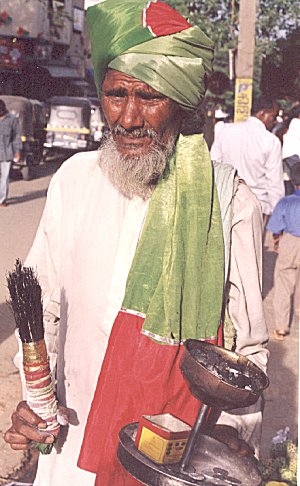
Beggar by choice: A Sufi fakir seeks alms on the street

The beggars have to master the art of begging just as they have to master the art of dressing up. They realize that it is very difficult to refuse a hungry man begging just as you come out of a popular restaurant. While a woman begs in the name of her husband who is in the death bed in a hospital, it is not uncommon that the husband is begging in his wife’s name on the next street. A pregnant woman will say that her previous child has died, and she needs money for the funeral. Her heart-rendering appeal fetches good money, yet nobody knows if any of her six children has died. An entire family will beg saying they lost everything in the floods. The children and women in scanty clothing will be sleeping on the road side and the head of the household blocks the passers-by for  small change.

Beggar with Drums Outside a Temple
Attire of a Professional Beggar

Notice his drums and bells. He’s carrying everything that he owns.The beggars are fairly well-organized although they not unionized. They view  new beggars with suspicion and try to find out his/her depth by typical questionnaires. They have a means of estimating and budgeting income and expenses. A small town beggar has a hard time to raise two to three Rupees per day while a city beggar can easily earn ten bucks. During the festivals, they could earn as much as thirty Rupees (the time of this writing). For commoners, this may look like a paltry sum, but we have to understand that the beggars do not have any expenses. . No rent, no groceries to buy. The leftovers from the restaurants is their dinner; else every beggar  typically has a godmother who never refuses food for him/her. The roadside food courts typically provide discount prices to beggars. They travel in buses which have friendly conductors, without tickets and they always know that temples/churches/railway stations can be used for toilet and sleeping. Since they do not have a safe place to keep money, they carry with them all the time. I know of an old beggar lady who passed away and they found her shawl embedded with currency notes which amounted to two thousand rupees.

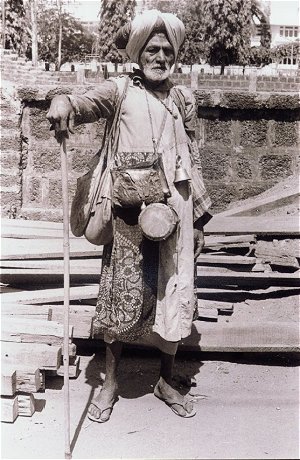
A beggar at the Mangeshi temple, Goa

Beggar Leaders

The beggars need protection just like everyone. They especially need protection of their savings and begging zones. Often there are these self-style beggar leaders who enforce the rules. There is no rule to pay him money for his leadership. You can provide a hot cup of coffee once in a while. There are even beggar gangs whose leader takes a bigger share, but distributes among the members. The team of blind men and the team of transvestites belong to this category. The beggars at the railway stations and bus stands are usually dominated by thugs who run begging rackets. There are these goondas who liberate beggars from rehabilitation centers and send them back to the streets for begging.

Source:

Kamat’s PotPourri

Links: 

Slums are Manifestations of Urban Poverty

Urban Poor, UN and Slums

Urban Poverty Differs from Rural Poverty


Posted in earth | Leave a comment

Genetic proof for the AIT? Look again – Koenraad Elst

VOI's avatarBHARATA BHARATI

David Reich

Koenraad ElstThe message to take home for now is that even Dr David Reich, celebrated by India’s Aryan Invasion champions, … locates the Homeland outside Europe and helps to disprove the really existing invasionist Homeland theory, viz. with the Pontic steppes as Homeland. – Dr Koenraad Elst

Authorities on science and the scientific temper very wisely teach students never to use Wikipedia as a source: it is often amateurish and incomplete, and on any controversial subject (not just politics) it is invariably partisan, with one of the contending parties having captured the “encyclopedia” entry and preventing  the other parties from entering corrections or their own versions. And yet, it is while browsing through a reference that turned out to lead to a Wikipedia page, that I found the following quotation by Harvard geneticist David Reich that had escaped my notice during the whole hullabaloo triggered by India’s anti-Hindu crowd that finally…

View original post 691 more words

Posted in earth | Leave a comment