Social Disorganization Theory and Urban Crime

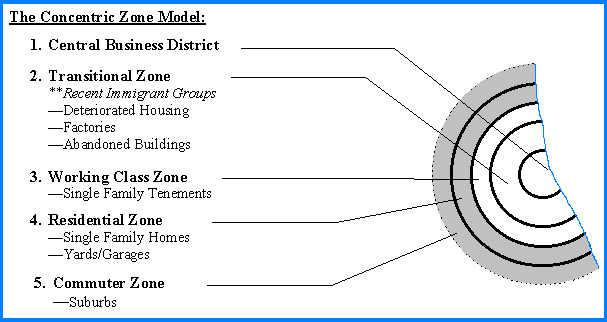
The social disorganization theory is a theory developed by the Chicago School, related to ecological theories. The theory directly links crime rates to neighbourhood ecological characteristics; a core principle of social disorganization theory that states location matters. In other words, a person’s residential location is a substantial factor shaping the likelihood that that person will become involved in illegal activities. The theory suggests that, among determinants of a person’s later illegal activity, residential location is as significant as or more significant than the person’s individual characteristics (e.g., age, gender, or race). For example, the theory suggests that youths from disadvantaged neighborhoods participate in a subculture which approves of delinquency, and that these youths thus acquire criminality in this social and cultural setting.

Larry Gaines and Roger Miller state in their book Criminal Justice in Action that “crime is largely a product of unfavorable conditions in certain communities”. According to the social disorganization theory, there are ecological factors that lead to high rates of crime in these communities, and these factors linked to constantly elevated levels of “high school dropouts, unemployment, deteriorating infrastructures, and single-parent homes” (Gaines and Miller). The theory is not intended to apply to all types of crime, just street crime at the neighborhood level. The theory has not been used to explain organized crime, corporate crime, or deviant behavior that takes place outside neighborhood settings.

Processes Leading from Social Disorganization to Crime

Family Processes

Sampson (1986) indicates that social disorganization may have an effect on youth violence through its effects on family structures and stability. He suggested that traditional social disorganization variables may influence community crime rates when taking into account the effects of levels of family disruption. This may occur by (1)removing an important set of control structures over youths’ behaviour, and (2)creating greater opportunities for criminal victimization (i.e., through the lack of capable guardianship). Essentially, Sampson (1986) recognized the relationship of social disorganization theory to control theory and routine activities/lifestyle theory.

To test his assertions, Sampson (1986) used three measures of family structure. First, he included a measure of the per cent of residents in a neighbourhood who were ever married and who were either divorced or separated. The second measure of family structure was the per cent of female-headed families. Finally, he included a measure of the per cent of primary or single-headed households. His analyses revealed that, independent of the traditional social disorganization variables, the family structure variables each had a direct significant effect on community crime rates. Thus, Sampson’s work identified an important and additional source of social disorganization (implicit in the work of Shaw and McKay) that had been previously overlooked by empirical studies.

McNulty and Bellair (2003) also investigated the importance of family processes within the social disorganization tradition. This study integrates theory and research in criminology and urban sociology to specify a contextual model of differences in adolescent violence between whites and five racial-ethnic groups. The model presented views these differences as a function of variation in community contexts, family socioeconomic well-being, and the social capital available to adolescents and families. Data from the National Education Longitudinal Survey (1988 to 1992), which included information on 14,358 adolescents across 2,988 US locales, were matched with community-level data from the 1990 US census to test the resulting model. The white-black disparity in adolescents’ fighting is explained by higher levels of disadvantage in the communities in which black children often live. The disadvantage index accounted for the largest reduction in the black effect on fighting, reflecting the well-documented concentration of disadvantage in black communities. Importantly, and in agreement with the importance of family processes for social disorganization theory, the results indicate that the effect of concentrated disadvantage on fighting is mediated by more proximate processes that are linked to family well-being.

Tolan, Gorman-Smith and Henry (2003) employ data from a longitudinal study of 284 African-American and Latino adolescent boys and their caregivers, living in poor urban communities, to test a developmental-ecological model of violence. Six annual waves of data were applied to evaluate the relations between microsystem influences of parenting and peer deviance, macrosystem influences of community structural characteristics and neighbourhood social organization, and individual involvement in violence. Structural equation modelling analyses showed that community structural characteristics significantly predicted neighbourhood social processes. Importantly, it was found that parenting practices partially mediated the relation between neighbourhood social processes and gang membership.

Consistent with the above research that social disorganization may influence the level of youth violence through its effect on family processes, other researchers have found that family processes may be used to mitigate the deleterious effects of social disorganization. Burfeind (1984), for example, examined the role of the family, within a larger social context, as it relates to delinquency. This study focused on 1,588 non-black junior and senior high school students in the US. Burfeind analyzed the interactive effects of five family dimensions in relation to four other causal variables commonly associated with delinquency involvement: community social disorganization, delinquent friends, attachment to peers, and delinquent definitions. Analysis revealed that family factors influenced delinquency in different ways. The level of an adolescent’s attachment to the father was found to be independently related to delinquent activity after controlling for all other effects (independent and interactive). Paternal discipline had an interactive effect on delinquency, such that the type of paternal discipline influenced the effect that community social disorganization and the number of delinquent friends had on delinquency.

Sampson (1992) has attempted to consolidate the empirical findings that relate social disorganization to family processes and then to delinquency and youth violence. In so doing, he has developed a community-level theory of social disorganization, which places primary emphasis on family management practices and child health and development. He notes that the embeddedness of families and children in a community context is a central feature of the theory. Prenatal care, child abuse prevention, monitoring and supervision of youth, and other family management practices are intertwined with community networks of social organization. Social disorganization directly and indirectly influences the care of children and other family processes, and ultimately, rates of delinquency and crime.

Neighbourhood Processes

Neighbourhood processes have been implicated in the link between social disorganization and crime, with a number of authors arguing for the importance of different causal pathways. Sampson and Groves (1989) investigated how informal social controls are affected by social disorganization. Their study used aggregated data from the British Crime Survey. The intervening mechanisms between social disorganization variables and crime rates specified in their study include informal control mechanisms such as youths’ local friendship networks, the prevalence of unsupervised peer groups, and the level of organizational participation in the neighbourhood. Their general hypothesis is that social disorganization (i.e., low economic status, ethnic heterogeneity, residential mobility) affects informal control mechanisms in such a way that it increases crime and delinquency rates. The dependent measures employed in the study were total victimization, robbery, mugging, burglary, theft, and vandalism rates. The model was first tested by analyzing data for 238 localities in Great Britain, constructed from a 1982 national survey of 10,905 residents. The model was then replicated on an independent national sample of 11,030 residents of 300 British localities in 1984. Results from both surveys support the hypothesis and show that social disorganization significantly influenced the intervening variables, which in turn influenced all crime outcome measures.

Sun, Triplett and Gainey (2004), using American data, test an extended model of social disorganization that includes the theoretical paths proposed by Sampson and Groves (1989). Their model predicts that neighbourhoods with low socio-economic status, high residential mobility, racial heterogeneity, and family disruption should have sparse local friendship networks, low organizational participation, and unsupervised youth groups. These, in turn, are predicted to increase crime rates. To test this model, the authors used interview data from 8,155 residents of 36 neighbourhoods in seven US cities. The findings offered partial support for the Sampson and Groves model, since social disorganization variables were more effective in transmitting the effects of structural characteristics on assault compared with robbery.

Sampson, Raudenbush and Earls (1997) examined how social disorganization influences violence and crime, via its effects on collective efficacy. Their study argued that socially disorganized neighbourhoods are likely to be low on collective efficacy, which was defined as “the willingness of local residents to intervene for the common good” (Sampson et al., 1997: 919). The authors go on to state that community residents are “unlikely to intervene in a neighbourhood context in which the rules are unclear and people mistrust or fear one another. It follows that socially cohesive neighbourhoods will prove the most fertile contexts for the realization of social control.” (919). Using aggregated data from the Project on Human Development in Chicago Neighbourhoods, they found that the traditional social disorganization variables explained 70 per cent of the variation in their collective efficacy measures, which, in turn, effectively mediated much of the direct effects of the social disorganization variables on violence and crime.

Cantillon et al. (2003) utilized an updated systemic model of social disorganization to investigate neighbourhood effects on both positive and negative youth outcomes. They argue that updated social disorganization models facilitate the assessment of truly important social processes and dynamics that result in cohesive and supportive neighbourhoods. These authors hypothesized that a sense of community was a more valid, comprehensive, and applicable measure for the mediating variables in social disorganization theory. Sense of community was defined as “a feeling that members have of belonging, a feeling that members matter to one another and to the group, and a shared faith that members’ needs will be met by their commitment to be together” (324). Data for this study was gathered by interviews in 1999–2000. The sample consisted of 103 tenth-graders, one parent, and one neighbour of each tenth-grader. Mediation testing employed the principles outlined by Baron and Kenny (1986). Results supported the hypothesis that sense of community mediates the effect of neighbourhood disadvantage on youth outcomes.

Social Disorganization and Economic Deprivation

A number of studies have supported the idea that economic deprivation may be an important influence on social disorganization, which, in turn, as the previous research has indicated, is an important influence on youth violence. This proposes that economic deprivation could lead to social disorganization, which in turn leads to violence and crime. Other researchers, in contrast, have argued that poverty conditions the effects of social disorganization on youth violence. That is, social disorganization in conjunction with poverty results in higher rates of youth violence than either social disorganization or poverty alone do. No mediating processes are proposed in this second explanation. The research highlighted below offers partial support for both propositions, and indicates that researchers and practitioners who are interested in the effects of social disorganization on crime should also consider the importance of economic deprivation

Warner and Pierce (1993) examine social disorganization theory using calls to the police as a measure of crime. Data were gathered from 60 Boston neighbourhoods in 1980. The authors argue that data based on complainant reports of crime, rather than official police reports, allow for the investigation of differences in findings based on victimization data and official crime data. The rates of assault, robbery, and burglary are regressed on poverty, residential mobility, racial heterogeneity, family disruption, and structural density. Interaction terms for poverty and heterogeneity, poverty, and mobility, and mobility and heterogeneity are also explored. The authors find that each of the social disorganization variables predicted crime rates, with poverty being the strongest and most consistent predictor. Interaction terms constructed between poverty and racial heterogeneity and poverty and residential mobility were also fairly stable predictors of crime. Similarly to Smith and Jarjoura (1988), the results indicate that poverty strengthens the effects of social disorganization on crime.

Warner and Roundtree (1997) employ a sample of 100 Seattle census tracts and investigate the influence of poverty, racial heterogeneity, residential stability, and interaction terms on assault and burglary. Consistent with the results of Smith and Jarjoura (1988) and Warner and Pierce (1993), they find that an interaction term between poverty and residential stability significantly predicts both dependent measures.


Source(s):

Wikipedia

Ontario Ministry of Social Services

Posted in Class Notes, earth | 1 Comment

In A Society Built On War, We Must Do More Than Just Prefer Peace – Caitlin Johnstone

M. C.'s avatarMCViewPoint

We live in a civilization that was built by war. A civilization that is currently propped up by war. A civilization that has its future mapped out with war as its career and war as its retirement plan. The political and economic system which dictates the way our society moves and operates has its roots sunk deep into the soil of war. The only thing separating us from the wars our government is waging in our name is physical proximity.

https://caitlinjohnstone.com/2019/10/27/in-a-society-built-on-war-we-must-do-more-than-just-prefer-peace/

American activist Angela Davis once said, “In a racist society it is not enough to be non-racist, we must be anti-racist.” Our responsibility to truth and justice isn’t fulfilled by merely witnessing the perverse tendency in western society toward white supremacy without participating in it, any more than our responsibility is fulfilled by merely witnessing but not participating in a gang rape. Simply choosing not to…

View original post 831 more words

Posted in earth | Leave a comment

Social Disorganization Leads to Urban Crime?

The research on urban crime is generally of two types. There are studies that compare cities, seeking to understand why some have higher crime rates than others. And there are studies that focus on explaining variations in crime levels within cities. However, both types of studies use similar theories and focus on the same social forces to understand their observations. The primary theories used to study urban crime are social disorganization, subculture, and conflict theories.

Social disorganization theory  is concerned with the way in which characteristics of cities and neighborhoods influence crime rates. The roots of this perspective can be traced back to the work of researchers at the University of Chicago around the 1930s. These researchers were concerned with neighborhood structure and its relationship to levels of crime. Classical Chicago School theorists, and Shaw and McKay in particular, were most concerned with the deleterious effects of racial and ethnic heterogeneity, residential mobility, and low socioeconomic status on an area’s ability to prevent crime. However, since the work of Shaw and McKay and others, researchers who adopt the macrosocial approach to the study of urban crime have identified a number of additional “disorganizing” factors including family disruption (Sampson and Groves), relative poverty (Messner, 1982), and racial segregation (Peterson and Krivo).

Researchers  believe that characteristics such as these are likely to lead to high levels of social disorganization, which in turn increases the likelihood of crime and criminal violence. In general terms, social disorganization refers to the inability of a community structure to mobilize the common values of its residents to maintain effective social controls (Kornhauser).  Neighborhoods characterized by high levels of poverty or economic deprivation, residential mobility, ethnic heterogeneity, family disruption, poor housing conditions, and low levels of education are most likely to be disorganized and have higher levels of crime and violence. Disorganization, a lack of solidarity and cohesion, and the absence of a shared sense of community and mutual commitment between residents allows crime to flourish because the community’s capacity for informal social control (that which does not depend on the less efficient formal criminal justice institutions) is inhibited. Social disorganization theory has been criticized for failing to appreciate the diversity of values that exist within urban areas (Matza), for not recognizing that communities in urban areas indeed may be organized, but around unconventional values, and for failing to define clearly its main concept, social disorganization, thereby making the identification and operationalization of variables difficult (Liska).

Subcultural theories to explain urban crime are of two types—subculture of violence and subculture of poverty. Common to both types is the belief that certain groups carry sets of norms and values that make them more likely to engage in crime. The subculture of violence thesis holds that high rates of violence result from a culture where criminality in general, and violence in particular, are more acceptable forms of behavior. Carriers of a subculture of violence are quicker to resort to violence than others. Situations that normally might simply anger others could provoke violence by those carrying subculture of violence values. In the formulation of these ideas, subcultural theorists claim that social institutions themselves contribute to the development and persistence of a subculture conducive to criminality and violence. For example, the disintegration of particular institutions (i.e., churches, families, and schools) denies certain populations (and in particular, minorities) the opportunity to learn conventional norms and values. The result of such processes is that certain groups are more likely to use violence in their day-to-day encounters, and violence is seen as an acceptable means to solving disputes. The classic statement on the subculture of violence is Wolfgang and Ferracuti’s The Subculture of Violence: Towards an Integrated Theory in Criminology (1967), although others have contributed as well (Elkins; Curtis, 1975).

Subculture of poverty explanations have focused more on urban crime than have subculture of violence explanations. Subculture of violence explanations have been used to explain crime in urban and nonurban settings, but those who have written about the subculture of poverty have been concerned primarily with the criminal behavior in the ghettos and barrios of central cities (Banfield). The central thesis here is that values and norms that discourage work and investment of money or energies are likely to develop in poor communities. Because carriers of this subculture are disinclined to strive to achieve, have limited patience, and are less likely to defer gratification, they act impulsively. Too often these impulses lead to crime. Critics of this theory cite a biased, middle-class perspective that seems to neither understand the plight of the poor—the effects of social structures and institutions on their behavior—nor accurately describe their lives, options, or behavior. The most notable expression of conflict theories as an explanation of urban crime has focused on income inequality (Blau and Blau). Here scholars have argued that frustration is a byproduct of income gaps that are viewed as unjust by those in subordinate positions. Social structural cleavages based on race have also been used to explain why poor urban blacks and Latinos have higher crime rates than the general population (Blau and Blau).

Source:

Jrank

Posted in Class Notes, earth, opinions, urban morphology, Urban Studies | 1 Comment

Living Your Passion

Orlando's avatarOrlando Espinosa

If you want to be successful and produce extraordinary results in life, you must live your life with passion and purpose. Those who are not living their passion are usually not enjoying their life and just going through the motions. Life is too short not to live it with passion!

View original post

Posted in earth | Leave a comment