Levelling in Surveying (Geography)

Levelling  is a branch of surveying, the object of which is to

  1. Find the elevation of a given point with respect to the given or assumed datum.
  2. Establish a point at a given elevation with respect to the given or assumed datum.

Levelling is the measurement of geodetic height using an optical levelling instrument and a level staff or rod having a numbered scale. Common levelling instruments include the spirit level, the dumpy level, the digital level, and the laser level
 

Method Of Levelling :-

  1. Rise and fall method
  2. Height of collimation method


  1. Rise and fall method :-

                                                  In this method, the difference of level between two consecutive points for each setting of the instrument, is obtained by comparing their staff readings. The difference between their staff readings indicates a rise if the back staff reading is more than the fore sight and a fall if it is less than the fore sight. The algebraic sum of rises and falls, gives the difference in level between the starting and closing points.

  1. Height of collimation method :-

                                                            In this method height of the instrument is calculated for the first setting of instru­ment by adding the back sight to the reduced level of the given Bench Mark. The reduced level of the first station is obtained by subtracting its fore sight from the instrument height (H.I.).

      Arithmetical checks :-

∑ B.S.- ∑ F.S. =∑ Rise – ∑ Fall = Last R.L. – First R.L.

 Comparison of Line of Collimation Method with Rise and Fall Method :-

Height of collimation method Rise and fall method
1. It is more rapid and saves a            considerable time and labour.

2. It is well adopted for reduc­tion of levels for construction work such as longitudinal or cross section levelling opera­tions.

3. There is no check on reduc­tion of R.L.S. of intermediate stations.

4. There are only two arith­metical check i.e.,, the dif­ference between the sum of the back sights and the sum of the fore sights must be equal to the difference in R.L. of the last station and first station.

5. Errors if any in inter­mediate sights are not detected.

1. It is laborious as the staff reading of each station is com­pared, to get a rise or fall.

2. It is well adopted for deter­mining the difference in levels of two points where precision is required.

3. There is a complete check on the reduction of R.Ls. of inter­mediate stations.

4. There are three arithmeti­cal checks i.e. the difference between the sum of the back sights and the sum of the fore sights must be equal to the difference between the sum of the rises and the sum of the falls as well as it must be equal to the difference in R.Ls. of the last station and first station.

5. Errors in intermediate sights are noticed as these are used for finding out the rises or falls.


 Sprit level:-

The spirit level is on a tripod with sight lines to the two points whose height difference is to be determined. A graduated leveling staff or rod is held vertical on each point; the rod may be graduated in centimetres and fractions or tenths and hundredths of a foot. The observer focuses in turn on each rod and reads the value. Subtracting the “back” and “forward” value provides the height difference.

 Refraction and Curvature:-

The curvature of the earth means that a line of sight that is horizontal at the instrument will be higher and higher above a spheroid at greater distances. The effect may be significant for some work at distances under 100 meters.

The line of sight is horizontal at the instrument, but is not a straight line because of refraction in the air. The change of air density with elevation causes the line of sight to bend toward the earth.

The combined correction for refraction and curvature is approximately.

 Or

For precise work these effects need to be calculated and corrections applied. For most work it is sufficient to keep the foresight and back sight distances approximately equal so that the refraction and curvature effects cancel out. Refraction is generally the greatest source of error in leveling. For short level lines the effects of temperature and pressure are generally insignificant, but the effect of the temperature gradient dT / dh can lead to errors.

Dumpy level :-

 The dumpy level was developed by English civil engineer William Gravatt, while surveying the route of a proposed railway line form London to Dover. More compact and hence both more robust and easier to transport, it is commonly believed that dumpy levelling is less accurate than other types of levelling, but such is not the case. Dumpy levelling requires shorter and therefore more numerous sights, but this fault is compensated by the practice of making foresights and back sights equal.

Precise level designs were often used for large leveling projects where utmost accuracy was required. They differ from other levels in having a very precise spirit level tube and a micrometer adjustment to raise or lower the line of sight so that the crosshair can be made to coincide with a line on the rod scale and no interpolation is required

Reading the staff :-

The staff starts at zero, on the ground. Every 10 cm is a number, showing ( in meters to one decimal) the height of the bottom of what appears to be a stylised E (even numbers) or 3 (odd numbers), 5 cm high. The stems of the E or 3 and the gaps between them are each 10mm high. These 10mm increments continue up to the next 10 cm mark.

To read the staff, take the number shown below the reticle. Count the number of whole 10mm increments between the whole number and the reticle. Then estimate the number of mm between the last whole 10mm block and the center of the reticle. The diagram above shows 4 readings:- 1.950, 2.000, 2.035 and 2.087.

The person holding the staff should end heavour to hold it as straight as possible. The leveller can easily see if it is tilted to the left or right, and should correct the staff-holder. However, it cannot easily be seen that the staff is tilted towards or away from the leveller. In order to combat this possible source of error, the staff should be slowly rocked towards and away from the leveller. When viewing the staff, the reading will thus vary between a high and low point. The correct reading is the lowest value.

Digital levels electronically read a bar-coded scale on the staff. These instruments usually include data recording capability. The automation removes the requirement for the operator to read a scale and write down the value, and so reduces blunders. It may also compute and apply refraction and curvature corrections.

 LEVELLING PROCEDURE :-

A typical procedure is to set up the instrument within 100 meters (110 yards) of a point of known or assumed elevation. A rod or staff is held vertical on that point and the instrument is used manually or automatically to read the rod scale. This gives the height of the instrument above the starting (backsight) point and allows the height of the instrument (H.I.) above the datum to be computed.

The rod is then held on an unknown point and a reading is taken in the same manner, allowing the elevation of the new (foresight) point to be computed. The procedure is repeated until the destination point is reached. It is usual practice to perform either a complete loop back to the starting point or else close the traverse on a second point whose elevation is already known. The closure check guards against blunders in the operation, and allows residual error to be distributed in the most likely manner among the stations.

Some instruments provide three crosshairs which allow stadia measurement of the foresight and back sight distances. These also allow use of the average of the three readings (3-wire leveling) as a check against blunders and for averaging out the error of interpolation between marks on the rod scale.

The two main types of levelling are single-levelling as already described, and double-levelling (Double-rodding). In double-levelling, a surveyor takes two foresights and two back sights and makes sure the difference between the foresights and the difference between the backsights are equal, thereby reducing the amount of error. Double-levelling costs twice as much as single-levelling.

Safety and precautions in leveling :-

While leveling, the following precautions should be taken:

  • The staff should be held vertical while taking the reading;
  • The bubble in the level tube is to be brought to central before taking any reading;
  • Readings should be taken in the proper direction depending on the type of staff;
  • Balancing of sight is to be maintained as far as possible;
  • Reading and recording of observation correctly.


 Link(s) andSource(s):

parorocks

Datum

Differential Levelling

Posted in Class Notes, earth, Geography Practicals/Lab and Statistical Techniques | Leave a comment

Liberty in the Time of Coronavirus

Never before has ‘freedom from’ so worryingly related to ‘freedom to.’ Nearly three billion people currently live under lockdowns enacted by governments. In these uncertain times, most of us remain confined to our homes and accept these unprecedented restrictions as a temporary but necessary sacrifice in the fight against a deadly virus. We understand that lockdowns are part of a short-lived trade-off between liberty and safety. But how comfortable are we with the idea that this state of emergency could last long enough to leave a permanent imprint on the social, economic and political fabric of our communities? What could be the institutional aftermath of this pandemic?…..

Read here in this thought-provoking  Article by Aris Trantidis

Posted in opinions | Leave a comment

Hedonic and Eudaimonic wellbeing

The concept of happiness is the cornerstone of the assumptions of positive psychology. Happiness is characterised by the experience of more frequent positive affective states than negative ones as well as a perception that one is progressing toward important life goals (Tkach & Lyubomirsky, 2006).

 In the pursuit of understanding happiness, there are two main theoretical perspectives that focus on addressing the question of what makes people feel good and happy. These are the hedonic and eudaimonic approaches to happiness (Keyes, Shmotkin, & Ryff, 2002).

Hedonic wellbeing

Hedonic wellbeing is based on the notion that increased pleasure and decreased pain leads to happiness. Hedonic concepts are based on the notion of subjective wellbeing. Subjective well-being is a scientific term that is commonly used to denote the ‘happy or good life’. It comprises of an affective component (high positive affect and low negative affect) and a cognitive component (satisfaction with life). It is proposed that an individual experiences happiness when positive affect and satisfaction with life are both high (Carruthers & Hood, 2004).

Eudaimonic wellbeing

Eudaimonic wellbeing, on the other hand, is strongly reliant on Maslow’s ideas of self actualisation and Roger’s concept of the fully functioning person and their subjective well being. Eudaimonic happiness is therefore based on the premise that people feel happy if they experience life purpose, challenges and growth. This approach adopts Self-Determination Theory to conceptualise happiness (Keyes et al., 2002; Deci & Ryan, 2000). Self determination theory suggests that happiness is related to fulfilment in the areas of autonomy and competence.

From this perspective, by engaging in eudaimonic pursuits, subjective well being (happiness) will occur as a by product. Thus, life purpose and higher order meaning are believed to produce happiness. It appears that the general consensus is that happiness does not result from the pursuit of pleasure but from the development of individual strengths and virtues which ties in with the concept of positive psychology (Vella-Brodrick, Park & Peterson, 2009). The differences between eudaimonic and hedonic happiness are listed below.

Hedonic (Subjective Wellbeing)

  1. Presence of positive mood
  2. Absence of negative mood
  3. Satisfaction with various domains of life (e.g. work, leisure)
  4. Global life satisfaction

Eudaimonic (Psychological Wellbeing)

  1. Sense of control or autonomy
  2. Feeling of meaning and purpose
  3. Personal expressiveness
  4. Feelings of belongingness
  5. Social contribution
  6. Competence
  7. Personal growth
  8. Self acceptance

Positive psychologists view happiness from both the hedonistic and eudaimonic view in which they define happiness in terms of the pleasant life, the good life and the meaningful life (Norrish & Vella-Brodrick, 2008). Peterson et al., identified three pathways to happiness from the positive psychological view:

  1. Pleasure is the process of maximising positive emotion and minimising negative emotion and is referred to as the pleasant life which involves enjoyable and positive experiences.
  2. Engagement is the process of being immersed and absorbed in the task at hand and is referred to as the good life which involves being actively involved in life and all that it requires and demands. Thus the good life is considered to result from the individual cultivating and investing their signature strengths and virtues into their relationships, work and leisure (Seligman, 2002) thus applying the best of self during challenging activities that results in growth and a feeling of competence and satisfaction that brings about happiness.
  3. Meaning is the process of having a higher purpose in life than our selves and is referred to as the meaningful life which involves using our strengths and personal qualities to serve this higher purpose. The meaningful life, like the good life, involves the individual applying their signature strengths in activities, but the difference is that these activities are perceived to contribute to the greater good in the meaningful life.

Ultimately, it is a combination of each of these three elements described above that positive psychology suggests would constitute authentic and stable happiness (Vella-Brodrick, Park & Peterson, 2009; Carruthers & Hood, 2004).

Source:

Counseling Connections

Posted in Class Notes, earth | Leave a comment

The Modification of August Lösch

Starting in the 1930s, German geographer August Lösch began to build upon and modify Christaller’s model. He did this, in part, because he noticed that the variation in K is very important in shaping the organizations of centers and the numbers of centers at each level in a hierarchy. Because Christaller arbitrarily choose the K=3, K=4, and K-7 values, Lösch argued that, in such a model, no particular K value could be considered sacrosanct. From the point of view of Lösch, Christaller’s three locational principles were simply interesting special cases. Lösch suggests that, in fact, a large number of K values can be used. The only restriction, according to Lösch, is that a hexagonal pattern must be maintained in the model. In contrast to Christaller K=7 hierarchy of 1,6,42,294, Lösch put forth that a K=7 hierarchy would be more efficient if it were arranged 7, 13, and 19 because, in these cases, places are not divided among several different centers.

Enter image and alt text here. No sizes!

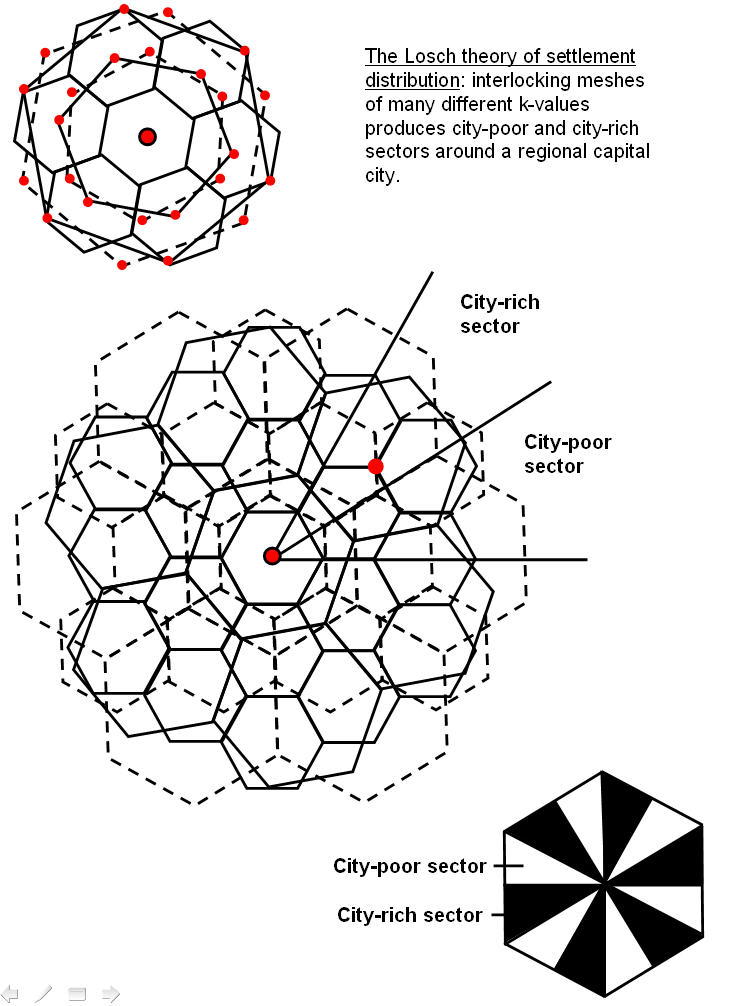
Figure 4.26: Lösch Theory of Urban Settlement Distribution.

This modification of Christaller’s original model is important because many market areas of sizes K=3, 4, . . ., n are situated so that they all have at least one common center, and with the rotation of these hexagons we are able to achieve six sectors with central places that include many types of businesses. Additionally, this process creates a maximization of agglomeration relative to production locations, maximized local purchases, and minimizes the total distance between production points. The resultant pattern results in city-rich and city-poor sectors. This arrangement of linear clusters of central places conforms to the principle of least effort (that people will generally attempt to minimize the effort needed to do business, i.e., all else equal, they will trade at the nearest retail establishment). The graphic above provides a visual demonstration of this concept. The basic properties of the city-rich part of the model are that the greatest numbers of locations coincide, local purchases are maximized, distances between central places are minimized, and the volume of shipments and the total length of transportation routes are minimized. The city-poor parts of the model account for an uneven distribution of population, cities, and businesses.

Enter image and alt text here. No sizes!

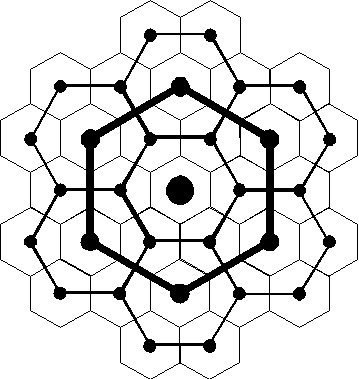
Löschian Model.
Credit: Lösch (1954, cited in Gore 1984)

In order to arrive at these modifications, Lösch identified the three smallest market areas. Lösch worked on the assumption that a farmer at a given location (A1) produces a commodity in excess of the need in his market area and therefore sells the excess to customers in adjacent market areas (A2 and 3). This results in a triangular market area. If A1 increases output, it may become a central place (B1) and the farmer will then sell his output in a hexagon consisting of six triangles. The market area of B1 would then be increased by encroaching on the market areas of neighboring central places (B2 and 3), by either rotating the hexagon around B1 or by rotating and enlarging the hexagon so that it expands into open space without touching any other settlement (see graphic above).  Lösch indicated that the smallest market areas are only the smallest in an infinite series. The multiple rotations and enlargements of hexagons created market areas with K values of 9, 12, 13, 16, 19, 21, and 25. The landscape, according to Lösch, is made up of a discontinuous series of central place possibilities, because there are variations in the efficiencies of the various possible arrangements.

Therefore, the models developed by Christaller and Lösch are very different because they result in markedly different systems. The permanent K constraint in Christaller’s model means that all places at the same level in a hierarchy have the same business types, and all higher-order places must contain all the business types contained in lower-order places. Lösch noted that this does not accurately reflect the spatial organization of central places in the “real world.” Thus, the model developed by Lösch presents a less definite hierarchical arrangement than does Christaller’s. In the Löschian system, settlements of the same size are not required to have the same arrangement of business types, and higher-order central places do not need to have all the functions available in lower-order places (although they will probably tend to have most of them).

Whereas central-place theory provides great insights into the hierarchy of urban places, it has shortcomings. For one thing, these models are simply descriptive in nature. Additionally, they do not take into account non-optimal human decisions and fail to consider the historical process through which capitalism developed as the framework in which places come to positions of dominance. Moreover, central-place theory deals only with relationships between consumers and producers in a region. It does not consider settlement patterns that are the result of long-distance trade between regions. Furthermore, central-place theory rests on the assumption of uniformity of space.

Link(s) and Source:

Posted in Class Notes, earth, Settlements, Urban Studies | Leave a comment