What Would Have Been Syed’s Dream in This Digital World? :HAPPY SIR SYED DAY

Let us Assume That Sir Syed was living in this age.

What have been his vision for an educational institution?

Perhaps

A Cloud University in Cyberspace?

jo abr yahaan se uththega, vo saare jahaan par barsegaa
har juu-e-ravaan par barsegaa, har koh-e-garaan par barsegaa

Clouds of knowledge would have been raining all over the universe, Ocean of Knowledge and Wisdom.

Certainly.

The real questions are : Are we true torch bearers of his dream? Are we following his Vision?

Are we living the true spirit of Tarana and Nazr-e -Aligarh:

har shahr-e-tarab par garjegaa, har qasr-e-tarab par kadkegaa

ye abr hameshaa barsaa hai, ye abr hameshaa barsegaa

Join me in Saluting this great visionary.

.

Posted in earth | 1 Comment

Data Acquisition Methods and Main Considerations

There are four methods of acquiring data: collecting new data; converting/transforming legacy data; sharing/exchanging data; and purchasing data. This includes automated collection (e.g., of sensor-derived data), the manual recording of empirical observations, and obtaining existing data from other sources.

Common Data Acquisition Considerations 

There are a number of consideration when acquiring data . Once the data are collected or received, the data must be reviewed to assure that the data meet standards and can be certified as acceptable for their intended use by USGS.

  • Project Needs: The first thing to always consider is the need – why are these data required? What will be done with them?
     
  • Project Rules: A business rule identifies the constraints under which the business operates. For instance, where applicable, all geospatial data must have Federal Geographic Data Committee (FGDC) compliant metadata. These rules will affect your data acquisition decisions.
     
  • Data Standards: Any Government, USGS, or industry standards that apply will need consideration.
     
  • Accuracy Requirements: Among the most familiar accuracy requirements is the locational accuracy for spatial data; but there are other accuracy requirements that you may need to consider as well.
     
  • Cost: Cost is always a consideration. Sometimes it’s cheaper to buy than to collect.
     
  • Currency of Data: For many types of work, the data need to be fairly current. For others, data may need to cover a specified time period. For others, data need to be in a specific season. If you are trying to determine vegetation coverage, for example, you may want photographs from the summer, when vegetation is at the highest. If you are trying to look for land forms, you may want winter photos.
     
  • Time Constraints: You should determine how soon you need the data.
     
  • Format: Do you need the data as spatial data, photos, flat files, Excel files, XML files? This may not apply, but you need to determine that for each project.

Source: USGS

Posted in earth | Leave a comment

Urbanism as a Way of Life

Posted in earth | Leave a comment

Research method in urban studies: principles and guidelines

betweenarchitectureandurbanism's avatar

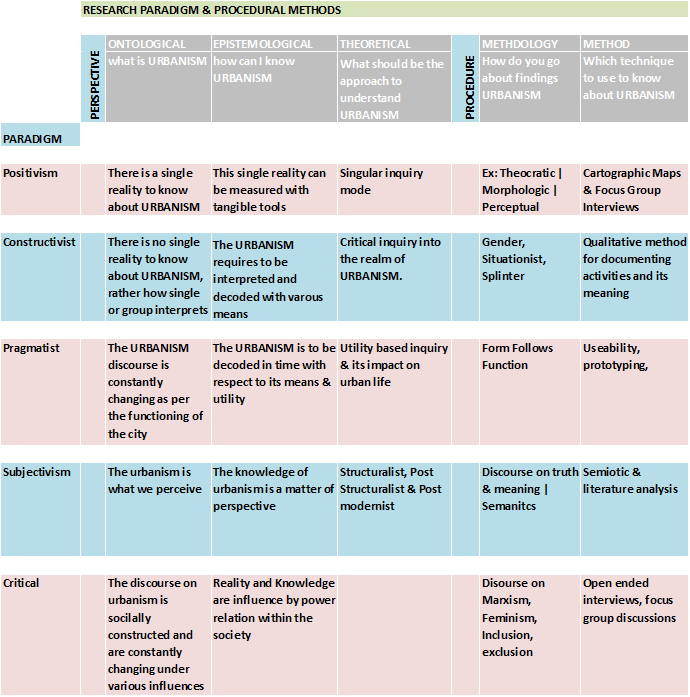
The blog attempts to articulate the research method, especially within the field of urban studies. The chart attempts to decode the various knowledge territories that are operative functionally as well as spatially within various research areas. The chart also attempts to acknowledge and recognise such knowledge systems. This also makes tangible links that research in any such knowledge systems are central to various urban discourses that recognise the liveability indexes and sustainability of such characters of the city.   

Methodology is the systematic, theoretical position, approach that is applied to a field of study. It comprises the theoretical analysis and principles associated with a branch of knowledge.

Method is simply a research tool and technique component of conducting research – a qualitative method such as interview or quantitative method such as demographic study are examples of methods.

Image Credit: Manoj Parmar Architects

View original post

Posted in earth | Leave a comment