Destination Moon

“As I take man’s last step from the surface, back home for some time to come … I’d like to just [say] what I believe history will record — that America’s challenge of today has forged man’s destiny of tomorrow. And, as we leave the moon at Taurus-Littrow, we leave as we came and, God willing, as we shall return, with peace and hope for all mankind.”

On Dec. 17, 1972, Eugene A. Cernan, the commander of Apollo 17, said these words as he took a last look around at the stark moonscape of the Taurus-Littrow Valley on the southeastern rim of the moon’s Mare Serenitatis crater. Then, he and Harrison Schmitt, the lunar module’s pilot and the only geologist-astronaut to walk on the moon, stepped back into the lunar module one last time to return to Earth.

Due to NASA’s shrinking budget and to make room for the space shuttle program, Apollo 17 was the last of NASA’s pioneering manned missions to the moon. But even then, no one imagined that it would be more than three decades before humans returned.

Later this year, however, NASA plans to launch its first new missions to the moon in more than 35 years. The goal: To scope out likely spots to land and create a habitat where astronauts can stay for longer than the Apollo program ever dreamed.

But therein lies the controversy: Mars, with its potential stores of oxygen and water, has the highest potential for long-term human habitation. The moon, even in NASA’s manned spaceflight plans, isn’t supposed to be the primary destination for humans’ return to space. Some scientists are asking why we are working so hard to return to a place where we’ve already set foot.
Edwin “Buzz” Aldrin, Apollo 11’s lunar module pilot, left his bootprint on the moon in July 1969.
NASA’s plans suggest that the lunar habitat is, to some extent, meant to be a kind of stepping stone, a field laboratory where scientists can test out new technologies, investigate how to mine the surface and figure out how to keep humans alive in the harsh lunar environment. It’s a classroom and staging ground before taking the much bigger and more dangerous leap to Mars.

Meanwhile, the moon is no longer the finish line in a race between two superpowers; instead, other nations are joining in. In addition to the U.S. and Russia, China, Japan, India and other nations have announced plans or have already launched missions of their own to assess and stake a claim in the new era of the space race.

An even bigger step for mankind
In January 2004, President Bush announced his “Vision for Space Exploration” to mixed reviews from Congress, scientists and the public. The announcement, on the heels of the 2003 space shuttle Columbia disaster, promised a new era of human spaceflight, retiring the aging space shuttles by 2010 and developing instead a new crew exploration vehicle called Orion. The vision was ultimately to “extend human presence across the solar system and beyond” — but first, to initiate a program to explore the moon, with not only scientific but also commercial and national goals.

In September 2005, NASA responded with a $100 billion plan called Project Constellation, a multi-component program to build the next generation of spacecraft for human spaceflight, to maintain the U.S. presence in low-Earth orbit and to lay the foundation for Mars exploration and beyond. The project includes plans to put four astronauts on the moon for a weeklong stay by 2018.

The first, unmanned phase of the program is scheduled to launch later this year, and includes NASA’s Lunar Reconnaissance Orbiter (LRO), which will spend a year orbiting the moon, mapping its surface, radiation and gravity fields, looking for potential resources and finding new landing sites. Identifying safe places for a manned lunar lander to set down is key, as recent data from Earth-based radar signals suggest that the terrain near the moon’s south pole is much more rugged than once thought, with peaks as high as Alaska’s Mount McKinley and crater floors deeper than the Grand Canyon.

Along for the ride on the same launch vehicle will be the Lunar Crater Observation and Sensing Satellite (LCROSS), whose mission is to confirm whether frozen water exists at the moon’s south pole. Data from NASA’s Lunar Prospector Orbiter in 1998, which closely examined the poles, suggested that the dark, cold polar regions of the moon contain abundant hydrogen atoms, which could be signs of water.

Because that water may be buried up to half a meter beneath the soil and loose rock fragments covering much of the moon’s surface, the LCROSS mission is designed to go below the surface to find that evidence. After reaching orbit in 2009, LCROSS will split into two parts: A 2,000-kilogram vehicle that will crash into a dark crater near the pole hard enough to kick up that buried material, and a satellite that will observe the composition of that dust.

Meanwhile, plans for manned missions to the moon are under way. The Vision for Space Exploration includes the development of a crew exploration vehicle called Orion, which will be similar in shape to the Apollo spacecraft but somewhat larger — big enough to carry four astronauts to the moon (or six, if the destination is the International Space Station).

The launch of the new moon missions will be considerably different from the Apollo missions, however. Instead of a single launch, the unmanned lunar lander will be launched first aboard the heavy-lifting cargo launch rocket Ares V, while the Orion spacecraft will follow in a second launch aboard the sleek Ares I rocket. Once in a low-Earth orbit, the two pieces will link up and begin their journey to the moon.

Those lunar missions will play a crucial role in moving manned spaceflight forward, NASA says, by providing a short-distance test run for other manned expeditions, including missions to Mars, which would be much longer and require at least 500 days on the planet’s surface, not to mention the roughly 250 days to get there.

“I view my job as building transportation infrastructure to get to Mars eventually,” says Richard Gilbrech, who, as head of NASA’s Exploration Systems Mission Directorate in Washington, D.C., is helping to orchestrate the Constellation missions. “We would much rather go three days away from home than a 30-month journey with no possibility of rescue or return,” Gilbrech says. “There is a wealth of technologies that has to be proven.”

Moon rush
The United States is not alone in racing to begin new moon programs and launch satellites to explore the lunar surface and assess its resources. In September 2007, Japan successfully launched its first lunar orbiter, SELENE. SELENE’s objectives during its one-year mission are to map the moon’s surface, study its gravity and take the first high-definition images of the moon from space. India’s first moon mission, Chandrayaan-1, is set to be launched this year.

Meanwhile, last October, the Chinese National Space Administration launched the satellite Chang’e-1 (named for the Chinese goddess of the moon), in collaboration with the European Space Agency, which provided ground support and tracking data from its SMART-1 mission.

Chang’e-1’s goals include orbiting the moon for a year, taking images of the lunar surface, analyzing the chemical elements on the surface, measuring the depth of the soil and observing space weather in the Earth-moon space. China plans to follow up the satellite with a lander and rover by 2012, robots to bring back samples by 2017 and possibly sending a taikonaut — a Chinese astronaut — by 2020.

Moon mining
Although national pride may be one reason for the new international push to the moon, another may be its potential resources. In addition to the hunt for water, which would be critical to the success of a future lunar outpost, new technologies are being developed to extract oxygen from the soil and rocks, or “regolith,” on the moon’s surface, Gilbrech says.

The hydrogen locked in the ice could also be a potential source of fuel, and such a readily available fuel source on the moon would facilitate Earth-moon travel, he says. “We’re trying to get to the point where we don’t have to launch everything from Earth, and can start making some things locally,” he adds. “If we can develop components or tools or solar arrays [on the moon], that would be a huge shift.”

Between the absence of clouds and the moon’s slow rotation, solar arrays could also be a potential source of power, particularly at the poles. Data from NASA’s 1994 Clementine mission suggested that, during the moon’s summer, the rims of some craters near the moon’s north pole were in constant sunlight for an entire lunar day — equivalent to 29 Earth days.

The moon may also contain a potentially valuable future energy resource in the form of the isotope helium-3. Helium-3 is a small component of solar wind, streams of charged particles ejected from the sun that have bombarded objects in the solar system for billions of years, says nuclear engineer Gerald Kulcinski of the University of Wisconsin at Madison. Helium-3 exists in Earth’s interior, but there is little at the surface; planets with a magnetic field or an atmosphere — including Mercury, which has a magnetic field, Venus, which has a thick atmosphere and Earth, which has both — are protected from the plasma streams, and thus don’t accumulate the isotope. That leaves the moon as the closest object in the solar wind’s path, and helium-3 has been piling up in the regolith for 4.5 billion years, Kulcinski says.

The isotope’s importance lies in its potential to become a clean source of nuclear energy, Kulcinski says. “We never think of the moon as a source of energy, but there’s 10 times more energy in helium-3 on the moon than there ever was in fossil fuels on Earth,” he says.

Fusing two atoms of helium-3 together produces an efficient, long-lived fuel with no radioactivity — an improvement over today’s commercial nuclear energy, produced by the fission, or splitting apart, of the nucleus of uranium or plutonium atoms. Researchers are also investigating energy produced by the fusion of two isotopes of hydrogen, deuterium and tritium, which produces shorter-lived waste — but that reaction also generates large amounts of damaging radioactivity.

But the helium-helium reaction is very difficult to produce in the laboratory, and the technology to make helium-3 mining commercially viable does not yet exist, Kulcinski says. Still, he says, some countries, particularly Russia, China and Japan, have expressed an interest in mining the isotope on the moon. NASA acknowledges helium-3 as one of many potential moon-based commercial applications, but only much further down the line, Gibrech says. “Our main task is creating capability — we’re envisioning this not just as a NASA lab, but a feeder for industrial and commercial activities.”

Science missions
To geologists, the moon is, of course, much more than a way station on the path to Mars and other more distant destinations. In 2007, the National Academy of Sciences’ Space Studies Board released its final report outlining the scientific research objectives for a lunar return, citing the moon’s nearly pure 4.5-billion-year-long record of solar system history, unaltered by crust recycling, volcanism or erosion.

And in addition to the clues it contains about meteoric bombardments and the formation of the planets in the inner solar system, the moon holds promise in other scientific arenas, NASA researchers say. Sitting squarely in the solar wind flowing from the sun, the moon can act as a laboratory from which to observe plasma physics, as well as observations of Earth’s own atmosphere, ionosphere and magnetosphere.

Another long-cherished dream of astronomers has been the construction of an array of radiotelescopes on the far side of the moon to detect very-low-frequency (VLF) radio waves, signals from the formation of the precursors to star clusters and galaxies forming in the “Dark Ages” of the universe — its first 100 million years, a time when the cosmos was filled with cosmic background radiation rather than stars. VLF signals are nearly impossible to detect on Earth because the planet’s ionosphere, as well as radio and television transmissions, create too much noise. But the far side of the moon, astronomers say, is fully shielded from this terrestrial interference. In February, NASA awarded grants to two teams of astronomers, one led by MIT researchers and the other by scientists at the U.S. Naval Research Laboratory, to develop plans for such an array over the next year, with construction scheduled to begin sometime after 2025.

To the moon … or Mars?
But to some scientists pushing for humans to reach Mars, these missions are just drawing attention — and money — away from that goal. “The Constellation program is not widely perceived as a Mars program, and that’s a mistake, because it doesn’t garner the public interest it should,” says Louis Friedman, executive director and co-founder of The Planetary Society in Pasadena, Calif. “I have respect for NASA’s point of view — that they want to get their sea legs back at the moon,” Friedman says. “They have to use the moon as a stepping stone. But they don’t have to stay there, or build a base. If we accept that the idea of humans getting to Mars is the goal, the question is, what do we do to get there?”
Apollo 17’s crew — Lunar Module Pilot Harrison H. Schmitt, Command Module Pilot Ron Evans and Commander Eugene A. Cernan — pose in the moon rover during preparations for the last Apollo mission, which launched in December 1972.
In January, NASA shipped this prototype inflatable habitat to McMurdo Station, Antarctica. The habitat — possible future moon housing — will be tested for a year in Antarctica’s cold, harsh environment.

NASA/JSC

Space travel is both very expensive and very risky, so the value of the missions should be high to match, Friedman says. “In the case of humans going to Mars, the value is very, very high — that is the only place that we can determine the future of the human species off the planet. It’s the only planet that we can conceive of that we can reach that may have harbored life and can in the future.”
The scientific and commercial goals for the moon program alone — such as VLF telescopes and mining for resources — are simply less vital, Friedman says. “If it does make sense to somebody to mine … helium-3 or build large telescopes, then fine, that can be a goal in itself. But it should not be an interim goal on the way to Mars.”
Some scientists have proposed using “near-Earth objects” (NEOs), such as large asteroids, as stepping stones to Mars rather than building a more expensive and time-consuming habitat on the moon. For one thing, astronauts wouldn’t need landing gear to land on these smaller, nearly gravity-free objects, and the costs could be considerably cheaper. Furthermore, NEOs would be interesting to study. But they are still not the goal, Friedman emphasizes. Connecting the interim points — asteroids, the moon — back to a manned Mars mission would help to sustain the program, but “if each program becomes an end in and of itself, that’s discouraging. You lose public interest right at the beginning.”

That’s not how NASA views it, Gilbrech says. “To say that we’ve exhausted all the scientific interests … seems misguided.” As for public interest in moon missions, he adds, “I think the support is there.” Indeed, another measure of the public enthusiasm for the moon program, Gilbrech says, is international interest. “It’s not like Apollo, when it was just us and the Russians. When you look at all the missions being planned to go to the moon, it’s very much becoming a global framework of activity.” In fact, the return to the moon is not so much a “race” as it is the beginning of a long-term occupancy — not unlike staking a claim in Antarctica, he says. “It’s equivalent to racing to reach the South Pole versus putting a base down there. We’re putting a base on the moon.”

NASA hopes, in fact, to tap into that international interest in moon exploration and stimulate competition among international companies for some of the aspects of its lunar missions. “Some things we’ll hold on to, like spacesuit design, navigation and communications, and the lunar lander,” Gilbrech says. “But outside of that, we’re opening up other elements to commercial and international participation.”

As nations proceed with their proposed moon missions, to what extent they will be composed of international collaboration as opposed to competition — or, more likely, some combination thereof — remains to be seen. That international interest is vital to the success of space programs, however, is something on which all parties can agree. “For human spaceflight to really get public funding, it needs to serve an international goal — we learned that with the International Space Station,” Friedman says. “We couldn’t do it domestically because we wouldn’t get political support and the budget, and the same is even more true of Mars.” One concern, he adds, is that as the economy, global climate change and ongoing war efforts place more strain on the U.S. economy, a new administration will be under pressure to slash human space exploration from the budget. “We don’t want the concept to be thrown away because of certain deficiencies in the program,” he says. “We don’t want to throw the baby out with the bathwater.”
NASA
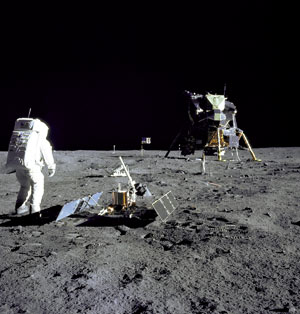
Buzz Aldrin deploys scientific equipment on the moon in July 1969.
NASA, meanwhile, is focusing on the tasks at hand — the upcoming robotic launches, building its spacecraft and assessing the future habitability of the lunar environment, Gilbrech says. The current priority, he says, is “to be back with human boots on the moon by 2020.”Peace in Space?

In 1957, the Space Age and the American-Soviet space race began in earnest, with the launch of the world’s first artificial satellite, the U.S.S.R.’s Sputnik I. Sputnik’s launch, which predated the first U.S. satellite by more than three months, ultimately led to the creation of NASA in 1958. That year also saw the creation of the U.N. Committee on the Peaceful Uses of Outer Space (COPUOS), which set out to define how multiple nations could peacefully coexist in the new territories beyond Earth’s atmosphere.
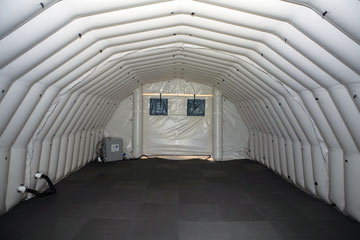
In January, NASA shipped this prototype inflatable habitat to McMurdo Station, Antarctica. The habitat — possible future moon housing — will be tested for a year in Antarctica’s cold, harsh environment.


As humans continue to explore space, space law has evolved in an attempt to address new questions and new territories. Below are some highlights of space treaties to date.

1967 — the “Outer Space Treaty”: the U.N.’s COPUOS treaty guarantees all nations access to all parts of celestial bodies. As of January 2008, 98 nations have signed this treaty.

1968 — the “Rescue Agreement”: COPUOS’ treaty for the rescue and return of both astronauts and “objects launched into outer space.”

1979 — the “Moon Treaty”: provides that the moon and other celestial bodies can only be used for peaceful purposes and their environments must be kept pristine. This treaty was originally intended to be a more comprehensive update of the earlier COPUOS agreement, by expanding on the Outer Space Treaty’s provisions regarding appropriating resources and prohibiting territorial claims. But many nations have yet to agree to these terms, and only a handful of countries have ratified it — the United States has not.

1998 — the “Space Station Agreement”: the nations participating in the International Space Station (the United States, member states of the European Space Agency, Japan, Russia and Canada) signed an agreement for cooperation on the Civil International Space Station. Under the treaty, each country is responsible for its own module, although NASA coordinates their activities. The agreement protects intellectual property rights and outlines criminal prosecution.
source

Posted in Moon, Space | Leave a comment

How Glaciers Form And Flow

Glaciers are more-or-less permanent bodies of ice and compacted snow that have become deep enough and heavy enough to flow under their own weight. Today, glaciers are found in mountainous regions or in the very cold areas around the poles, and cover only about 10% of the Earth’s surface. During past glacial periods this area increased considerably so, although active glaciation is very limited in Europe now, and non-existent in the UK, much of the landscape of northern Europe shows evidence of past glacial activity.

How glaciers form and flow

Glaciers develop where the temperatures are cold enough to allow snow to accumulate over a period of years. Favourable conditions are found around the poles and at high altitudes in lower latitudes, i.e. mountainous regions such Northern Scandinavia and the Alps. Enough snow must fall each winter to ensure that it doesn’t all melt in the summer. This way, the amount of snow lying on the ground gets deeper each year as new snow is added to the remains of last years fall.

On north facing slopes it may survive all year without melting, whereas all the snow may melt on south facing slopes ( in the northern hemisphere ). This is because north facing slopes get much less direct sunshine than south facing ones, and thus remain cooler.


North facing corries (French Alps), showing small snow patches remaining in mid summer

Fresh falling snow is made up of microscopic ice crystals and has a very delicate structure, nothing like solid ice found in glaciers, but after it lands it goes through a series of alterations to become hard ice.

In fact, very cold, and thus dry, snow will hardly stick together at all under normal conditions and would never be any use as ice unless it was changed.

As snow accumulates its structure changes. Newly fallen snow is very light and porous,with a density from 50 to 300 kg/m³, but as the snow becomes buried by subsequent snowfalls the ice crystals that make up the snowflakes partially melt and sublimate, particularly at the delicate points of the flakes. The vapour then condenses, and over time the flakes change into granular ice crystals called firn, which has a density greater than 500 kg/m³.

As more time passes the firn becomes buried even deeper under more fresh snow and firn, and the weight above it compresses it into solid ice with a density of approximately 900 kg/m³. This is the typical ‘blue’ ice of glaciers.

The time needed to change snow in to glacial ice in this way depends on several factors such as how warm or cold it is and how much new snow is added each year. In fact, it can take anywhere from 5 years in an ideal site, to over 3000 years.

The solid ice mass that is produced, unless it is on a very steep slope, wont start to move until its thickness approaches approximately 50 metres. This is because it is only when the ice is about 50m thick, that the pressure is enough to make the lowest, or basal, ice undergo plastic deformation, ie: it begins to flow like a soft or liquid plastic.


Side view near the snout of an Alpine glacier, with a 30m wall of ice rising above the lateral moraine.

The ice flows very slowly, moving away from the place where the pressure is greatest. This will be the place where the ice is thickest. The ice will even flow up hill if the pressure is great enough.

In many regions the areas of accumulation of snow and ice are at high altitudes so the glaciers tend to flow down hill under the influence of gravity. The speed of the flow varies considerably, and in some cases, especially at high latitudes where it can be very cold, the glacier may be frozen to the bed rock so that it flows only by deformation under its own weight. It is as if the ice bends and slowly flows away like a block of toffee.

Glaciers that are frozen to the underlying rock surface are called “cold glaciers”. In a cold glacier the ice at the bottom of the glacier doesn’t move at all, but the speed increases towards the surface of the glacier as the ice deforms. The fastest moving ice is that above about 50 metres from the surface of the glacier. The area of deformation in a glacier is also known as the “region of shear” because layers of ice are sliding over each other.

In less cold regions the basal ice of the glacier may melt due to the pressure of the ice and firn above it. This creates a thin layer of water which allows the glacier to slide over the underlying land. Glaciers can also readily slide on a soft sediment bed that has some water in it. These glaciers are not frozen to their bed and are called “warm glaciers”.

In warm glaciers the maximum velocity at the surface is greater than in cold glaciers because it is the sum of the velocity at which the glacier is sliding over the bed and the velocity due to internal deformation.

The velocity of ice flow in all glaciers varies considerably, depending on factors like the thickness of the ice, the slope of the surface over which the glacier is advancing, and the amount of melt water that is available to lubricate the base of the glacier. Some glaciers creep so slowly that their movement can only be seen over a period of years; others advance at several metres per day.

When the ice becomes thick enough to flow, the glacier will begin to move away from its source. It will keep advancing as long as there is enough ice in the source area to keep supplying it. Whether it will advance along the valley, remain stationary or retreat again depends on the balance between the amount of new ice collected in the source area and the rate of melting (called ablation) in the rest of the glacier.

The accumulation of ice is controlled by the annual snowfall and melting rates. The melting rate is mainly influenced by the temperatures and the amount of debris covering the ice surface.

The ablation, or wastage, of a glacier takes place due to several processes with include sublimation, melting and, where the glacier ends in a water body, by calving of icebergs from the glacier snout. Melting is the most important process in almost all glaciers.

The boundary between the zones of accumulation and ablation is roughly the same as the limit of year round snow. In other words, the point up the mountain where it becomes cold enough for snow not to melt during the summer. This is called the Snow Line. If the rate of snow accumulation in the source area is greater than the rate of wastage then the glacier will advance, but if the rate of accumulation is less than the rate of wastage the glacier will retreat.

When accumulation and ablation are equal, they balance each other, and the snout of the glacier look as if it isn’t moving. In fact, ice is always flowing towards the snout of the glacier whether it is advancing, retreating or seeming to remain stationary.

Ice can deform under pressure, but most of the ice isn’t all that good at it. Unless the conditions are just right, it’s more likely that internal stresses will build up in the ice and it will crack rather than deform. This is especially so where the ice encounters a sudden increase in gradient and is stretched faster than deformation can accommodate. This results in fractures developing in the ice, often narrowing at depth and widest at the surface because the ice is being stretched with a point of rotation at or near the glacier base. These cracks, which generally run at 90° to the glacier are called crevasses. Through crevasses melt water and rock debris can be transported to the base of the glacier where they aid in the erosion of the bed rock.

Crevasse with rock debris at its lip

Crevasses are often the most obvious features on the ice surface, appearing either on their own or in groups. They present a danger to climbers and others who have to cross the ice since they are not only deep and smooth sided, they can be covered over by fresh snow that gives way under foot.

Laurentide ice sheet

The Laurentide Ice Sheet was a massive sheet of ice that covered hundreds of thousands of square miles, including most of Canada and a large portion of the northern United States, between c. 95,000 and c. 20,000 years before the present day. Its southern margin included the modern sites of New York City and Chicago, and then followed quite precisely the present course of the Missouri River up to the northern slopes of the Cypress Hills, beyond which it merged with the Cordilleran Ice Sheet.

Up to two miles thick in Nunavik but much thinner at its edges where nunataks were common in hilly areas, this ice sheet was the primary feature of the North American ice age.

Its cycles of growth and melting were a decisive influence on global climate during its existence. This is because it served to divert the jet stream which would otherwise flow from the relatively warm Pacific Ocean through Montana and Minnesota to the south. This gave the southwestern United States, otherwise a desert, abundant rainfall during ice ages — in extreme contrast to most other parts of the world which became exceedingly dry, though the effect of ice sheets in Europe had an analogous effect on the rainfall in Afghanistan, parts of Iran, possibly western Pakistan in winter, as well as North Africa.

Its melting also caused major disruptions to the global climate cycle, because the huge influx of low-salinity water into the Atlantic Ocean initially via the Susquehanna River and later via the Saint Lawrence is believed to have disrupted the circulation of water from south to north in the Atlantic, creating the brief Younger Dryas cold epoch and a brief re-advance of the ice sheet, which did not retreat from Nunavik until 6,500 years ago.

Some people have argued that huge influxes of fresh water stopped the feeding of the ice sheet and starved it, aiding the retreat that had already began. This is a controversial position because it is known that the North Atlantic was very cold throughout glacial periods and it is likely that the anticyclone on top of the ice sheet helped sustain it through moist easterly winds which encouraged snow-bearing winds from the south.

During the Kansan Glaciation the Laurentide Ice Sheet extended even further south, reaching as far as Douglas County, Kansas and almost as far as St. Louis, Missouri.

The ultimate collapse of the Laurentide Ice Sheet is also suspected in influencing European agriculture indirectly through the rise of global sea levels.

Canada’s oldest ice is a remnant of the Laurentide Ice Sheet called the Barnes Ice Cap on central Baffin Island being 20,000 years old.

links:http://www.geography-site.co.uk/pages/physical/glaciers/origin.html

http://en.wikipedia.org/wiki/Laurentide_ice_sheet

http://www.museum.state.il.us/exhibits/ice_ages/laurentide_deglaciation.html

‘Noah’s Flood’ Kick-started European Farming?

Posted in Glaciers, water | Leave a comment

Pollution and Acid Rain

What is Acid Rain?

Acid rain is a result of air pollution. When any fuel is burnt, lots of different chemicals are produced. The smoke that comes from a fire or the fumes that come out of a car exhaust don’t just contain the sooty grey particles that you can see – they also contains lots of invisible gases that can be even more harmful to our environment.

Power stations, factories and cars all burn fuels and therefore they all produce polluting gases. Some of these gases (especially nitrogen oxides and sulphur dioxide) react with the tiny droplets of water in clouds to form sulphuric and nitric acids. The rain from these clouds then falls as very weak acid – which is why it is known as “acid rain”.

How acidic is acid rain?

Acidity is measured using a scale called the pH scale. This scale goes from 0 to 14. 0 is the most acidic and 14 is the most alkaline (opposite of acidic). Something with a pH value of 7, we call neutral, this means that it is neither acidic nor alkaline.

Very strong acids will burn if they touch your skin and can even destroy metals. Acid rain is much, much weaker than this, never acidic enough to burn your skin.

Rain is always slightly acidic because it mixes with naturally occurring oxides in the air. Unpolluted rain would have a pH value of between 5 and 6. When the air becomes more polluted with nitrogen oxides and sulphur dioxide the acidity can increase to a pH value of 4. Some rain has even been recorded as being pH2.

Vinegar has a pH value of 2.2 and lemon juice has a value of pH2.3. Even the strongest recorded acid rain is only about as acidic as lemon juice or vinegar and we know that these don’t harm us – so why do we worry about acid rain?

The Effects of Acid Rain

Acid rain can be carried great distances in the atmosphere, not just between countries but also from continent to continent. The acid can also take the form of snow, mists and dry dusts. The rain sometimes falls many miles from the source of pollution but wherever it falls it can have a serious effect on soil, trees, buildings and water.

Forests all over the world are dying, fish are dying. In Scandinavia there are dead lakes, which are crystal clear and contain no living creatures or plant life. Many of Britain’s freshwater fish are threatened, there have been reports of deformed fish being hatched. This leads to fish-eating birds and animals being affected also. Is acid rain responsible for all this? Scientists have been doing a lot of research into how acid rain affects the environment.

Forests

It is thought that acid rain can cause trees to grow more slowly or even to die but scientists have found that it is not the only cause. The same amount of acid rain seems to have more effect in some areas than it does in others.

As acid rain falls on a forest it trickles through the leaves of the trees and runs down into the soil below. Some of it finds its way into streams and then on into rivers and lakes. Some types of soil can help to neutralise the acid – they have what is called a “buffering capacity”.

Other soils are already slightly acidic and these are particularly susceptible to the effects of acid rain.

Acid rain can effect trees in several different ways, it may:

• dissolve and wash away the nutrients and minerals in the soil
which help the trees to grow.

• cause the release of harmful substances such as aluminium into the soil.

• wear away the waxy protective coating of leaves, damaging them
and preventing them from being able to photosynthesise properly.

A combination of these effects weakens the trees which means that they can be more easily attacked by diseases and insects or injured by bad weather. It is not just trees that are affected by acid rain, other plants may also suffer.

Lakes and Rivers

It is in aquatic habitats that the effects of acid rain are most obvious. Acid rain runs off the land and ends up in streams, lakes and marshes – the rain also falls directly on these areas.

As the acidity of a lake increases, the water becomes clearer and the numbers of fish and other water animals decline. Some species of plant and animal are better able to survive in acidic water than others. Freshwater shrimps, snails, mussels are the most quickly affected by acidification followed by fish such as minnows, salmon and roach. The roe and fry (eggs and young) of the fish are the worst affected, the acidity of the water can cause deformity in young fish and can prevent eggs from hatching properly.

The acidity of the water does not just affect species directly, it also causes toxic substances like aluminium to be released into the water from the soil, harming fish and other aquatic animals.

Lakes, rivers and marshes each have their own fragile ecosystem with many different species of plants and animals all depending on one another to survive. If a species of fish disappears, the animals which feed on it will gradually disappear too. If the extinct fish used to feed on a particular species of large insect, that insect population would start to grow, this in turn will affect the smaller insects or plankton on which the larger insect feeds.

Buildings

Every type of material will become eroded sooner or later by the effects of the climate. Water, the wind, ice and snow all help in the erosion process but, unfortunately, acid rain can help to make this natural process even quicker. Statues, buildings, vehicles, pipes and cables can all suffer. The worst affected are things made from limestone or sandstone as these types of rock are particularly susceptible and can be affected by air pollution in gaseous form as well as by acid rain.

Where is it coming from?

Until relatively recently air pollution has been seen as a local issue. It was in southern Scandinavia in late 1950’s that the problems of acid rain were first observed and it was then that people began to realise that the origins of this pollution were far away in Britain and Northern Europe. One early answer to industrial air pollution was to build very tall chimneys. Unfortunately,all this does push the polluting gases up into the clouds allowing emissions to float away on the wind. The wind carries the pollution many hundreds of miles away where it eventually falls as acid rain. In this way, Britain has contributed at least 16% of the acid deposition in Norway. Over ninety percent of Norway’s acid pollution comes from other countries. The worst European polluters were Germany, UK, Poland and Spain, each of them producing over a million tonnes of sulphur emissions in 1994. Governments are now beginning to admit that acid rain is a serious environmental problem and many countries are now taking steps to reduce the amount of sulphur and nitrogen emissions.

What can be done?

Reduce emissions:

• Burning fossil fuels is still one of the cheapest ways to produce electricity so people are now researching new ways to burn fuel which don’t produce so much pollution.

• Governments need to spend more money on pollution control even if it does mean an increase in the price of electricity.

• Sulphur can also be ‘washed’ out of smoke by spraying a mixture of water and powdered limestone into the smokestack.

• Cars are now fitted with catalytic converters which remove three dangerous chemicals from exhaust gases.

Find alternative sources of energy

• Governments need to invest in researching different ways to produce energy.

• Two other sources that are currently used are hydroelectric and nuclear power. These are ‘clean’ as far as acid rain goes but what other impact do they have on our environment?

• Other sources could be solar energy or windmills but how reliable would these be in places where it is not very windy or sunny?

• All energy sources have different benefits and costs and all theses have to be weighed up before any government decides which of them it is going to use.

Conserving Resources

• Greater subsidies of public transport by the government to encourage people to use public transport rather than always travelling by car.

• Every individual can make an effort to save energy by switching off lights when they are not being used and using energy-saving appliances – when less electricity is being used, pollution from power plants decreases.

• Walking, cycling and sharing cars all reduce the pollution from vehicles

Restoring the Damage done by Acid Rain

Lakes and rivers can have powdered limestone added to them to neutralise the water – this is called “liming”. Liming, however, is expensive and its effects are only temporary – it needs to be continued until the acid rain stops. The people of Norway and Sweden have successfully used liming to help restore lakes and streams in their countries. A major liming programme is currently taking place in Wales.
source

Posted in Uncategorized | 1 Comment

Venturing to Venus

An artist’s rendering of the Venus Express.

In the twilight sky, low on the horizon, glows a brilliant body. Occasionally mistaken for a UFO, the planet is actually our nearest neighbor and Earth’s twin: Venus. Earth and Venus share a similar mass, volume and distance from the sun. Scientists even think the two planets were birthed from the same parent material some 4.5 billion years ago. But while Earth was developing into a thriving planet filled with life, Venus went down a wayward path, becoming Earth’s “evil” twin: a hellishly hot world enveloped by a thick, toxic atmosphere. “It’s like having two chocolate cake mixes and one comes out a lemon cake,” says Ellen Stofan, a Venus researcher at Proxemy Research, Inc. in Laytonsville, Md.

Exactly how and why Earth and Venus diverged is a nagging question that scientists can’t yet answer. But by learning more about Venus and its evolution, scientists say they can better understand the geological and climatic processes that affect Earth and predict what’s in store for the planet in the future. Solving the mysteries of Earth’s nearest neighbor, however, will only be possible with the help of more data, and the only way to gather more data is to send new, more sophisticated missions to explore Venus.

The United States has not sent a dedicated mission to Venus in almost 20 years and doesn’t have any definite plans to do so in the future. “It’s an easy place to get to,” says Kevin Baines, a planetary scientist at NASA’s Jet Propulsion Laboratory (JPL) in Pasadena, Calif., “but America has ignored it.” Fortunately for Venus researchers, the Europeans and Japanese have not. In 2005, the European Space Agency launched Venus Express, an orbiting satellite designed to study Venus’ atmosphere and climate. The Japan Aerospace Exploration Agency will follow suit in 2010 when it sends its own Venus Climate Orbiter “Planet-C” into space.

Although these missions are important, scientists say more are needed and that now is the time for the United States to get back in the game. American researchers hope to seize opportunities this year that may allow them to make missions to Venus a reality within the next decade — missions that could send spacecrafts to Venus’ lower atmosphere and perhaps even the Venusian surface.

NASA/JPL
Impact craters are evenly distributed across Venus.

“Venus is a place we’ve looked at fleetingly,” says Stephen Mackwell, director of the Lunar and Planetary Institute in Houston, Texas. “You’ve got to wonder what we’d learn if we took a closer look.”

Early exploration
Before the first spacecraft reached Venus in the early 1960s, scientists thought the planet would be a pleasant place to visit with a warm climate reminiscent of Miami, Fla., Baines says. They had reasoned that even though Venus is closer to the sun than Earth is — and therefore should be hotter — its dense white cloud cover probably prevents much sunlight from reaching the surface. Those two factors would make Venus warm, but not scorching.

In 1962, NASA’s Mariner 2 became the first spacecraft to fly by Venus, and the information it sent back to Earth showed just how wrong scientists had been. The average surface temperature on Venus is 460 degrees Celsius — hot enough to melt lead — and subsequent missions showed the planet has an incredibly high, crushing surface pressure, equivalent to the intense pressures found hundreds of meters below Earth’s oceans. “Venus went from a nice balmy place to literally being hell,” Baines says.

During the 1960s and 1970s, the Soviet Union dominated much of the early exploration of Venus with a series of 16 missions with “Venera” spacecraft. In 1970, Venera 7 became the first spacecraft to land on Venus and send data back to Earth. But the lander was not prepared for Venus’ harsh environment and melted after just 23 minutes. Five years later, Venera 9 outlasted its predecessor by half an hour and transmitted the first photos of Venus’ surface back to Earth.

This topographic map of Venus was created from radar data collected by the Magellan spacecraft.

By the late 1970s, NASA returned to Venus and focused much attention on mapping the planet’s surface. This proved to be a tricky endeavor. Venus has “a very thick atmosphere that obscures its surface, so you can’t take pictures of it from orbit like you can for Mars, the moon or Earth,” says James Cutts, chief technologist at JPL’s Solar System Exploration Programs Directorate. Yet radar can penetrate the atmosphere, and in 1978 NASA sent the Pioneer Venus Orbiter to map parts of the planet. In 1989, NASA’s Magellan spacecraft made the most detailed map of Venus to date, Stofan says, covering 98 percent of the planet’s surface and giving researchers a rough sense of Venus’ topography.

These and other Venus missions gave researchers a taste of the many ways Earth differs from its twin. The photos and radar maps indicate Venus’ surface is mostly solid basalt similar to that found at Earth’s mid-ocean ridges, Mackwell says, with little to no signs of erosion. But the greater surface density on Venus would make visitors feel like they were wading through the ocean rather than walking on dry land. The planet hosts mountains as tall as the Himalayas, but most of Venus’ surface is low volcanic plains. Magellan also revealed unusual volcanic domes shaped like pancakes. Although volcanism was clearly active on the planet at some point, researchers only have indirect evidence, such as sulfuric acid in the atmosphere, that volcanic activity continues on Venus today.

Scientists know even less about Venus’ interior. Because Earth and Venus share a similar size and shape, researchers assume they probably have similar interior structures of crust, mantle and core. But unlike Earth, which generates a magnetic field from within its core that shields the planet from harsh solar winds, Venus has only a very small, weak magnetic field.

Tantalizing Clues
After more than three decades of probing Venus, researchers have been left with as many questions as answers. For example, the Magellan mission showed that craters on Venus are evenly distributed across the planet. Most rocky bodies in the solar system, however, have a variable distribution — some areas have a lot of craters, others only a few. Researchers think the heavily cratered areas are older than the sparsely cratered regions, because they must have been around longer to accumulate the many impacts. Venus’ pattern, in contrast, suggests the entire surface is of the same age. In fact, researchers think that the planet’s surface is quite young and may have been completely resurfaced at some point within the last billion years, Mackwell says.

Most of Venus’ surface is low volcanic plains, but it also has pancake-shaped volcanic domes like this one.

How and why this could have happened is not yet known, but some blame the planet’s lack of plate tectonics. On Earth, the movement of the plates helps release some of the heat from inside the planet’s fiery interior. On Venus, the lack of plate tectonics may have led to a buildup of so much heat inside the planet that the surface collapsed: The crust became so weak that it became vulnerable to widespread foundering.

Finding clues to this and other pressing geological questions about Venus and its evolution, such as whether plate tectonics were ever active, is difficult. “It’s tough to look for old bits on the surface,” Mackwell says. “All we have are orbital satellites that use radar frequencies,” which say nothing about geochemistry, a rock’s age or the planet’s composition. “It’s hard to peel back the history of a planet when you’ve got so little to go on,” he says.

But researchers do have some clues that Venus may have been more similar to Earth during its youth. By analyzing certain heavy isotopes of hydrogen in Venus’ atmosphere, researchers know the planet was once home to significant amounts of water and probably once housed an ocean that lasted at least a billion years. Today, the planet is virtually free of water, so scientists are eager to learn if it was indeed a much wetter place in the past, and if so, what happened. Baines suggests Venus’ lack of water may be due to the fact that the planet has no significant magnetic field, which may allow hydrogen to leak out of the planet’s atmosphere: Water molecules that wander into the upper atmosphere and are broken down into hydrogen and oxygen by powerful ultraviolet sunlight, and then solar winds — untempered by a powerful magnetic field as on Earth — pull away the lighter hydrogen atoms while leaving behind the oxygen. Eventually, the leaking hydrogen may have drained Venus of the majority of its water. That could also explain the lack of plate tectonics on Venus today, Baines says, because water acts as a lubricant for the moving plates.

The missing magnetic field could be responsible for Venus’ hot temperatures too. With Venus losing its hydrogen, the free oxygen in the atmosphere could bind with carbon, creating carbon dioxide. Venus’ atmosphere is about 96 percent carbon dioxide (Earth’s atmosphere, in contrast, is less than 1 percent carbon dioxide), giving Venus “the mother of all greenhouse effects,” Cutts says. In fact, it was by studying how carbon dioxide traps and absorbs heat on Venus that scientists such as Carl Sagan first understood the greenhouse effect and how it works on Earth, Baines says. Studying Venus has also given researchers insight into how Earth’s ozone layer works, he adds: “Venus has taught us a lot about our planet,” and it still has a lot left to offer.

Return to Venus
In 2005, NASA sought proposals for exploratory missions to five destinations in the solar system under its New Frontiers Program, which funds “medium-class” missions that cost less than $800 million. NASA chose the locations, including Venus, based on recommendations in the National Research Council’s Solar System Exploration Decadal Survey (2003 to 2013). A mission to Jupiter won the funding, but Venus researchers are already preparing for NASA to announce the details of the next round of New Frontiers funding sometime later this year. A “Venus mission is a prime candidate,” Cutts says.

NASA
An artist’s conception of a future mobile explorer on Venus (above) and the Venus In-Situ Explorer (below).

NASA

In 2005, NASA also formed the Venus Exploration Analysis Group (VEXAG) to outline scientific goals and priorities for future missions to the planet. Consisting of Venus researchers from around the United States, VEXAG met most recently last October. The group identified three broad themes that should be central to any future missions: the origin and evolution of Venus, the geological and climatic processes that still affect the planet and what Venus may say about the future of Earth. They also outlined the various observations, measurements and technologies needed to further understanding in these areas.

For atmospheric researchers, one of the top priorities is to investigate the chemistry of the atmosphere more closely. In particular, measuring Venus’ noble gases will help scientists learn more about the planet’s origin and evolution. Because noble gases don’t react or combine with other elements, the ratio of noble gases present in Venus’ atmosphere today should be representative of its earliest atmosphere and the material from which the planet formed, Baines says. Cataclysmic events like impacts also leave their mark in a planet’s noble gas record, he says. But measuring noble gases will require sending a probe directly into the atmosphere because noble gases do not emit unique spectral signatures that can be detected from a satellite orbiting the planet.

What planetary geologists really crave is a return to the surface, Stofan says. A surface probe could assess the geochemical and mineralogical characteristics of surface sediments, like the rovers are doing on Mars. Further into the future, some researchers envision establishing a network of seismometers on Venus to assess its seismic activity, she says, or using seismology and ground-penetrating radar to view the internal structure of the planet, Mackwell says.

But before any probe enters Venus’ atmosphere or lands on its surface again, several technical challenges need to be addressed — especially the planet’s metal-melting temperatures. “The big issue is the temperature because it’s a lot harder to cool things down than to heat things up,” Cutts says. Communication and computer electronics aren’t designed to work at Venus’ high temperatures, so a system of passive cooling — akin to packing a cooler with ice — could extend the lifetime of a mission by days, he says, which is something NASA is “very close to being able to do.” But achieving a long-term mission on Venus will require developing a way to keep a spacecraft cool by pumping out the heat — an achievement not likely in the immediate future, he adds.

Despite its extreme environment, not everything is a challenge when it comes to exploring Venus. “It’s close to Earth, a little easier to get to than Mars,” Cutts says. And he notes that Venus’ thick atmosphere actually makes it easier for a spacecraft to land on the surface because it slows down vehicles as they descend, allowing for gentler landings that require less active navigation than a spacecraft landing on Mars would need, for example.

ESA (image by Christopher Carreau)
Instruments aboard the Venus Express have detected evidence of lightning on Venus.

The most likely next NASA mission to Venus would consist of sending a large balloon into the Venus atmosphere equipped with instruments to measure properties of both the atmosphere and surface. During the last round of New Frontiers funding, NASA requested proposals for such a mission, called the Venus In-Situ Explorer. This would not be the first balloon mission on Venus, however. In 1984, the Soviet Union released two balloons­— Vega 1 and Vega 2 — into the Venusian atmosphere, approximately 50 kilometers above the surface. At that height, the temperature and pressure conditions are much closer to those on Earth, Cutts says. A new balloon mission could be more successful than the Soviet balloons, because researchers now have better electronics and instrumentation to explore the planet, Mackwell says. And the advantage of a balloon is that it could survive much longer — days or weeks — than a probe on the surface and could use Venus’ strong winds to power its journey, Baines says. It could also be designed to descend to the ground periodically to collect surface samples that could then be analyzed in the atmosphere to limit the probe’s exposure to heat and pressure, Stofan says.

A successful balloon mission could pave the way for a mobile explorer on Venus. Unlike the Mars rovers, a mobile vehicle on Venus would probably not have wheels, Cutts says. Instead, because the lower atmosphere is so dense, such a vehicle might rely on a metallic balloon to lift it off the ground and then use its buoyancy to float through the air near the Venus surface, similar to an airboat. This would also allow the vehicle to travel farther distances across the Venus terrain, Mackwell says, which is important because researchers don’t yet know how far a vehicle would need to travel to encounter enough features to get a representative view of Venus.

To prepare for the imminent New Frontiers announcement, VEXAG is meeting again this month to discuss new advancements in Venus science research and further refine exploration goals and priorities. “There’s a lot to learn there,” Mackwell says. “It’s a very tricky planet.” Venus researchers are keeping their fingers crossed that this will be the year Venus makes the final cut.

source:

Posted in News, Solar System | 1 Comment