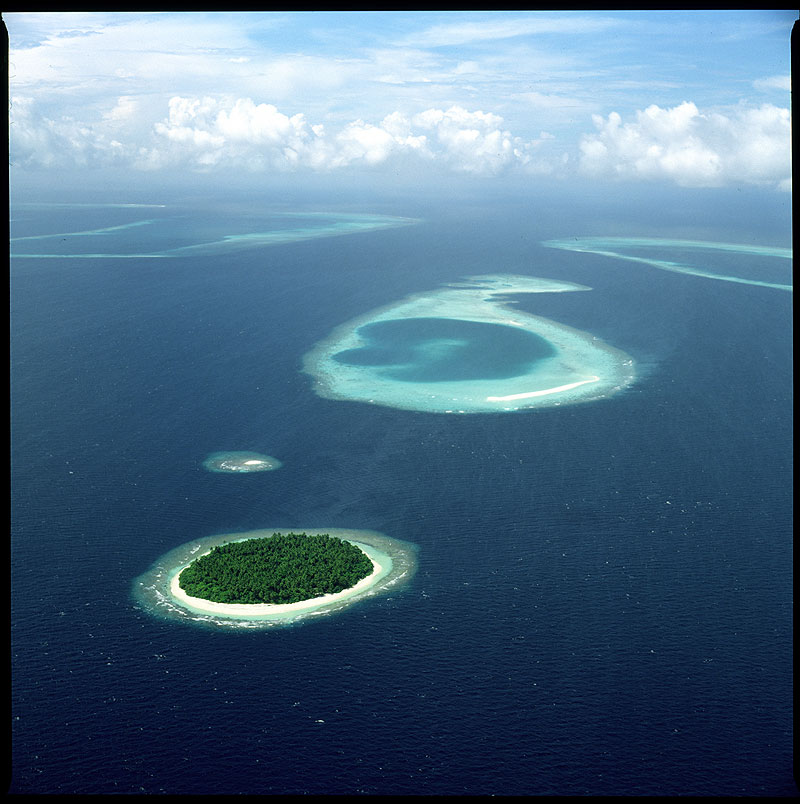
Coral Atolls are Now Blamed for Sea Level Rise

MUCH has been written of late regarding the impending demise of the world’s coral atolls due to sea level rise.Interestingly  in the Solomon Islands, the sea level rise has been blamed for salt water intrusion into the subsurface “lens” of fresh water under some atolls.

Beneath the surface of most atolls, there is a lens shaped body of fresh water which floats on the seawater underneath.The claim is that the rising sea levels are contaminating the fresh-water lens with seawater. These claims of blame ignore several facts. The first and most important fact, discovered by none other than Charles Darwin, is that coral atolls essentially “float” on the surface of the sea.

Atolls exist in a delicate balance between new sand and coral rubble being added from the reef, and sand and rubble being eroded by wind and wave back into the sea.When the sea falls, more sand tumbles from the high part, and more of the atoll is exposed to wind erosion. The atoll falls along with the sea level. When the sea level rises, wind erosion decreases. The coral grows up along with the sea level rise.

The flow of sand and rubble onto the atoll continues, and the atoll rises. Since atolls go up and down with the sea level as Darwin discovered, the idea that they will be buried by sea level rises is totally unfounded. They have gone through sea level rises much larger and much faster than the current one.

read more

Posted in BIODIVERSITY, Ecosystem, oceans | Tagged | 1 Comment

Japan Will Put Robot on Moon

Japan is considering putting a robot on the moon by 2020 and an astronaut by 2030, a report from a government office showed on Friday, amid fears that the country will be left behind in Asia’s space race.

The plans follow China’s first space walk and India’s launch of their first unmanned moon mission last year. Beijing officials have said that China is looking to eventually put astronauts on the moon, though the government has not revealed any schedule.

The robot and the astronaut would probe the moon to see how its resources could be used, the report showed.

Japan’s space program was in tatters in the late 1990s and early 2000s after unsuccessful rocket launches, but it successfully launched its first lunar explorer in 2007. It has sent six astronauts to space, all through international missions.

The Soviet Union, United States and China are the only countries that have put people in space with their own rockets.

Amid worries about a regional space race and North Korea’s nuclear and missile capabilities, Japan introduced a new space law last year that allows military use of space, ending a decades-old pacifist policy.

The law, which allows the military to launch its own satellites for spying and warn of missile launches but rules out offensive weapons in space, opened ways for the nation’s space industry to compete globally.

JAXA runs on an annual budget of 228 billion yen ($2.3 billion), just a fraction of NASA’s $17 billion annual spending.
source

Posted in Countries, News | 2 Comments

NASA Launches Telescope to Search for Earth Like Planents

NASA launched a pioneering telescope  to survey a corner of the galaxy in hopes of learning if other planets like Earth exist.The telescope, named Kepler, rode into a starry night sky aboard an unmanned Delta rocket that blasted off  from Cape Canaveral Air Force Station in Florida.

Once in position trailing Earth around the sun, Kepler will turn its gaze onto a patch of sky between the constellations Cygnus and Lyra that is filled with more than 4 million stars. Scientists plan to scrutinize Kepler’s observations of more than 100,000 targets in hopes of catching tiny blinks of light caused by passing planets.

“Trying to detect Jupiter-size planets crossing in front of their stars is like trying to measure the effect of a mosquito flying by a car’s headlight,” said Jim Fanson, Kepler project manager. “Finding Earth-sized planets is like trying to detect a very tiny flea.”

A planet the size of Earth that is about as far from its parent star as Earth is, will pass by Kepler’s view just once a year. Scientists say they’ll need to catch three transits to verify existence of an Earth-sized world.

source

Posted in News, Solar System | Leave a comment

Arctic summer ice could vanish by 2013

The Arctic is warming up so quickly that the region’s sea ice cover in summer could vanish as early as 2013, decades earlier than some had predicted, a leading polar expert said .Warwick Vincent, director of the Center for Northern Studies at Laval University in Quebec, said recent data on the ice cover “appear to be tracking the most pessimistic of the models”, which call for an ice free summer in 2013.The Arctic is warming at twice the rate of the rest of the world and the sea ice cover shrank to a record low in 2007 before growing slightly in 2008.

In 2004 a major international panel forecast the cover could vanish by 2100. Last December, some experts said the summer ice could go in the next 10 or 20 years.

If the ice cover disappears, it could have major consequences. Shipping companies are already musing about short cuts through the Arctic, which also contains enormous reserves of oil and natural gas.

Vincent’s scientific team has spent the last 10 summers on Ward Hunt Island, a remote spot some 2,500 miles northwest of Ottawa.

“We’re losing, irreversibly, major features of the Canadian ice scape and that suggests that these more pessimistic models are really much closer to reality.”

In 2008 the maximum summer temperature on Ward Hunt hit 20 degrees Celsius (68 degrees Fahrenheit) compared to the usual 5 degrees. Last summer alone the five ice shelves along Ellesmere Island in Canada’s Far North, which are more than 4,000 years old, shrunk by 23 percent.
source

Posted in climate change, Global Warming | Leave a comment