


Total Visitors
- 5,613,294
Search Inside
My You Tube Channel
-
Visitors on The Site

-
Join 6,676 other subscribers
Fill This Form to Contact Me
Top Posts & Pages
- Waste to Energy in India
- About Me and This Site
- Physical Divisions of North America: An Overview
- Levant: The Term, The Region and Cities
- Discontinuities Inside the Earth
- Gond Tribe of India
- Book Reviews
- Penck’s Theory of Landform Development and the Concept of Time
- The Structure of the Ocean Floor(Ocean Topography)
- Migration Theories : Lee’s Push Pull Theory
Being Social
Pages
- Article Submission
- Basics of Geography
- Book Reviews
- Disaster Management
- Field Training and Tour
- Geography Notes
- Geography of Tourism
- Geography Study Material for NTA-NET & IAS Exams
- Geomorphology
- Geomorphology Class Black Board
- Hindi Posts
- Human Geography
- My Projects
- New UGC NET Syllabus-Geography
- Online Class
- Posts on Geography Practicals and Statistical Techniques
- Regional Studies
- Settlement Geography
- Social Geography
- Urban Agro Systems
- Urban Systems
- Useful Links
- Water Resources
- About Me and This Site
Blogroll
Digital Blackboards
My Pages
Other Sites I Am Involved With
Recommended Links
Useful Links
Bioversity International tells us what’s important about the genetic diversity of trees. It’s worth reading that article. It taught me a lot.
The United Nations names yesterday, 21st March, the International Day of Forests. It names today, 22nd March, World Water Day. I wish these two important dates weren’t on consecutive days.
Posted in Uncategorized
Leave a comment
Large biotech agribusinesses like Monsanto control much of the global seed market with genetically modified (GM) crops. This centralization of GM seeds threatens food safety, food security, biodiversity, and democratic ideals.
Question: Would you want a small handful of government officials controlling America’s entire food supply, all its seeds and harvests?I suspect most would scream, “No way!”
Yet, while America seems allergic to public servants – with no profit motive in mind – controlling anything these days, a knee-jerk faith in the “free market” has led to overwhelming centralized control of nearly all our food stuffs, from farm to fork.
The Obama administration’s recent decision to radically expand genetically modified (GM) food – approving unrestricted production of agribusiness biotech company Monsanto’s “Roundup Ready” alfalfa and sugar beets – marks a profound deepening of this centralization of food production in the hands of just a few corporations, with little…
View original post 880 more words
Posted in Uncategorized
1 Comment
Some Best Highways of the World
From the beginning of civilization, the need for public interconnecting roads became evident for the speediness of communication and national defense. With the creation of advanced technology, paved roads combined with other tactics created the most proficient roadways to better serve travelers. Sometimes these roads are shortcut to hell which takes away life.
Some roads have been around for centuries whereas others are known for their specific engineering characteristics. From longest to busiest to deadliest, here are the most remarkable roadways ever built.
German Autobahns
 Known as the fastest highway in the world, the German Autobahn is a motorway specifically for cars. Bicycles, mopeds, pedestrians or any other means of transportation that is unable to go faster than 38 mph, or 60 kph, are prohibited from entering.
As the nationally coordinated motorway for Germany, it is called Bundesautobahn (BAB), which translates to the federal way for cars. Although 52 percent of BAB doesn’t have a speed limit, it is recommended to travel at a limit of 81 mph, or 130 kph. Other areas of the German motorway are subject to driving conditions.15 percent have speed limits depending on weather or traffic conditions.
Due to the high speeds of most of the vehicles traveling on the autobahn, it is illegal to stop unnecessarily on the motorway and this includes running out of fuel.
James Dalton Highway (Alaska)

The James Dalton Highway is a 414 mile gravel road. It heads straight north from the Livengood turnoff of the Elliott Highway, through arctic tundra to the farthest north reaches of Alaska. Alyeska built the 360 mile haul road, now known as the Dalton Highway, from the Yukon River to Prudhoe Bay, for $150 million to supply the oil facilities on the North Slope. The pipeline bridge across the 1,875 mile Yukon River is the only span across that river in Alaska.
It is still the main supply route for the Prudhoe Bay oilfields, and you will be sharing the road with large tractor trailers. Windshields and headlights are easy targets of flying rocks. Most rental companies will not allow you to drive their cars on the Dalton. Trucks speeding along the slippery gravel track kick up thick clouds of dust or mud, reducing visibility to absolute zero; potholes take a heavy toll on cars and services, gas, and repairs are practically nonexistent.
The Big Dig

Boston’s Big Dig was an idea estimated to cost $2.8 billion in 1985 and substantially soared to $14.8 billion, making it the most expensive highway project ever undertaken in history.
Beginning in 1991, construction for the Big Dig led to the fatal injuries of four workers and death of a motorist from the collapse of a concrete panel. The expressway system was completed in 2007.
Yungas Road
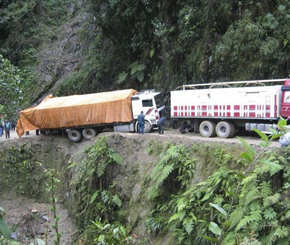
Less than 50 miles long and barely ten feet wide, Bolivia’s Yungas Road kills an estimated 200 to 300 travelers each year.
Traveling along the Andes Mountain, the road leads from the city of La Pez to the Yungas region and was deemed the most dangerous road in the world by the Inter American Development Bank in 1995.
Pan American

Since 1923, plans were in the making of building a highway from Alaska to Chile.The Pan American Highway is the long est highway system covering roughly 16,000 miles. It runs through 16 countries, including the U.S., Mexico, Canada, Costa Rica and Peru.
Highway 401

Highway 401, also known as the Macdonald Cartier Freeway, is the busiest highway in North America with 420,000 vehicles visiting some parts of the highway daily.
Since its completion in the 1960s, the highway serves travelers in the southern, central and eastern parts of Ontario, Canada.
The Katy Freeway

With 26 lanes in certain parts, the Katy Freeway, or Interstate 10, is the widest highway in the world. It serves more than 219,000 vehicles daily. Originally constructed in the 1960s, Interstate 10 expands across a 23 mile stretch from its intersection with Interstate 610 to the city of Katy in Texas.
The Karakoram Highway
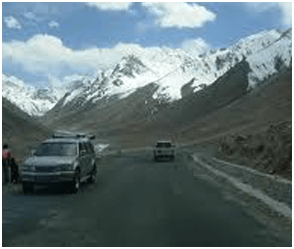
The Karakoram Highway is the highest paved highway in the world at 16,000 feet and running through three mountain regions: the Himalayas, Karakorams, and Pamirs. The Indus River also runs through some parts of the road.
Extending 500 miles, the highway connects the Xinjiang region of China with Islamabad, the capital of Pakistan. In 1963, Pakistan and China signed a borders agreement to construct a road that would mutually benefit the two countries. In 1986, the Karakoram Highway officially opened to travelers and connected China with central Asian countries.
Hong Kong’s Tuen Mun Road
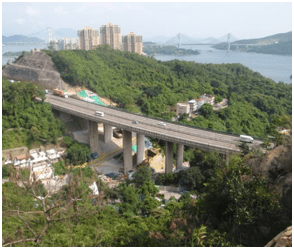
Hong Kong’s Tuen Mun Road is known for its high volume of accidents with the culprit bei ng a ghost. Built in 1977 to connect China regions Tuen Mon and Tsuen Wan, the high speed roadway is believed by some to be haunted by ghosts causing accidents.
The Guoliang Tunnel
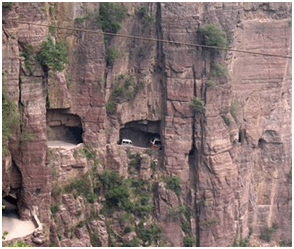
In China’s Taihang Mountains, there is a 4,000 feet long road called the Guoliang Tunnel that was built by the villagers themselves.
In 1972, 13 villagers began the project to carve a road along the side of a mountain in order to link their village to the outside world. On May 1, 1977, the road was opened for travelers.
Source :Siliconindia
Related articles
- 5 of the World’s Most Dangerous Roads to Drive On (cars-10.com)
- Truck Lifted on Autobahn by Mysterious Light (goldenageofgaia.com)
- The Top 10 Most Dangerous Roads in the World (americanlivewire.com)
- About 20 vehicles involved in Highway 401 pileup (cp24.com)
Posted in Roads andHighways
3 Comments


