Political Control of Sanitation in India

JC Martel's avatarOn the rapid urbanization of Asian cities and built environment in the U.S.

Between 30-60% of India’s population use facilities for defecation, with most sanitation infrastructure development occurring over the past two decades. Sanitation is the responsibility of the states under India’s Constitution. Yet political activity for sanitation is observed in each governmental role – prime minister, president, supreme court, state legislatures, congress, and bureaucracy. Recently, the Indian Prime Minister Narendra Modi who was elected into office in May 2014 has been utilizing a political campaign for “Not temples, but toilets” during and continuing after his election. In a recent Times of India news article, Congress reportedly critiqued Prime Minister Modi for claiming sanitation improvements as his own political agenda, while failing to recognize the momentum for sanitation that other political institutions had created. Does it matter which political institutions are supporting sanitation? How does authority over sanitation differ among government roles? Finally, how do elected officials control implementation by non-elected government officials?

View original post

Posted in Uncategorized | Leave a comment

Africans shaped India’s History and Ruled !!(link)

There was a time in India’s history when being African was no taboo and they mingled in the society and in fact, played a crucial role in India’s history. Some Africans at one point of time were part of India’s ruling elite. The story of Yakut in Razia’s court is not a lone one.

Here are some notable examples.

The journey of Africans to India was itself incredible: bought and brought by Arab slave traders, they were packed into hell ships that came to India via the Indian Ocean and its surrounding seas. They were bought by kings, princes, rich merchants and aristocrats and were referred to as habshis. But not all remained slaves. Some like Yakut did make their own destiny. But while Yakut’s was perhaps a story that didn’t end too well, others set examples worth emulating.

Malik Kafur’s is an interesting case. The transgender slave was bought by Sultan Alauddin Khilji’s general Nusrat Khan for a thousand dinars. Kafur caught the fancy of the sultan and rose through the ranks, becoming his deputy and entering the history books as Nawab Hazar Dinari. In his last days, an enfeebled Khilji was at the mercy of Kafur who effectively ruled Delhi and also played kingmaker after the sultan’s death.

In the Deccan, Africans were making an impact on the political landscape. The small states of the Bahmani kingdom resisted the expansion of the Mughal Empire to the south. One of the pillars of this resistance was Malik Ambar, the prime minister and general of Ahmadnagar  who was an African by origin. Ambar is believed to be the father of guerrilla warfare in India since he used his Maratha cavalry against the Mughals with great effect.

The Bijapur state had a powerful group of habshi nobles led by Ikhlas Khan, a powerful general.

Some Africans also get to set up independent kingdoms, like the Siddis of Janjira. The Janjira state and its successor state of Sachin survived until Independence.

Read at Source

Posted in Human Geography, India, Links, opinions | Tagged , , , , | Leave a comment

Crypto-geographies and the Internet of Things

Jeremy's avatarOpen Geography

Secret codes have long fascinated people. According to Secret History, a new history of cryptology by Craig Bauer, who was Scholar-In-Residence at the NSA Center for Cryptologic History in 2011-12, cryptography predates the Greeks. Many of these ciphers were relatively simple by today’s standards, involving either transposition or substitution (respectively systems where the letters are moved but not replaced, and where the letters are replaced, eg., A is replaced by Z, etc).

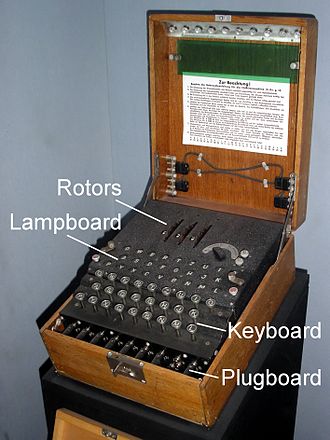
The now fairly well-known Enigma machine, deciphered by British scientists at Bletchley Park (and the subject of many books and a couple of movies) is pictured above. This was a German system of ciphering, used by the German Nazi regime during WWII. Less well-known (but undeservedly so) are the decryptions by the NSA and its predecessor group (The US Army Signals Intelligence Service located at Arlington Hall, a former girl’s school in Virginia) of the so-called Venona…

View original post 1,694 more words

Posted in Uncategorized | 1 Comment

Internet Marketing in Africa

Guest Post by Vishal Agarwal

The freedom in mobile technology and internet access has conceived the flawless storm for an outburst in activities and internet marketing in Africa. The internet has become a crucial platform to generate self-employment for the youths (fresh graduates) and the unemployed, and this is due to an increase of interest in improved infrastructure and internet marketing. High usage of internet by companies, individuals and governments in Africa have generated the need of internet marketers who can create income in the coming years for themselves and others also.

Due to the development in infrastructure and the arrival of wireless technologies has played an important role in the growth of Africa’s Broadband and internet sector. Africa is the world’s quickest growing market for wireless mobiles. This drastic development has created vast associations for internet marketers all over the world.

Uptake of Internet technology in Africa:

Internet technologies have enhanced exponentially the livelihoods around the world, and now the same is to happen in Africa. The rapid growth of internet related technologies in Africa can be known through a few reports generated by the United Nations and the International Telecommunications Union. Access to mobile services is the main reason for the development of internet marketing in Africa. Moreover, the arrival of 3G services has made it easy to share the African content over the world. In addition to this, Africa has made many other ways connect with the world which includes the famed undersea optic fiber cable, Mobile Money, satellite connections and much more to be added in this growing list.

Now that all the communication systems are being related to the internet, the African government is mainly focusing on the development of internet infrastructure technology. Affordable handsets brands with internet facilities are being imported from China in order to increase the use of internet technology. Many companies like Telco, Ecoweb, ZOL, Broadlands, Webtech, YoAfrica, Powertel and IwayAfrica etc. have started their internet services over there.

The future of Internet:

This drastic increase in the internet services is going to play an important role in the field of internet marketing in Africa. Currently, the public searches in Africa are related to the academic subjects, employment opportunities abroad, etc. In near future, these search activities are expected to be made on LOCAL BUSINESS and LOCAL INFORMATION.

There are very few websites where you can find the local information about African states. The information provided are no longer working or available as of now. This shows that many of the online sites are not updating their contents related to their nation. Still internet marketing in Africa has to surpass many challenges to get stable in the world. To reach a state of stability, the continent has high hopes on e-business, e-everything, e-commerce and e-governance.

The way to overcome this is to share, connect and network online. Every responsible citizen has to build their databanks of information and try to share the information throughout the world. Data bank builup is a bit easy to do, as there is a growing market of internet in Africa.

Posted in Africa, Guest Post, Internet, inventions | Tagged | Leave a comment