Mecca Masjid, is one of the oldest mosques in Hyderabad, Telangana in India, and it is one of the largest masjids in India. Makkah Masjid is a listed heritage building in the old city of Hyderabad, close to the historic landmarks of Chowmahalla Palace, Laad Bazaar, and Charminar.
Muhammad Quli Qutb Shah, the fifth ruler of the Qutb Shahi dynasty, commissioned bricks to be made from the soil brought from Mecca, the holiest site of Islam, and used them in the construction of the central arch of the mosque, thus giving the mosque its name. It formed the centerpiece around which the city was planned by Muhammad Quli Qutub Shah
On the edge of the pond for wudu are two stone and slab benches, whoever sits on them, according to legend, returns to sit on them
A room in the courtyard is believed to house a hair of Prophet Muhammed (PBUH).
A trend is a change or development towards something new or different.
A pattern is the repeated or regular way in which something happens or is done.It is an arrangement of lines or shapes, especially a design in which the same shape is repeated at regular intervals over a surface.
Global Trends of Urbanisation
More than half of the world’s population lives in urban areas. Due to the ongoing urbanisation and growth of the world’s population, there will be about 2.5 billion more people added to the urban population by 2050, mainly in Africa and Asia.Asian cities are growing very fast. Many are the fastest growing cities are found in the continent. In India , interestingly Tier II cities have a faster growing rate.The world’s urban areas are highly varied, but many cities and towns are facing problems such as a lack of jobs, homelessness and expanding squatter settlements, inadequate services and infrastructure, poor health and educational services and high levels of pollution.
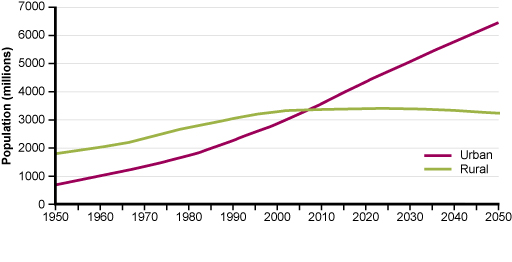
In 1960, the global urban population was 34% of the total; however, by 2014 the urban population accounted for 54% of the total and continues to grow. By 2050 the proportion living in urban areas is expected to reach 66% (UNDESA, 2014). Figure 5.1 shows the change in the rural and urban populations of the world from 1950 through to projected figures up to the year 2050.
Urban and rural population of the world, 1950–2050. (UNDESA, 2014)
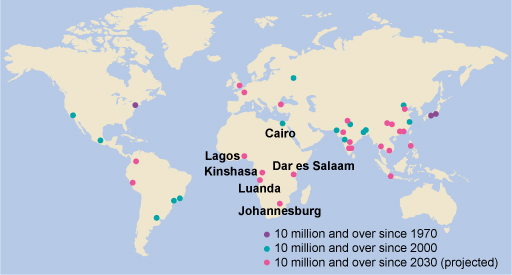
The process of urbanisation affects all sizes of settlements, so villages gradually grow to become small towns, smaller towns become larger towns, and large towns become cities. This succession of settlements with growing diversification of economy. has led to the growth of mega-cities. A mega-city is an urban area of greater than ten million people. Rapid expansion of city borders, driven by increases in population and infrastructure development, leads to the expansion of city borders that spread out and swallow up neighbouring urban areas to form mega-cities. In 1970, there were only three mega-cities across the globe, but by the year 2000, the number had risen to 17 and by 2030, 24 more mega-cities will be added .
The top mega-cities in the world in 1970, 2000 and 2030. (UNDESA, 2014
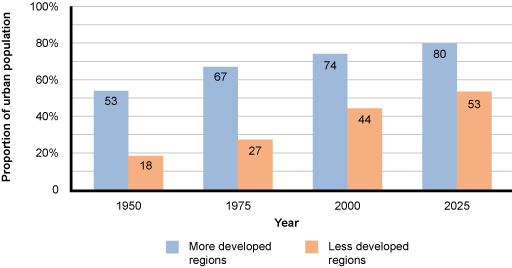
The global trend in urbanisation is not the same in all parts of the world. Asia and Africa currently have the highest rates of urbanisation. Figure 5.3 shows a comparison of trends in more or less developed regions of the world.
Trends in urban population growth, comparing more and less developed regions. The graph shows the proportion of the total population living in urban areas.
Global Pattens of Urbanisation
The world passed a landmark statistic sometime in 2014, when it was estimated that for the first time in human history over 50% of the world’s population was living in urban areas. What is happening to where we live, and why?
For urbanisation to happen, people need to move into cities rather than be born in them. The end result is a growth in the size of urban spaces, which could also be called ‘built environments’.
A Discussion in Urban Geography Class
Urban populations grow as a result of:
Rural-urban migration (voluntary): urban ‘Pull factors’ predominate as people anticipate an improved quality of life in a city together with enhanced future prospects for themselves and their family.
Rural-urban migration (forced): rural ‘Push factors’ predominate as a result of environmental pressures in rural areas (floods/drought), food shortages and/or political conflict . More directly, government policy of moving rural inhabitants to cities may take any choice away from the migration. China’s bureaucratic relocation involved in the ‘National New-type Urbanisation Plan 2014-2020’ foresees moving over 260m people to cities in an attempt to modernise social and economic systems – an easier prospect when people are gathered rather than dispersed.
Assimilation: as urban areas expand they may incorporate nearby smaller towns and villages into expansive conurbations. The term ‘urban sprawl’ denotes the rapid spatial expansion of an urban area that is likely to surround and incorporate previously separate settlements.
Rapid suburbanisation took place as mass-housebuilding occurred in the decade after the Second World War. Rebuilding bomb-damaged cities and providing higher quality housing became a priority for the Labour government after 1945, and continued through successive governments. In order to prevent urban sprawl that had been a feature of the 1930s, much development was focused on the New Town programme (Milton Keynes, Telford etc.) and designating Green Belt land around major cities to, among other priorities, prevent cities merging into unbroken urban development.
Global patterns or urbanisation
North America, Europe and Oceania underwent their fastest urbanisation rates well before 1945 – in the 19th century. South and central America urbanised rapidly during the 1960s-80s, while the industrialisation and economic ‘take-off’ of many Asian countries in the 1980s to the present day (and continuing) has been accompanied by rapid urbanisation. This is likely to continue into the coming decades as economic growth continues and while there are still so many potential urban migrants living in rural areas. The continent that is presently starting to see rapid urbanisation occurring is Africa, with cities such as: Dar es Salaam (Tanzania) due to grow by 85% between 2010-2025; Nairobi (Kenya, 77%); Kinshasa (DRC, 72%) and the continent’s largest city – Lagos (Nigeria, 50%).
Megacities are defined by their size (over 10m inhabitants) rather than their global significance. It may be one city (metropolitan area) such as Cairo, Egypt or a merging of a number of cities into a continuous built-up area (Tokyo-Yokohama, Japan).
They have doubled over the past two decades, from 14 in 1995 to 29 in 2016.
Their development is more likely where rapid economic growth is concentrated in a limited number of locations within a country. Mass rural-urban migration tends to be focused on these core urban areas rather than dispersed between a wider set of optional cities that migrants may select from, with different decisions made.
Megacities can benefit from more efficient infrastructure, such as mass transport systems and economically with both horizontal and vertical industrial integration. However, urban problems may be magnified in megacities (congestion, waste disposal, air pollution, lack of housing) and prove more problematic to solve.
Megacities are frequently major global hubs of manufacturing and export (Shenzhen, China and Delhi, India) in which goods are produced efficiently and at low cost and exported to the major world markets. They are also key markets, themselves for basic raw materials, components and energy resources.
Can developing countries create mega cities that are fit to live in? If you want to know more, you can check this video via AJ+ that explains The Megacities of 2050
World cities:
These are cities that have particular influence on global economic, cultural and political systems. They may be megacities (New York, Tokyo) but aren’t necessarily (London, Moscow, Paris, Berlin). They are seen to function as global hubs.
Key global financial networks are influenced by their concentration of major banks and commercial HQs, stock markets and politico-economic influence and include New York, London and Tokyo. Decisions taken there have global significance.
World cities may display the full range of key influences, or be distinctive for their dominance in certain ones rather than others (Paris: culture, fashion, art and media).
Many of the fastest developing cities in Asia combine a number of economic functions but are dominated by the service economy. Hyderabad, in India, is fast becoming an economic hub dominating the tertiary and quaternary sector in India. As well as being the financial and economic capital of the state of Telangana it is experiencing rapid growth as a city of Information Technology. Its call centres employ many university graduates who are in surplus to jobs available, the highest qualified of whom have led to it hosting major firms such as IBM, Dell, Oracle and General Electric. The city is aiming to become they key location for the Microsoft Development Centre in India and a prestige township development- HITEC City – has attracted a number of start-up IT and IT Enabled Services (ITES) allowing remote working.
Slums
UN-HABITAT defines a slum household as a group of individuals living under the same roof in an urban area who lack one or more of the following:
1. Durable housing of a permanent nature that protects against extreme climate conditions.
2. Sufficient living space which means not more than three people sharing the same room.
3. Easy access to safe water in sufficient amounts at an affordable price.
4. Access to adequate sanitation in the form of a private or public toilet shared by a reasonable number of people.
5. Security of tenure that prevents forced evictions.
Not all slums are homogeneous and not all slum dwellers suffer from the same degree of deprivation. The degree of deprivation depends on how many of the five conditions that define slums are prevalent within a slum household. UN-HABITAT analyses show that Sub-Saharan Africa’s slums are the most deprived; over 80 per cent of the region’s slum households have one or two shelter deprivations, but almost half suffer from at least two shelter deprivations.
Urbanism is the new way of life. Our world is turning into a big urban realm. The first urban settlements are thought to have started around 3500 BC in lower Mesopotamia around the Tigris and Euphrates. First was Ur, which from 2300 BC to 2180 BC was the capital city of the Sumerian Kingdom, extending north along the Fertile Crescent, possibly as far as the Mediterranean. Diversification of economy led to growth of cities.
Since then cities continue to grow because people believe that the benefits of urban life outweigh the liabilities associated with living in a densely populated place. Cities grow so fast because they are efficient. They grow layer by layer. Clearly, the primary benefit of clustering populations is the efficiencies gained by serving a large economic market concentrated in a relatively small area. When businesses serve large numbers of people clustered in a relatively small area, they are able to achieve advantageous economies of scale. They also get benefit of agglomeration. In Contrast, when businesses must accommodate a much larger service area in order to achieve a minimum demand threshold, they incur greater operational transportation costs.
In addition to making it easier to achieve positive economies of scales, urban areas provide markets that are large enough to encourage and justify specialization. Generally, the level of specialization in an area is a function of the size of the market.
For cities to function, they must have internal and external linkages (streets, roads, docks, highways, telephone and internet service, and public transportation facilities) that allow for an efficient flow of goods, services, and information. Internal infrastructure of city and road design play an important role in safety in city. Normally larger cities accommodate larger complexes of specialized activities. Sometimes, cities grow at a rate that overwhelms their transportation/communication systems. In such circumstances, city officials must dedicate resources to improving connectivity and accessibility or accept the limits imposed by an obsolete circulation system. This is often a particularly vexing problem in older large urban centers such as London or Amsterdam where ancient transportation networks and infrastructure cannot efficiently handle the demands of growing populations and markets. Therefore, the more efficient the communication system, the more likely it is that an urban area will grow.
The layout of cities evolved development of transport. The land-use of the city change with changing layout.It changed with the changing mode of transport.
Despite the capability of cyber-space technology to reduce the importance of distance, it is still necessary for people to travel to urban centers for extremely specialized products and services. City layout is often a result of distribution of services and availability of goods as evident by city layout theories such as Concentric Zone Model of Burgess. Von Thunen based his model on transportation cost. The city can develop around many nuclei as shown in multiple nuclei model.Many who live in relatively isolated places are able to make on-line purchases that bring most of the necessities of life to their doorsteps, in order to undergo major surgery, they normally must travel to an urban medical center. Additionally, although airline tickets can now be purchased online, travelers must go to a central airport to catch a flight. Of course these are only two examples of the many essential functions of urban places. Therefore, distance still matters.
Furthermore, even though people can order much of what they need by telephone or by way of the internet, resources, labor, capital and management must come together in order to manufacture, package, and process consumer products.
One aspect is of city coming to villages by diversification, by sprawl or more naturally by urban expansion.Today the possibility of the migrant’s return to the old village should be whole heartedly discouraged . No one should be allowed to live a life that is an annual contribution to the national statistics on starvation, infant mortality, disease , and suicide. But the possibility of never leaving a village that is transforming into a new town raises the prospects of a better life. It is a task wholly imaginative and without the prescription of tested models. Cities designed explicitly for the rural areas is not just a good idea for the poor, but can act as a game changer for the self-centered ugliness created in the metros by the middle-class.