


Total Visitors
- 5,595,380
Search Inside
My You Tube Channel
-
Visitors on The Site

-
Join 6,678 other subscribers
Fill This Form to Contact Me
Top Posts & Pages
- Waste to Energy in India
- About Me and This Site
- Migration Theories : Lee’s Push Pull Theory
- Levant: The Term, The Region and Cities
- Gond Tribe of India
- Discontinuities Inside the Earth
- Santhal:Largest Tribal Community in India
- Gujjar Tribe
- Social Processes: Concept, Types and Salient Features
- Geography Study Material for NTA-NET & IAS Exams
Being Social
Pages
- Article Submission
- Basics of Geography
- Book Reviews
- Disaster Management
- Field Training and Tour
- Geography Notes
- Geography of Tourism
- Geography Study Material for NTA-NET & IAS Exams
- Geomorphology
- Geomorphology Class Black Board
- Hindi Posts
- Human Geography
- My Projects
- New UGC NET Syllabus-Geography
- Online Class
- Posts on Geography Practicals and Statistical Techniques
- Regional Studies
- Settlement Geography
- Social Geography
- Urban Agro Systems
- Urban Systems
- Useful Links
- Water Resources
- About Me and This Site
Blogroll
Digital Blackboards
My Pages
Other Sites I Am Involved With
Recommended Links
Useful Links
You Be First
Holding grudges can consume and impede you from growing and being a happy person. Focus your time and energy on letting go of the things and the people that are hindering you from being happy! Be the first, to forgive, to forget and move on! You have to be the first to be happy!
Posted in earth
Leave a comment
Geography’s Perspectives: A Matrix
Geography’s relevance to science and society arises from a distinctive and integrating set of perspectives through which geographers view the world around them.
Taking time to understand geography’s perspectives is important because geography can be difficult to place within the family of academic disciplines. Just as all phenomena exist in time and thus have a history, they also exist in space and have a geography. Geography and history are therefore central to understanding our world and have been identified as core subjects . Clearly, this kind of focus tends to cut across the boundaries of other natural and social science disciplines. Consequently, geography is sometimes viewed by those unfamiliar with the discipline as a collection of disparate specialties with no central core or coherence.
What holds most disciplines together, however, is a distinctive and coherent set of perspectives through which the world is analyzed. Like other academic disciplines, geography has a well-developed set of perspectives:
- geography’s way of looking at the world through the lenses of place, space, and scale;
- geography’s domains of synthesis: environmental-societal dynamics relating human action to the physical environment, environmental dynamics linking physical systems, and human-societal dynamics linking economic, social, and political systems; and
- spatial representation using visual, verbal, mathematical, digital, and cognitive approaches.
These three perspectives can be represented as dimensions of a matrix of geographic inquiry as shown in Figure .
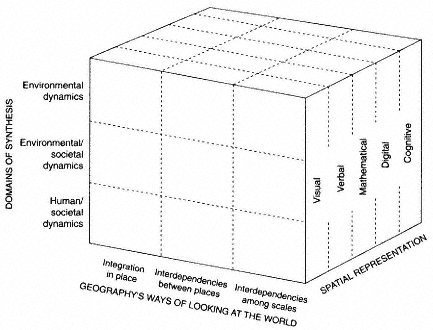
The matrix of geographic perspectives. Geography’s ways of looking at the world—through its:
- focus on place and scale (horizontal axis)—cuts across its three domains of synthesis:
- human-societal dynamics, environmental dynamics, and environmental-societal dynamics (vertical axis).
- Spatial representation, the third dimension of the matrix, underpins, and sometimes drives research in other branches of geography.
Source:
Posted in opinions
Leave a comment
Our rich and diverse urban flora: an exciting study from Paris
Results of an exciting new study, focusing on the flora of the Paris area have been published. The aim of the study was to better understand the “filters” that allow some species to establish successfully in our cities (while other plant species may fail to establish). These filters can be environmental (cities pose challenges such as high temperatures, dry and impervious soils…) or biological (species that are already there offer stark competition).
The Ile-de-France region, surrounding the city of Paris comprises around 50% of agricultural land, 24% of forests, 16% of built land (including housing, industrial areas, quarries, worksites and transport).
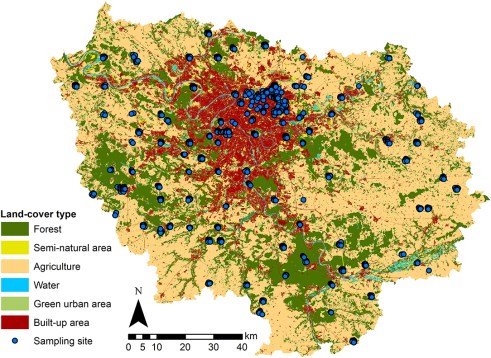
In this paper, researchers used records collected by citizen scientists, part of the Vigie Flore program, with 620 plots (10 m²) surveyed between 2009 and 2017.
They chose to study a unique measure called “species originality“. The idea is that a species is “original” if…
View original post 480 more words
Posted in earth
Leave a comment


