
Total Visitors
- 5,464,778
Search Inside
My You Tube Channel
-
Visitors on The Site

-
Join 783 other subscribers
Fill This Form to Contact Me
Top Posts & Pages
- Waste to Energy in India
- About Me and This Site
- Migration Theories : Lee’s Push Pull Theory
- Discontinuities Inside the Earth
- Gond Tribe of India
- Physical Divisions of North America: An Overview
- The Structure of the Ocean Floor(Ocean Topography)
- Levant: The Term, The Region and Cities
- Santhal:Largest Tribal Community in India
- Geography Study Material for NTA-NET & IAS Exams
Being Social
Pages
- Article Submission
- Basics of Geography
- Book Reviews
- Disaster Management
- Field Training and Tour
- Geography Notes
- Geography of Tourism
- Geography Study Material for NTA-NET & IAS Exams
- Geomorphology
- Geomorphology Class Black Board
- Hindi Posts
- Human Geography
- My Projects
- New UGC NET Syllabus-Geography
- Online Class
- Posts on Geography Practicals and Statistical Techniques
- Regional Studies
- Settlement Geography
- Social Geography
- Urban Agro Systems
- Urban Systems
- Useful Links
- Water Resources
- About Me and This Site
Blogroll
Digital Blackboards
My Pages
Other Sites I Am Involved With
Recommended Links
Useful Links
COVID-19: A Battle for Human Survival, Increasing Food Insecurity and Poverty
Guest Post by Sanober Naheed
Food Security is a complex issue and has been a major concern for human populations struggle against hunger and malnutrition. Diseases and plagues have been divine scourges of inadvertent magnitudes to correct a nation of heretics as believers put it and skeptics deny.
As the world is struggling to contain the coronavirus, there have been speculations among the economic circles on the enormity of the damage caused to the global economy, food security and efforts to reduce poverty. The economic impacts resulting from earlier viral outbreaks of SARS, avian flu and MERS, which had caused direct damage to livestock sectors, eventually leading to food shortages and food price hikes in affected areas. In the present situation, no such major food shortages have occurred, but there have been reports of panic buying from several European countries, which again needs to be modified in a sustained manner in order not to hoard extra food to be discarded later.
The total shutdown of entire cities and regions to contain the spread of the virus has put a halt on economic activity, quarantining workers and idling factories and many services and many service activities. In an unprecedented move, the IMF and World Bank have decided not to hold their spring meetings virtually to avoid a large gathering of people and the spread of the virus. Going by the Organization of Economic Cooperation and Development (OECD) projection under the worst-case scenario, global growth could be cut in half, to 1.5% in 2020.
Already a food price hike and market panic is evident globally, which will further jeopardize food security. In an urban age, with higher population densities and hence greater risk of a person to person transmission, it is likely that the economic activity is being directly affected by social distancing efforts to contain the COVID-19. From this economic slow down it is expected to pose a major risk for food security and a tangible increase in the number of people living in poverty. Based on International Food Policy Research Institute’s (IFPRI) global model which has calculated that for 1% of economic slowdown the number of people living in poverty and also in food insecurity would increase by 2% or by about 4 million worldwide and affecting 9 million people living in rural areas of developing countries.
It is being considered too early to jump to such conclusions, to believe that the virus will have major direct impacts on the supply of staple foods. Yet they have sounded caution with regard to food security. The implications of such a slowdown for poverty and food insecurity depend on the assumptions made about the duration of the pandemic and transmission mechanisms.
Overall 1% lower growth in the world economy would translate into a global increase in the extreme poverty rate of between 1.6% to 3%. IFPRI analysis puts forth that the greatest regional poverty impact would fall on Africa south of the Sahara, where 40-50% of global poverty increase would be concentrated. The impact of a trade shock would affect Africa’s poor more than those in South Asia. Africa’s economy are on average more dependent on trade than those of South Asia’s, having a large but closed economy. The productivity shocks, in contrast, would be a bigger impact on poverty in S.Asia than Africa, because of the adverse impact in the Scenario on non-agricultural sectors, which have a larger weight in South Asian economies (IFPRI March 2020).
Global food security already faces challenges
Many countries around the world are in the grip of hunger and malnutrition, for the past three years due to conflicts and the refugee crisis, climate change, and worsening inequality, with the Middle East and Sub-Saharan regions being particularly vulnerable. According to the United Nations Food and Agriculture Organization (FAO), more than 820 million people across the globe are already suffering from hunger, close to 150 million children in countries around the world are stunted because of a lack of proper nutrition. COVID-19 is a health crisis. If proper measures are not in place it may unfold a bigger crisis in the form of food security.
Need to learn from previous epidemics
The SARS and MERS outbreaks had relatively little impact on the economy and food and nutrition security of China, including Hong Kong and Taiwan, largely due to the country’s resilience and ability to cope with emergencies. Countries such as Singapore, Vietnam, and Canada, too, showed such resilience, because they have enough food reserves and boast of vibrant value chains linking the domestic and international markets.
But Ebola had a huge impact on the economies of some African countries’ agricultural production, marketing, and trade. On the production side, due to road blockages, farmers had limited access to inputs such as seeds, fertilizers, and insecticides. And many of the regions faced acute labor shortages.
All this resulted in more than 40 percent of the agricultural land not being cultivated. As for marketing, farmers could not transport fresh produce to local and urban markets. In addition, day meal programs in schools were disrupted because food aid could not be delivered to the schools. And trade was disrupted as international shipping services were either delayed or canceled because crew members of cargo vessels refused to travel to those countries for fear of being infected.
Food prices will shoot up if nations panic again
The 2008 food price crisis, too, taught us a valuable lesson. The crisis was caused by droughts in Australia and Argentina, increasing oil prices, rising use of food grains for biofuel production and trade policy failures. These prompted many countries to impose various export policies to restrict the export of food products.
For example, there was no shortage of rice supply, but due to panic behavior, many countries imposed higher taxes on rice exports or banned rice exports altogether. Rice prices doubled in the global market in six months, causing severe disruptions in rice trade leading to a food price crisis. If countries panic this time too, food trade and markets could be disrupted, albeit on a much larger scale.
The sharp rise in food prices was mainly caused by a combination of reduced cereal stocks, increased demand and the rising price of oil, increasing the cost of fertilizer and stimulating the production of biofuels in the US. By 2008, the number of hungry people in the world had increased to over 1 billion, up from 850 million in early 2007. Populations already affected by the crisis were the hardest hit. While globally the price of cereals had decreased, it remained high in many of these countries.
Governments around the world need to consider the scale and impact of the global food crisis on vulnerable populations, particularly city-dwellers – a neglected group in humanitarian response –subsistence farmers and pastoralists. Previous experience has shown how affected people reduced their food intake, changed their diet and reduced expenditure on basic goods such as health care and education, in some countries, migration, child labor and asset sales increased.
Conclusion
The COVID- 19 pandemic brings with it the third and greatest economic, financial and social shock of the 21st Century, after 9/11 and the Global Financial Crisis of 2008. This shock brings a halt in production in affected countries, hitting supply chains across the world, and a steep drop in consumption together with a collapse in confidence. The various measures being taken based on observations, although essential to contain the virus are pushing the economy further from where revival will be a daunting task.
The most urgent priority is to minimize the loss of life and health. The disruptions associated with the COVID-19 virus and the various responses to this pandemic are far more likely to adversely affect the poor and other marginalized groups with less power and resources to adapt to unpredictable crisis events. Not only will vulnerable populations and communities have greater difficulty accessing enough food for survival and adequate nutrition, but many also depend upon the food system’s stability for their livelihoods.
The COVID-19 crisis has laid bare stark weaknesses in our health care systems, from the number of intensive-care beds to the size of the workforce, the inability to provide enough masks and to deploy testing in some countries, and deficiencies in the research for and supply of drugs and vaccines. The real challenge comes from the lack of preparedness in the developing countries in the face of such a crisis which will put into question the ability of the system to tackle and deploy resources by streamlining management correctly. But only a combined, coordinated international effort will meet the challenge.
References:
- Hickel, J. (2019), The Global Food Crisis Is Here, Foreign Policy, https://foreignpolicy.com/2019/08/21/the-global-food-crisis-is-here/
- Hall, B. (2020), Coronavirus and the Implications for Food Systems and Policy, https://www.agrilinks.org/users/wbhall#profile-main
- Vos, R. Martin, W. and Laborde,D. (March 2020), How much will global poverty increase because of COVID-19? IFPRI Blog : Issue Post, https://www.ifpri.org/blog/how-much-will-global-poverty-increase-because-covid-19
- Agrilinks Team (March 2020), Preventing Global Food Security Crisis under COVID-19, USAID. https://www.agrilinks.org/post/preventing-global-food-security-crisis-under-covid-19-emergency
Posted in earth
Leave a comment
Impact of the COVID-19 Pandemic on Tourism Industry
Here are the main points:
- The World Travel and Tourism Council has warned the COVID-19 pandemic could cut 50 million jobs worldwide in the travel and tourism industry.
- Asia is expected to be the worst affected.
- Once the outbreak is over, it could take up to 10 months for the industry to recover.
- The tourism industry currently accounts for 10% of global GDP.
The coronavirus epidemic is putting up to 50 million jobs in the global travel and tourism sector at risk, with travel likely to slump by a quarter this year, Asia is the most affected continent, the World Travel and Tourism Council has said.
This impact would depend on how long the epidemic lasts and could still be exacerbated by recent restrictive measures, such as those taken by the U.S. administration on travel to Europe, WTTC’s managing director Virginia Messina told Reuters.
“Certain measures are not helping and they can prompt the economic impact to be way more significant,” Messina said referring to the U.S. decision.
She argued that such policies are too generic and not proven to be effective to contain the virus. She also said that such restrictions could complicate travel by medical experts and the delivery of medical supplies.

Airlines have seen a sharp decrease in passengers.
Image: REUTERS/Rahel Patrasso
Around 850,000 people travel each month from Europe to the United States, equivalent to a $3.4 billion monthly contribution to the U.S. economy, Messina said.
Of the 50 million jobs that could be lost, around 30 million would be in Asia, seven million in Europe, five million in the Americas and the rest in other continents, she projected.

An empty beach in Phuket, Thailand.
Image: REUTERS/Soe Zeya Tun
The equivalent to a loss of three months of global travel in 2020 could lead to a corresponding reduction in jobs of between 12% and 14%, the WTTC said, also calling on governments to remove or simplify visas wherever possible, cut travel taxes and introduce incentives once the epidemic is under control.
She also encouraged flexibility in the sector, so that travelers can postpone and not cancel their plans.
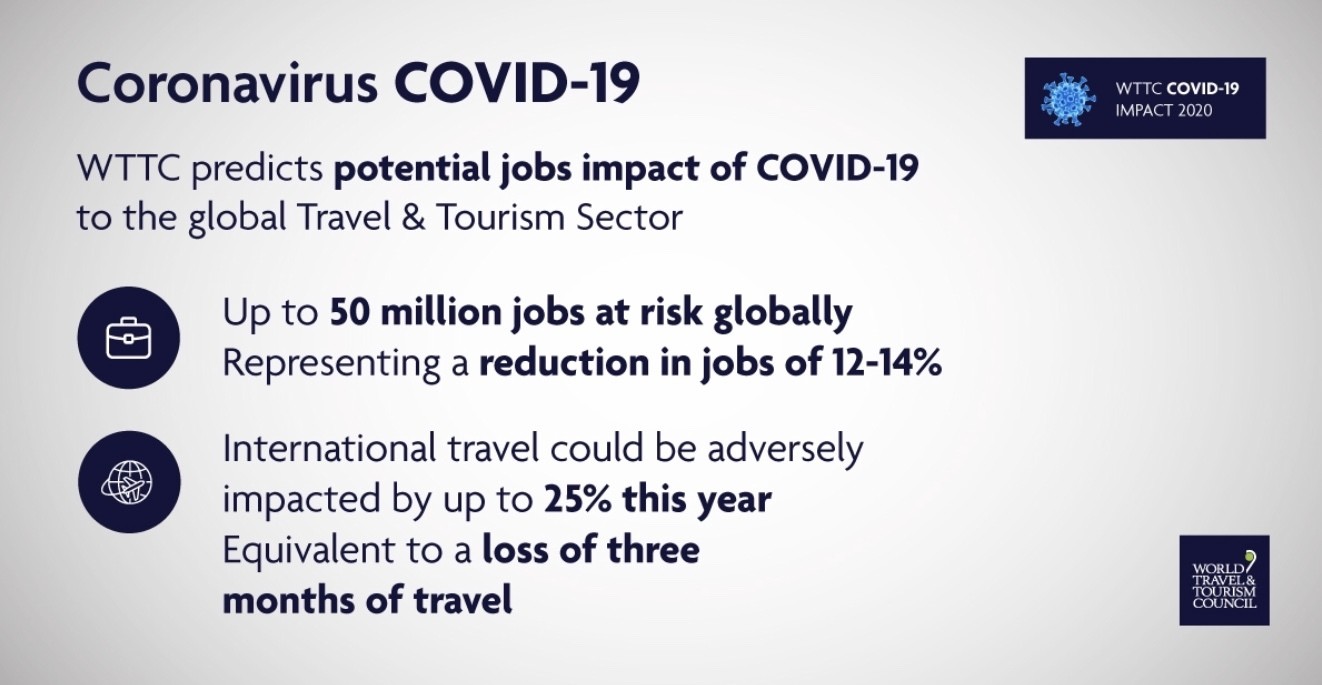
It could take up to 10 months for the tourism industry to recover from the shock of coronavirus.
Image: WTTC
By sector, airlines and cruise ships were currently being more impacted than hotels, the official added.
The tourism industry accounts for 10% of the world’s GDP and jobs.
The WTTC official defended the confinement of certain towns – as is currently happening in Italy and Spain – if health officials recommend it to contain the outbreak, but only in specifically targeted areas or for certain age groups.
Messina estimated that, once the outbreak is under control, it would take up to 10 months for the tourism sector to return to its normal levels.
Source:
Posted in earth
Leave a comment
10 Reasons to Focus on tier II Cities
Cities around the world are increasingly becoming the main drivers of trade, investment and local economic development. However, not enough attention is being paid to the fastest-growing urban areas of all, and the ones with the greatest potential to shape our urban future: secondary cities.
These cities, ranging in size from between 150,000 and five million, represent one of the biggest opportunities for urbanising economies globally. Some 75 per cent of the world’s population lives in urban settlements of fewer than 500,000 people.
Despite their growing role, countries often ignore the productive role that secondary cities can play in a balanced national system of cities. As a result, many secondary cities are facing numerous development challenges – including creating jobs, attracting investment for needed infrastructure, and diversifying or revitalising their economies – with far fewer options than their larger counterparts.
Another issue centres around migration and the growth of primary cities. In countries around the world, there are tremendous disparities between primary cities and secondary or tertiary cities. Many migrants arrive in secondary cities from their places of origin and then move on to primary cities, making it more difficult to achieve a balanced system of cities. Why are secondary cities unable to retain more of these migrants? Often, they lack investments and become administrative cities rather than drivers of the economy.
Ten Reasons to Focus on Secondary Cities
1. They are the fastest-growing urban areas. Some 75 per cent of the world’s population lives in urban settlements of fewer than 500,000 people. This number will only increase; secondary cities, especially in African countries, are expected to double or even triple in population over the next 15 to 25 years. This means large infrastructure and service shortfalls, few opportunities for economic growth, and rising urban poverty.
2. There are a lot of them, especially in developing countries. There are more than 4,000 cities in the world with populations exceeding 100,000. Around 2,400 of these have populations of fewer than 750,000 and more than 60 per cent are located in developing regions and countries. Many are struggling with the problems of rapid urbanisation, poverty and job creation.
3. Many are poor and struggling. The rapid urbanisation of many secondary cities has come at a considerable environmental and social cost. Many secondary cities are poor and overcome by the pressures of development resulting from urbanisation. They often have weak or dysfunctional governance systems; urban development takes place uncontrolled without any consideration of plans, there is little urban infrastructure and provide services, and little attention is given to building and development control. In many cities, slums are growing unchecked.
4. They are the economic backbone of the world’s largest cities. Secondary cities produce less than 40 per cent of world Gross Domestic Product (GDP)but provide most of the resources needed to support the operations and development of the world’s 600 largest cities, which produce 60 per cent of the world GDP.
5. They are governance and economic centres. Most secondary cities are subnational capital cities responsible for the secondary level of government; key manufacturing, primary or resource-industry centre; or a global centre of cultural, natural or advanced-industry significance. They can also be major satellite cities forming a cluster of cities in a metro-region city.
6. They can really boost a national economy. Countries with a strong system of secondary cities – that are not dominated by a single megacity – tend to have lower levels of regional development disparities, higher levels of national productivity, and greater income per capita. An efficient secondary system of cities could double or triple the GDP of many poor cities and rural regions.
7. They come in all shapes and sizes. A secondary city will likely have a population or economy ranging in size between 10 per cent and 50 per cent of a nation’s largest city. In China, some secondary cities have populations of over five million; in Ethiopia, they have fewer than 200,000. Function and role – rather than population size – are increasingly defining a secondary city’s status within the global system of cities.
8. They are often eclipsed by primary cities. Globally, there is a growing gap in levels of socioeconomic development disparities occurring between secondary and primary cities that has a significant consequence on their capacity to develop and compete for trade and investment.
9. We don’t have much information about them. Most reports focus on the study of macro trends or the world’s biggest, most competitive, cities. There is much less information available on the economy, land, finance, infrastructure and governance of secondary cities. This situation is severely affecting their capacity to plan and manage urban development and promote employment and economic growth.
10. Few have the capacity for strategic planning. Much urban planning in secondary cities is geared towards master plans and structure planning. Very few have adopted integrated strategic planning, linking spatial plans to the development of infrastructure, land development, public finance, and long-term financial plans – a vital part of managing city development effectively, ensuring that resources are not wasted, and helping urban systems become much more efficient. Many cities can benefit from the excellent knowledge tools produced by organisations such as UN-Habitat, the Cities Alliance, Inter-American Development Bank and the Asian Development Bank.
Source:
Posted in earth, urban morphology, Urban Studies
Leave a comment


 Rashid's Blog: A Place for Inquisitive Souls