Aerotropolis

An Aerotropolis is a metropolitan subregion whose infrastructure, land use, and economy are centered on an airport.It fuses the terms “aero-” (aviation) and “metropolis”. Like the traditional metropolis made up of a central city core and its outlying commuter-linked suburbs, the aerotropolis consists of

1) the airport’s aeronautical, logistics, and commercial infrastructure forming a multimodal, multifunctional airport city at its core and

2) outlying corridors and clusters of businesses and associated residential developments that feed off each other and their accessibility to the airport. 

The word aerotropolis was first used by New York commercial artist Nicholas DeSantis, whose drawing of a skyscraper rooftop airport in the city was presented in the November 1939 issue of Popular Science.The term was repurposed by air commerce researcher John D. Kasarda in 2000 based on his prior research on airport-driven economic development.

Its a vital component in new world urban order which is taking shape fast which is in continuation of rise and fall of towns and land use around the city is in confirmation to this.

Read more here

Posted in earth | Leave a comment

Explaining Mauna Loa CO2 Increases with Anthropogenic and Natural Influences

Iowa Climate Science Education's avatarIowa Climate Science Education

SUMMARY

The proper way of looking for causal relationships between time series data (e.g. between atmospheric CO2 and temperature) is discussed. While statistical analysis alone is unlikely to provide “proof” of causation, use of the ‘master equation’ is shown to avoid common pitfalls. Correlation analysis of natural and anthropogenic forcings with year-on-year changes in Mauna Loa CO2 suggest a role for increasing global temperature at least partially explaining observed changes in CO2, but purely statistical analysis cannot tie down the magnitude. One statistically-based model using anthropogenic and natural forcings suggests ~15% of the rise in CO2 being due to natural factors, with an excellent match between model and observations for the COVID-19 related downturn in global economic activity in 2020.

Introduction

The record of atmospheric CO2 concentration at Mauna Loa, Hawaii since 1959 is the longest continuous record we have of actual (not inferred) atmospheric CO2 concentrations. I’ve visited the…

View original post 1,760 more words

Posted in earth | Leave a comment

Bongaism, Totems, and Taboos: Concept

Posted in earth | Leave a comment

Why Ocean Keeps Its Cool at 4 Celsius

Iowa Climate Science Education's avatarIowa Climate Science Education

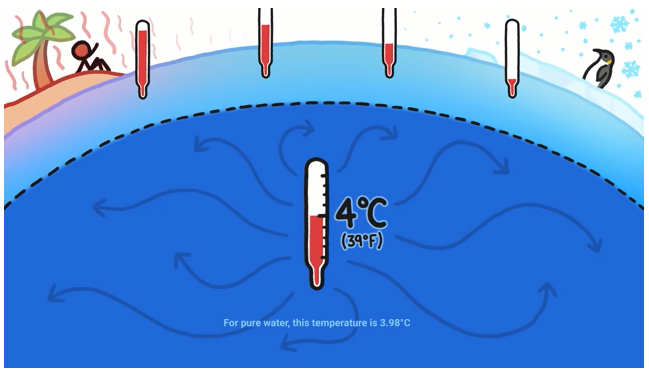
Water (H2O) has magical properties that make our planet suitable for us.  The video explains why most of the ocean water is about 4 degrees Celsius.  A transcript from another presentation draws the implications. Excerpts in italics with my bolds.

At the surface, ocean water can vary wildly in temperature – the water at the equator is around 30 degrees Celsius and the water at the poles is, well, freezing.  But surface waters are only a small fraction of the total water in the ocean.  Dive a little deeper, and you’ll find that a whopping 75 percent of the ocean’s water is all at the same temperature…and we’re not talking averages or anything – the vast majority of ocean water is 4 degrees Celsius.  And that’s not just a coincidence – it’s because water is weird.

As a liquid cools, its molecules slow down and the liquid generally gets denser and denser.  That’s how molten…

View original post 418 more words

Posted in earth | Leave a comment