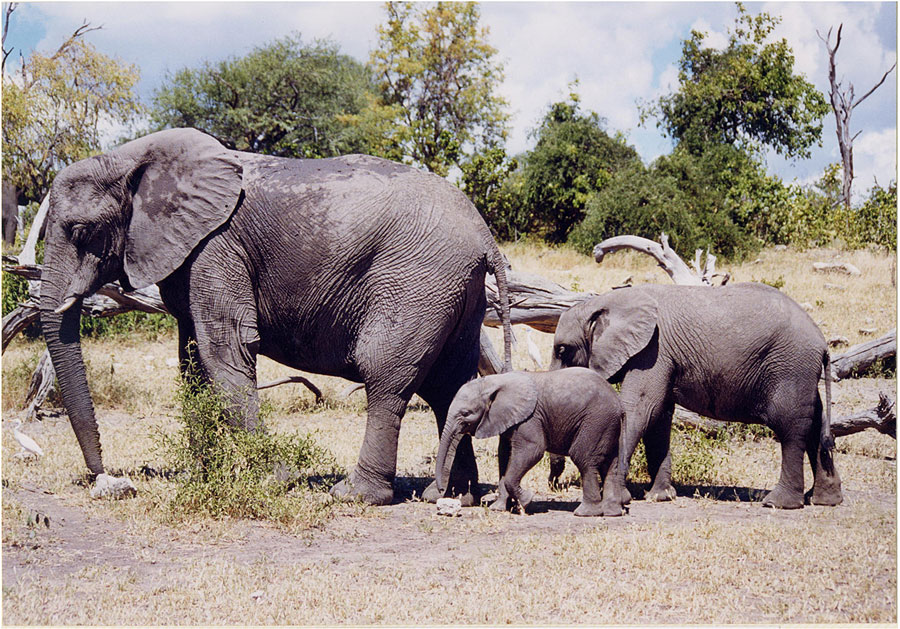
Elephant ‘GPS’ keeps families together

Call it a global positioning system for elephants. Their powerful rumbles — mostly too low in pitch for humans to hear — keep family members from wandering too far, new research suggests.

African elephants form tightly knit families centred around dominant females. Family members spread out while looking for food but always reunite, says Katherine Leighty, a behavioural ecologist at Disney’s Animal Kingdom in Lake Buena Vista, Florida, who led the new study.

Research on the elephants in the wild has hinted that their low-frequency calls, which can travel more than 2 kilometres, work like GPS, she says. But proving that in the wild requires tracking the movements and subsonic calls of multiple elephants — all relative to one another.
source

Posted in BIODIVERSITY, GPS | 2 Comments

Congratulations to Republic of India

Salute to Indomitable Spirit of India…

Posted in Uncategorized | Leave a comment

China to post 3D digital version of Great Wall online

China will create a three-dimensional digital version of the surviving sections of the Great Wall, which the public will be able to view online, informed the State Bureau of Surveying and Mapping. The digital version will be constructed from data obtained through a near-finished photographic mapping of the sections in nine provinces, autonomous regions and municipalities in northern China, the bureau said. The Great Wall was originally built by China’s first emperor Qin Shi Huang (259-210 B.C.), who also built the Terra Cotta Warriors in his grand tomb, but most of the surviving walls that are visited today were built in the Ming Dynasty, about 600 years ago. The Ming Dynasty portions are scattered across the northern part of the country, including the famous Badaling and Mutianyu sections in suburban Beijing. The bureau said it would soon announce the total, accurate length of the surviving sections.

Source : http://news.xinhuanet.com

Posted in Uncategorized | 1 Comment

Japan launches satellite to monitor greenhouse gases

An H-2A rocket No. 15 (H-2A F15) carrying Japan Aerospace Exploration Agency (JAXA) Greenhouse Gases Observing Satellite (GOSAT), known as Ibuki in Japan, blasts off from the southern island of Tanegashima January 23, 2009.An H-2A rocket No. 15 (H-2A F15) carrying Japan Aerospace Exploration Agency (JAXA) Greenhouse Gases Observing Satellite (GOSAT), known as “Ibuki” in Japan, blasts off from the southern island of Tanegashima January 23, 2009.

Japan launched a satellite on Friday to monitor greenhouse gases around the world in the hope that the data it gathers will help global efforts to combat climate change.

The satellite, called “Ibuki” or “vitality” in Japanese, will enable scientists to measure densities of carbon dioxide and methane from 56,000 locations on the Earth’s surface, including the atmosphere over open seas.

That would compare with just 282 land-based observation sites as of last October, mostly of which are in the United States, Europe and other industrialized regions, the Japan Aerospace Exploration Agency has said.

Japanese officials hope the data will add credence to existing research on greenhouse gases, including reports by the U.N. Intergovernmental Panel on Climate Change (IPCC), a group of hundreds of scientists.
source

Posted in climate change, Global Warming, News | Leave a comment