In Chile, the birds are dying, and no one knows why

Millions of dead sardines washed up on a beach in southern Chile. The cause of their death is under investigation. PATRICIO OLIVARES/FOR THE MIAMI HERALD

Chilean scientists are investigating three mysterious ecological disasters that have caused the deaths of hundreds of penguins, millions of sardines and about 2,000 baby flamingos in the past few months. The events started to unfold in March, when the remains of about 1,200 penguins were found on a remote beach in southern Chile. Then came the sardines — tons of them — dead and washed up on a nearby stretch of coastline. The stench forced nearby schools to close, and the army was called in to shovel piles of rotting fish off the sand.

Farther north, thousands of rare Andean flamingos abandoned their nests on a salt lake in the Atacama Desert. The eggs failed to hatch and, over a period of three months, all 2,000 chicks died. The extent of the damage was discovered in April, during an inspection.

Farther north, thousands of rare Andean flamingos abandoned their nests on a salt lake in the Atacama Desert. The eggs failed to hatch and, over a period of three months, all 2,000 chicks died. The extent of the damage was discovered in April, during an inspection.

No one knows for sure what caused these three apparently unrelated ecological tragedies, although there are many theories. Global warming has been blamed, as have overfishing, pollution and bacterial disease. In the north, ecologists have accused mining companies of fatally altering the flamingos’ habitat by draining the area of subterranean water.

source

Posted in BIODIVERSITY | Leave a comment

Make your own biofuel

As the debate over ethanol heats up with creation of a federal biofuels working group and a new Renewable Fuel Standard, a Texas company has made it easier for businesses, farms and municipalities to produce their own. EFS ‘Mini-Refinery’ Automated Machines

The systems could benefit companies who want to use alternative fuels in their fleets, potentially save money and simplify their supply chains, but face challenges with the limited availability.

read on

Posted in Alternative Energy | Leave a comment

Conveyor Belt Concept of Ocean Water Circulation is Probably Wrong

This model of North Atlantic currents has been called into question by new data from Duke University and the Woods Hole Oceanographic Institution. (Credit: Archana Gowda, Duke)

The familiar model of Atlantic ocean currents that shows a discrete “conveyor belt” of deep, cold water flowing southward from the Labrador Sea is probably not correct.

New research led by Duke University and the Woods Hole Oceanographic Institution relied on an armada of sophisticated floats to show that much of this water, originating in the sea between Newfoundland and Greenland, is diverted generally eastward by the time it flows as far south as Massachusetts. From there it disburses to the depths in complex ways that are difficult to follow.

A 50-year-old thermohaline circulation model of ocean currents had shown this southbound subsurface flow of cold water forming a continuous loop with the familiar northbound flow of warm water on the surface, called the Gulf Stream.

“Everybody always thought this deep flow operated like a conveyor belt, but what we are saying is that concept doesn’t hold anymore,” said Duke oceanographer Susan Lozier. “So it’s going to be more difficult to measure these climate change signals in the deep ocean.”

read on

Posted in climate change, oceans, opinions | Leave a comment

Astronauts complete tricky Hubble surgery

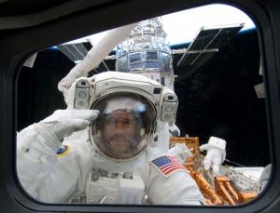
In a historic and daring feet astronauts opened up and installed new electronics on one of the Hubble Space Telescope’s most important instruments on Saturday. But NASA must now wait for the results of a battery of tests to see if the ambitious repair job was a success.

The space shuttle Atlantis is currently orbiting Earth on an 11-day mission to refurbish Hubble and extend its life until at least 2014. This is the fifth and last mission to service the telescope, which NASA hopes will leave Hubble with its best vision yet.

After two days of spacewalks that ran over-schedule, astronauts John Grunsfeld and Andrew Feustel made short work of the repair of Hubble’s Advanced Camera for Surveys (ACS), expected to be one of the most challenging tasks of the mission.

The instrument, which is actually a set of three cameras, or “channels”, was one of Hubble’s most widely-used devices, producing some of the telescope’s most breathtaking images. But a series of electrical problems in 2006 and 2007 left it with just one working channel, sensitive to ultraviolet light.

The ACS was not designed to be repaired in orbit. To access the camera’s interior, Grunsfeld had to use specialised tools to cut through a screen-like grid protecting the instrument and remove 32 screws to open a face plate. Once inside, Grunsfeld removed four circuit boards and installed a specially-designed electronics box and an external power supply.

source

Posted in Space | Leave a comment