Croatia Gospin dolac
 When it comes to sports stadiums, does it get any more picturesque than this? Gospic Dolac is home to the NK Imotski football club in Croatia and the 4,000 spectators that its bleachers hold get stunning views of nearby medieval ruins, the hillside and the Blue Lake. Gospin Dolac was built in 1989 and is situated next to a 500m deep fall into the lake.
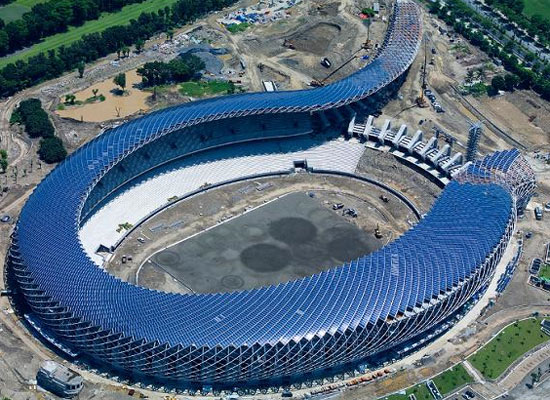
World Games Stadium
 Taiwan has what is being touted as the largest solar-powered stadium in the world, the ‘World Games Stadium’. It comes with massive and gigantic solar panels which harnesses all the solar energy in order to generate electricity that could be used by the stadium. It has a 14,155 square meter roof and it harnesses about 1.4 gigawatt hours of electricity every year. When the stadium is not being used, 80% of the neighborhood around the stadium can also be powered through the electricity generated by the stadium!
 Marina Bay
The Float at Marina Bay, also known as Marina Bay Floating Platform, is the world’s largest floating stage. It is located on the waters of the Marina Reservoir, in Marina Bay, Singapore. Made entirely of steel, the floating platform on Marina Bay measures 120 metres long and 83 metres wide, which is 5% larger than the soccer field at the National Stadium. The platform can bear up to 1,070 tonnes, equivalent to the total weight of 9,000 people, 200 tonnes of stage props and three 30-tonne military vehicles. The gallery at the stadium has a seating capacity of 30,000 people.
Vesturi a Eioinum
Vesturi a Eioinum Stadium is a multi-use stadium in Vagur, which is one of the larger villages in the southernmost island Suduroy in the Faroe Islands. It is currently used mostly for football matches and is the home ground of FC Suduroy, former called VB Vagur (until 2005) and VB/Sumba (until 2009). The stadium holds 3,000 people, but has only 330 seats. The Faroe Islands are an island group situated between the Norwegian Sea and the North Atlantic Ocean. Their national football team’s stadium is located next to the sea. There’s a guy in a boat that collects the balls that fall into the sea during a match.
Sapporo Dome, Japan
 Sapporo, Japan gets so much snow every year that engineers faced a dilemma in designing a stadium for the city: how could they ensure that the grass playing field would get enough sunlight without using a retractable roof, which may not hold up to 20 feet of frozen precipitation? Their solution was 8,300-ton field that slides in and out of the flying saucer-like stadium, allowing it access to fresh air and sunlight on nice days. This moving field also enables the stadium to switch between baseball and soccer.
Soure: Indiatimes