
Soil is the loose top layer of the Earth’s surface made up of minerals, organic matter, air, and water, which provides a habitat for plants and stores nutrients and water. It forms over time from weathered rock and decaying matter, creating distinct layers. Soil supports plants, is a vital resource, and hosts many living organisms. The main factors in soil formation are parent material, climate, landscape, organisms, and time, all of which interact to create different types of soil around the world.
Soil Components
Minerals: Inorganic particles that originate from the weathering of bedrock, varying in size (sand, silt, and clay).
Organic Matter: Decomposed plant and animal remains (humus) that enrich soil with nutrients and improve its structure.
Water: Essential for plant growth and for facilitating chemical reactions within the soil.
Air: Occupies the spaces between soil particles and is vital for the respiration of soil organisms and plant roots.
Living Organisms: A diverse array of microorganisms, insects, and other creatures that contribute to soil formation and health.
Main Factors Explained
- Parent Material: This refers to the underlying geological material (rock or sediment) from which soil develops. It determines initial soil texture, mineral content, and fertility, especially in the early stages of soil development.
- Climate: Climate heavily influences soil formation through temperature and precipitation. Higher rainfall and warmth accelerate weathering, organic matter decomposition, and chemical processes in soils, while cold or dry conditions slow them down and affect the type of vegetation and organic inputs.
- Topography (Relief): The shape, slope, and elevation of the land impact how water moves across and within the soil. Steep slopes often have thinner soils due to erosion, while low-lying areas might accumulate thicker soils with more organic material.
- Organisms (Flora, Fauna, and Microbes): Plants, animals, and microorganisms contribute organic matter, mix the soil, and assist in nutrient cycling and decomposition, directly affecting soil structure and fertility.
- Time: Soil formation is a lengthy process. With time, soils become more developed, exhibiting clearer horizons and characteristics that reflect the cumulative influence of other factors. Younger soils resemble parent material more closely, but as soils age, climatic and biological influences become dominant.
- These factors are interdependent; the effect of one factor may be modified by the others.
- Human activities can also influence soil formation by altering vegetation, drainage, and introducing or removing materials.
Flowchart Representation
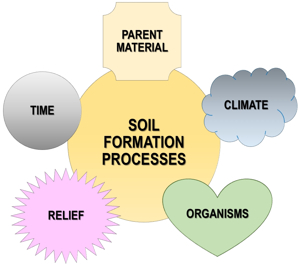
A simple flowchart or diagram often places “Soil Formation” at the center, with arrows pointing to it from the five main factors: Parent Material, Climate, Topography, Organisms, and Time.


 Rashid's Blog: A Place for Inquisitive Learners