
An urban microclimate is a small area of urbanized land that has different atmospheric conditions than the surrounding area. The following are illustrative examples.
Microclimates
Regular microclimates that happen to be in a city. For example, proximity to large bodies of water and differences in elevation tend to create unique local climates.
Urban Heat Islands
An area of a city or suburb that is hotter than its surroundings. This can be caused by surfaces such as pavement that absorb solar energy, a tendency for cities not to retain water and a lack of vegetation.
Green Infrastructure
Elements of green infrastructure can create a microclimate. For example, an urban forest that is considerably cooler than the rest of a city.
Street Canyons
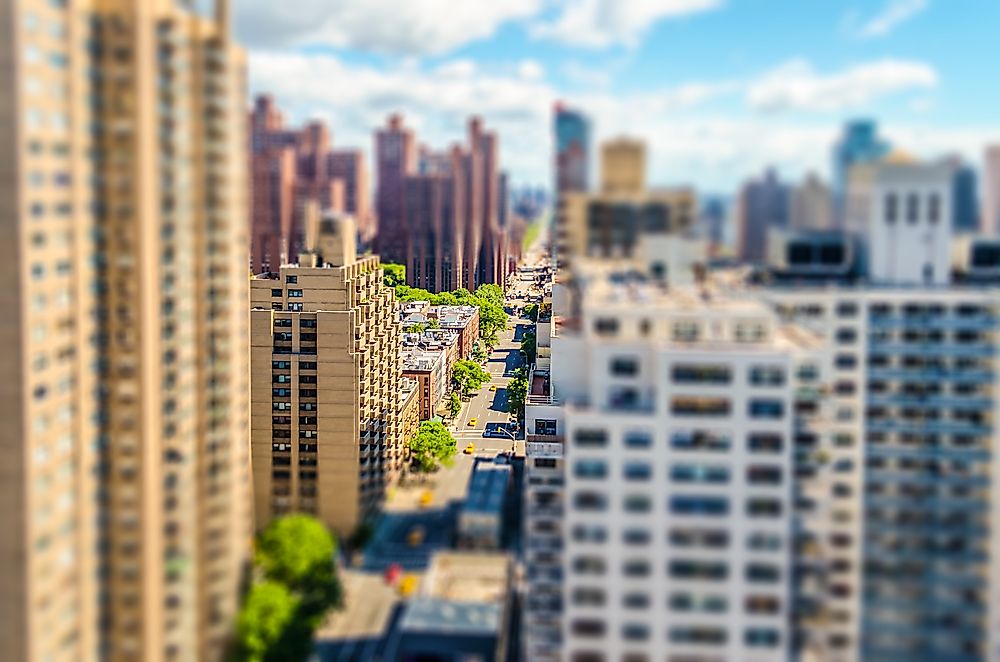
Tall structures that prevent wind from reaching some areas while concentrating it in others.A street canyon, also known as an urban canyon, is created when a street is flanked by tall skyscrapers on both sides which results in a canyon-like appearance. Many modern cities construct skyscrapers with the intention of maximizing the space available by using the least amount of surface area which creates street canyons. Some famous street canyons include 42nd Street in Manhattan, the Magnificent Mile in Chicago, and Kowloon Street in Hong Kong.
Smog
It is common for their to be significant differences in air quality from one neighborhood to the next based on proximity to pollution and other factors such as green space and topography.
Light Intensity
Tall structures that cast shadows that make some streets darker than others.The intensity of direct sunlight in a given microclimate is a function of a number of factors: The difference in elevation between the microclimate and an observer. The tilt of the solar path relative to the surface. The angle of the solar surface is relative to the vertical.
The urban microclimate is associated with the climate conditions in the lower atmosphere of urban areas that are influenced by the urban form, building geometry, land use, and human activities.The effect of land use transformation can be directly observed in urban areas as a change in the microclimate of the particular cities leading to some serious alteration of hydrometeorological variables such as a change in surface roughness leads to an increase in the albedo and net-radion, which impact the warming of cities
GIS-based urban microclimate models can also contribute to urban energy analysis since several studies have demonstrated that urban microclimate affects building energy consumption. For example, in response to heat waves, the overall energy consumption for cooling (i.e., refrigeration and air-conditioning) also increases. Therefore, the assessment of urban microclimate is necessary for researchers to identify and create targets to reduce energy consumption in buildings.


 Rashid's Blog: A Place for Inquisitive Souls