

Total Visitors
- 5,616,959
Search Inside
My You Tube Channel
-
Visitors on The Site

-
Join 6,676 other subscribers
Fill This Form to Contact Me
Top Posts & Pages
- Google Blimps & Balloons to Provide Wireless Networks in Africa
- Waste to Energy in India
- About Me and This Site
- Register for the AASRN Conference
- Gond Tribe of India
- Levant: The Term, The Region and Cities
- Migration Theories : Lee’s Push Pull Theory
- Urbanization and its Impact on Rural Life
- Discontinuities Inside the Earth
- Geography Study Material for NTA-NET & IAS Exams
Being Social
Pages
- Article Submission
- Basics of Geography
- Book Reviews
- Disaster Management
- Field Training and Tour
- Geography Notes
- Geography of Tourism
- Geography Study Material for NTA-NET & IAS Exams
- Geomorphology
- Geomorphology Class Black Board
- Hindi Posts
- Human Geography
- My Projects
- New UGC NET Syllabus-Geography
- Online Class
- Posts on Geography Practicals and Statistical Techniques
- Regional Studies
- Settlement Geography
- Social Geography
- Urban Agro Systems
- Urban Systems
- Useful Links
- Water Resources
- About Me and This Site
Blogroll
Digital Blackboards
My Pages
Other Sites I Am Involved With
Recommended Links
Useful Links
Today at the ASPRS meetings, Jerry Dobson, Professor at Kansas University, President of the American Geographical Society (AGS) and Jefferson Fellow at the Department of State, repeated a claim he’d first made in 2010:
So, you know, we hear a lot of people now agonizing over Iraq and Afghanistan and saying, “How did we get it so wrong?” But, it’s not just Iraq and Afghanistan, it’s Korea, it’s Vietnam, Beirut, Somalia, and so forth. We have this century of first half story victories, second half more quagmires than victories. What changed? Was it the valor of our troops? No, they’re as outstanding as always. Was it the training, or equipment, or technology? No, those are better than ever. Policy, strategy, foreign intelligence? We’ve been playing a dangerous game of blind man’s bluff and that corresponds with the American purge of geography. America abandoned geography after World War II…
View original post 863 more words
Posted in Uncategorized
Leave a comment
We Need to Pull Carbon Out of the Atmosphere to Save The Planet
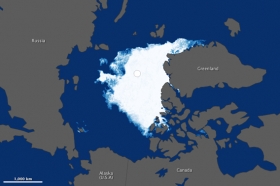 The year saw the Arctic sea ice extent fall to a new and shocking low, while the U.S. experienced it warmest month ever on record (July), beating even Dust Bowl temperatures. Meanwhile, a flood of new research has convincingly connected a rise in extreme weather events, especially droughts and heatwaves, to global climate change, and a recent report by the DARA Group and Climate Vulnerability Forum finds that climate change contributes to around 400,000 deaths a year and costs the world 1.6 percent of its GDP, or $1.2 trillion. All this and global temperatures have only risen about 0.8 degrees Celsius (1.44 degrees Fahrenheit) since the early Twentieth Century. Scientists predict that temperatures could rise between 1.1 degrees Celsius (2 degrees Fahrenheit) to a staggering 6.4 degrees Celsius (11.5 degrees Fahrenheit) by the end of the century.
A recent study in the Proceedings of the National Academy of Sciences (PNAS) argues for a bold, and perhaps less dangerous approach than geo-engineering ideas: physically pull carbon out of the atmosphere.
“If climate change is quicker than expected, then the world has likely overshot the acceptable limit of carbon dioxide in the atmosphere or will go over before emissions can get stopped,” Klaus Lackner, lead author of the paper with the Earth Institute at Colombia University and board member of atmospheric carbon-capturing company, Kilimanjaro Energy, told mongabay.com. “Unlike flue gas scrubbing [which removes emissions from power plants], air capture can remove more carbon dioxide than is emitted. Therefore, it can gradually reduce CO2 levels in the atmosphere; not overnight, but a lot faster than nature will do it by itself.”
read here
Posted in earth, Environment, pollution
1 Comment
The History and Future of Satellite Communications
Guest Post by Philip J Reed on behalf of WildBlue
Satellites help form the foundation of the global telecommunications network comprising telephone, television, and Internet services. They allow anyone in any location to pick up a cell phone and dial somebody across the world or to watch a sports game in another country. Satellites were once believed to be science fiction and outside humanity’s technological prowess, but the past half century has marked dramatic technological advances once thought impossible.
The Start of a Dream
As early as 1945, Arthur C. Clarke wrote about a network of satellites capable of transmitting television signals around the world. However, the idea failed to catch on at first, and Clarke’s articles and stories were considered fanciful until the Soviet Union launched the satellite Sputnik in 1957.
During the height of the Cold War, the Soviet Union showed that orbital satellites were not only theoretically possible but feasible with the current technology of the day. Overnight, news outlets and government agencies around the world began to seriously consider what capabilities they could arm satellites with.
Many initial theories centered around Clarke’s idea of a global communications network, but there were also fears that governments could arm satellites with ballistic missiles or other weapons. While Clarke’s peaceful vision has held true so far, there does not yet exist a comprehensive space weapons ban. However, U.S. President Barack Obama signaled a wish to ban anti-satellite weapons in 2009.
The First Communications Satellites
In 1960, AT&T filed for permission to place a communications satellite in orbit. Two years later, the first active communications website, Telstar-1, began to receive and transmit signals to ground-based dishes.
These satellites were placed into geostationary orbit over the equator. Because they completed one orbit every 24 hours, they were always located directly above the same point on the ground, allowing ground-based satellite dishes to maintain a static angle. Unfortunately, signals from equatorial satellites grow weak at high latitudes, which can prove problematic for regions like northern Canada or southern Chile.
The first communications satellites were capable of only a few dozen simultaneous phone calls. Computer circuits were both primitive and expensive, and the rockets capable of carrying the satellites into orbit cost thousands of dollars per pound for each payload. Given these costs, it’s nothing short of remarkable that AT&T, Comsat, and other early satellite providers were able to quickly and completely recoup their losses, paving the way for an entirely new industry.
Ubiquitous Service
Once telecommunications providers started developing new satellites, the industry made advances on a monthly basis. Today, integrated circuits used in satellites cost a small fraction of the price, but they’re capable of transmitting thousands of simultaneous telephone calls instead of dozens.
Just three years after the launch of Telstar-1, AT&T proposed a satellite TV network for the continental United States, but the proposal was promptly ignored as in the case of Arthur C. Clarke’s 1945 article. It would not be until 1972 that a major telecommunications company, Telesat Canada, would begin providing satellite television service. Western Union launched the first TV satellite for the United States in 1974.
Less than one year later, HBO introduced premium television service to U.S. customers, and high adoption rates spurred further satellite TV development. However, satellite telephone service did not take off until the 1990s, and satellite Internet became popular only after the turn of the century.
Where Does the Future Lead?
Over the past decade, launch services have moved from the public to private sectors. SpaceX, or Space Exploration Technologies Corporation, has built and tested two different rocket designs. The SpaceX Dragon 9 rocket was so innovative that it slashed launch costs by 90 percent, driving launch costs down below $1,000 per pound.
Satellites themselves are also smaller, cheaper, and more powerful than ever before. Cube satellites can measure as little as 1,000 cubic centimeters, about the size of a grapefruit. While cube satellites are used primarily for scientific research, they demonstrate how compressed satellite technology has become.
Because satellites are cheaper to build and launch into orbit than ever before, they will continue to complement land-based telecommunications for the next few decades. Whether or not satellite communications can sustain growth with limited frequencies and bandwidth remains to be seen.
For further reading…
http://history.nasa.gov/satcomhistory.html
http://www.nss.org/articles/falconheavy.html
http://www.reuters.com/article/2009/01/25/us-usa-obama-space-idUSTRE50O15X20090125


