 The severity of an earthquake can be expressed in terms of both intensity and magnitude. However, the two terms are quite different, and they are often confused.
Intensity is based on the observed effects of ground shaking on people, buildings, and natural features. It varies from place to place within the disturbed region depending on the location of the observer with respect to the earthquake epicenter.
Magnitude is related to the amount of seismic energy released at the hypocenter of the earthquake. It is based on the amplitude of the earthquake waves recorded on instruments which have a common calibration. The magnitude of an earthquake is thus represented by a single, instrumentally determined value.
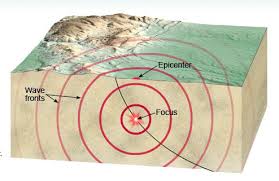
Earthquakes are the result of forces deep within the Earth’s interior that continuously affect the surface of the Earth. The energy from these forces is stored in a variety of ways within the rocks. When this energy is released suddenly, for example by shearing movements along faults in the crust of the Earth, an earthquake results. The area of the fault where the sudden rupture takes place is called the focus or hypocenter of the earthquake. The point on the Earth’s surface directly above the focus is called the epicenter of the earthquake.
The magnitude of an earthquake is measured on the richter scale, which is logarithmic (hence each level of magnitude is 10 times greater than the one before it on the scale). However, magnitude is not the only factor to be taken into consideration.So why do some earthquakes result in more fatalities than others? What are the factors which contribute to the severity of the effects of a quake?
1. Location of the Epicentre
The epicentre is the point on the surface directly above the focus ). It is at this point where the energy from an earthquake is usually at its greatest. The distance from the epicentre has a big impact.
2. Level of development of the Country /Preparedness
Earthquakes which occur in the richer countries of the world often have fewer fatalities simply due to the greater state of preparedness which is facilitated by the greater amount of money available to put into earthquake research, monitoring and preparation.
3Time of the Day / Time of Year
If an earthquake occurs at night, most people are in bed. In areas where buildings collapse easily this can result in a higher death toll, although in areas where fewer buildings are likely to collapse and where deaths are often higher due to collapsing roadways / falling debris, fewer people may die if the quake occurs at night. The time of year can also be important due to seasonal differences in temperature which can exacerbate the effects of a quake.
4. Population Density
An area of dense population is likely to experience more deaths than a rural area simply due to a greater liklihood of people being affected by the quake and more buildings, road networks and bridges which may collapse. A major difficulty however in earthquakes which occur in rural areas is getting rescue teams and aid to the affected areas.
5. Land that buildings are constructed on
Where buildings are constructed on soft granular sediments or areas of landfill, the effects of an earthquake maybe more severe due to the process of liquefaction. This process, which results in ground failure, occurs when ground shaking causes water to rise, filling pore spaces between granular sediments, increasing pore water pressure and causing the sediment to act as a fluid rather than a solid. This can result in the collapse of overlying buildings, roads etc., such as occured in the Marine District in San Francisco during the 1989 quake due to it being built on landfill from the 1906 quake
Sources: GCSE , USGS


