Guest Post by John Gower
Zion National Park is located in Southeast Utah, a short drive away from the more widely-known but equally beautiful Bryce Canyon. Both Zion and Bryce are located on the Colorado Plateau, an ancient geological formation that developed millions of years ago when forces inside the earth forced the crust to rise. This rising exposed many strata – layered beds of sedimentary rock – and since then erosion and weathering have sculpted the enormous rock formations seen in the parks today. Oxidizing iron and varying types of sandstone color the natural structures of Zion with a rich palette of reds, oranges, pinks, and browns.
The Sculpting of Zion
Around 240 million years ago, Zion National Park began as a flat basin near sea level. Mud, sand, and gravel eroded from the surrounding mountains and streams carried this debris down into the basin. This process formed numerous layers on the basin floor, and soon the weight of these layers caused the basin to sink. As the basin continued to sink new layers formed overhead, and so instead of rising upwards the surface of the basin always remained near sea level. Water slowly filtered through these compact sediments, and certain minerals such as iron oxide, calcium carbonate, and silica – along with the pressure from overlying layers – helped to cement the debris and turn it into stone. The land in and around the basin rose and fell unsteadily over the next thousand years, and the changing climate transformed the face of Zion from a shallow sea to a coastal plain to a massive desert. This process of sedimentation endured until more than 10,000 feet of debris accumulated in the basin. However, soon after this material was accumulated, winds, streams, and floods began its erosion. Since each layer in Zion originated from a unique source, each stratum of rock differs in size, mineral content, color, and degree of erosion. This diversity has helped to create the amazing formations that make up Zion today.
Zion Today
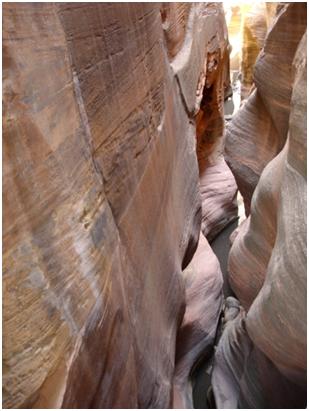
Zion National Park is home to some of the most incredibly unique rock formations in the world. A visitor to Zion will have the opportunity to see the beauty that remains after years of erosion from water and wind. Dangerous flash floods are responsible for ninety-percent of the rock carving in Zion; however wind and rivers – such as the Virgin River – have also played a part in the creation of this natural beauty. Some major attractions in Zion are the Great White Throne, the Checkerboard, and the slot canyons. The Great White Throne is a 2,450 foot monolith, sculpted from Navajo Sandstone, and deriving its name from the image of God’s throne it inspired in Zion’s Mormon settlers. Sunlight striking the upper part of the stone makes it shine a brilliant white, while the base of the throne is colored deep red due to oxidizing iron. The Checkerboard, found on the east side of the park, was created by the wind-blown sands of the Jurassic period. The horizontal furrows formed by the sand were then widened by a freeze and thaw process over thousands of years to produce the checkerboard pattern seen on the rocks today. Lastly, the slot canyons of Zion began as the path of the Virgin River, but flash floods caused by mountain storms and runoff caused the river to cut deeply into the soft riverbed, creating the dangerous and beautiful canyons. Hiking through these canyons can be difficult, as 60% of the trail is wading or swimming through the Virgin River, but anyone who has braved the canyons claims it’s worth the trouble. Like all national parks, Zion is best enjoyed by those ready to explore and get in touch with nature, but more importantly is best appreciated by those ready to be awed by its beauty.
John Gower is a writer for NerdWallet, a site dedicated to helping consumers with retirement savings.

Sources
Image of Zion National Park: http://www.environmentalgraffiti.com/national-parks/news-magic-zion-national-park?image=4
Image of Checkerboard Mesa: http://www.dreamstime.com/royalty-free-stock-photos-checkerboard-mesa-zion-national-park-usa-image7219518
Image of Slot Canyons: http://www.environmentalgraffiti.com/national-parks/news-magic-zion-national-park?image=6

 What caused temperatures to suddenly drop across the Northern Hemisphere? Scientists have tried to answer this question for decades, ever since they discovered geological and biological evidence for the “Big Freeze.”