

Total Visitors
- 5,598,550
Search Inside
My You Tube Channel
-
Visitors on The Site

-
Join 6,679 other subscribers
Fill This Form to Contact Me
Top Posts & Pages
- About Me and This Site
- Waste to Energy in India
- Levant: The Term, The Region and Cities
- Migration Theories : Lee’s Push Pull Theory
- Physical Divisions of North America: An Overview
- Social Processes: Concept, Types and Salient Features
- The Structure of the Ocean Floor(Ocean Topography)
- Gond Tribe of India
- Social Geography: Concept,Origin,Nature and Scope
- Silt: Environmental Impact
Being Social
Pages
- Article Submission
- Basics of Geography
- Book Reviews
- Disaster Management
- Field Training and Tour
- Geography Notes
- Geography of Tourism
- Geography Study Material for NTA-NET & IAS Exams
- Geomorphology
- Geomorphology Class Black Board
- Hindi Posts
- Human Geography
- My Projects
- New UGC NET Syllabus-Geography
- Online Class
- Posts on Geography Practicals and Statistical Techniques
- Regional Studies
- Settlement Geography
- Social Geography
- Urban Agro Systems
- Urban Systems
- Useful Links
- Water Resources
- About Me and This Site
Blogroll
Digital Blackboards
My Pages
Other Sites I Am Involved With
Recommended Links
Useful Links
Digital Geographies Symposium

The Digital Geographies Working Group (DGWG) Symposium will be themed “Justice and the Digital” and will take place on Friday, July 6 at the University of Sheffield. There will be panels, digital shorts, debates, and time to network.
More information will be provided shortly! See the webpage for more details, and last year’s Symposium.
Posted in earth
Leave a comment
Prismatic Compass: A Simple Survey Tool for Geographers
Prismatic compass is a light and simple instrument and is used for rough surveys where too much of accuracy is not necessary.
Components and Adjustment of Prismatic Compass
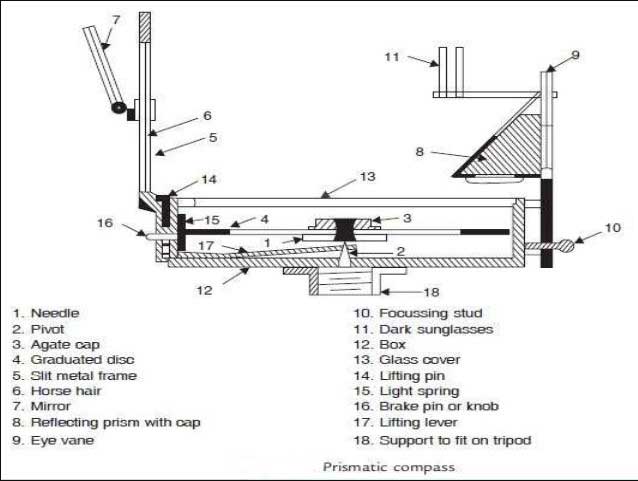
This compass is made into a box which is circular and 85 to 110 mm in diameter. In the center of the compass box, is a pointed steel pivot is used.
A magnetic needle of broad form is balanced over the pivot, and to this is fixed a light aluminum ring.
The aluminum ring is calibrated in degrees and half degrees. The calibrations are marked such that zero is at the south, 90 degrees at the west, 180 degrees at the north and 270 degrees at the east, i.e., the aluminum ring is calibrated in a clockwise direction with the zero at the south.
The figures showing the readings on the aluminum ring are written inverted, and a glass lid covers the top of the compass box.
Dioganally opposite the compass box are fixed the object or sight vane and the eye vane. The latter carries a reflecting prism.
The eye vane is fixed at the top of the prism. The reflecting prism can be raised or lowered to suit the eyesight of the observer by means of the focusing stud.
A hinge is provided so that the prism may be folded over the edge of the box when it is not in use.
When the eye is brought near the eye vane, the graduations on the ring are reflected to the eye and the same can be read.
The horizontal and vertical sides of the prism are made convex so that the readings on the ring are magnified.
The object vane consists of a metal frame hinged to the box. In the center of this metal frame is fixed a vertical horse hair or a tine wire or silk thread.
When the instrument is not in use the object vane should be folded over the glass lid, covering the top of the box.
When the object vane is folded over the glass lid, it presses a lifting pin which lifts the magnetic needle above the pivot and keeps it against the glass lid.
Thus the wear and tear of the pivot are reduced by keeping the magnetic needle away from the same when the instrument is not in use.
A spring brake is provided inside the box to damp the oscillations of the magnetic needle, i.e., to bring the magnetic needle to rest quickly before taking a reading.
By pressing the brake pin inward, the Spring may be made to come in contact with the magnetic needle thereby arresting the oscillations.
The object vane may be provided with a hinged mirror which may be slided to any position on the object vane, and the mirror can be made to incline on any angle.
This enables the surveyor to take the readings to objects which are too high or too low.
Sun glasses are provided to sight luminous objects. They are simply interposed in the line of sight and reduce the strain on the eyes of the observer.
A metal lid covers the glass lid and the sighting vane when not in use.
In the prismatic compass, the magnetic needle and the graduated rings are attached together and, therefore, they remain always along the north-south line when the box is rotated.
Procedure of Survey on Prismatic Compass.
For taking readings with a prismatic compass, instrument may be held in hand and turned till the ranging rod on the next station is bisected by the horse hair when seen through the eye-vane.
The instrument should be held as nearly level as can be judged. If the needle does not oscillate, it means that it is touching the glass lid and is not being held vertical.
It should be held properly, and the brake knob pressed lightly. Then the reading is taken. This gives the bearing of the line joining the point vertically below the compass and the point on which the ranging rod is held.
Least Count
Readings may be accurately taken up to 30 minutes and estimated up to the nearest 15 minutes.
Least count of Prismatic Compass is 30′ minute.
A Video About the Instrument
Here is a helpful video about correcting mistakes by Bowditch’s rule
Source(s) and Link(s):
Posted in Class Notes, earth
Leave a comment
Calculating Height With the Help of Sextant

A sextant is a mechanical device for measuring the angle between two objects. Most commonly associated with navigation at sea, a sextant can also be used to help calculate the height of trees, buildings, flagpoles or any other vertical object.
In ancient times, the navigator who was planning to sail out of sight of land would simply measure the altitude of Polaris as he left homeport, in today’s terms measuring the latitude of home port. To return after a long voyage, he needed only to sail north or south, as appropriate, to bring Polaris to the altitude of home port, then turn left or right as as appropriate and “sail down the latitude,” keeping Polaris at a constant angle.
The Arabs knew all about this technique. In early days, they used one or two fingers width, a thumb and little finger on an outstretched arm or an arrow held at arms length to sight the horizon at the lower end and Polaris at the upper.
The critical development was made independently and almost simultaneously by John Hadley in England and by Thomas Godfrey, a Philadelphia glazier, about 1731. The fundamental idea is to use of two mirrors to make a doubly reflecting instrument—the forerunner of the modern sextant.
The Arabs knew all about this technique. In early days, they used one or two fingers width, a thumb and little finger on an outstretched arm or an arrow held at arms length to sight the horizon at the lower end and Polaris at the upper.
The critical development was made independently and almost simultaneously by John Hadley in England and by Thomas Godfrey, a Philadelphia glazier, about 1731. The fundamental idea is to use of two mirrors to make a doubly reflecting instrument—the forerunner of the modern sextant.
Choose an observation point from which you can clearly see both the top and the bottom of the object you wish to measure. Determine the exact distance between the observation point and the base of the object.
Set the sextant to zero and look at the object through the eyepiece, adjusting your view until it is in the center of the frame.
Adjust the sextant arm to split the screen in two halves. Continue moving the arm until the top half of the object on one side of the image is aligned with the bottom half of the object on the other side of the image.
Read the angle from the arc of the sextant.
Use a scientific calculator to find the height of the object by multiplying its distance from the observation point by the tan of the angle that you measured. For example, if you were 150 feet from the base of the object, and the recorded angle was 75 degrees, the height of the object would be 150 x tan 75 = 560 feet.
Remember to add the height you are holding the sextant above the ground to the total height of the object.
This video will help you:
Errors and Adjustments
The sextant is subject to a number of errors and adjustments. To find the true altitude of a celestial body from the observed these must be allowed and adjusted for.
Briefly these are:
- Index Error
- Dip
- Refraction
- Parallax
- Semi-diameter
Index error is an instrumental error. When looking through a sextant at the horizon the exact level horizon will seldom be seen to be at 0°.

Sextant set at 0° – horizon split.Before every sextant session the Index error should be determined.

Index error corrected for – horizon level.
If the error is less than 0° it should be added to whatever reading is obtained – if more subtracted. Hint: remember Noah, if off the Ark – add, if on the Ark – take off.
Dip is an adjustment made for the height of the eye above sea level. In practice this is usually taken as 0.98 times the square root of the height of the eye in metres above sea level multiplied by 3.28.

Refraction is extracted from the Nautical Almanac. It allows for the “bending” of light rays as they travel through successive layers of varying density air.
Parallax corrections are needed if the observed body is a planet, the sun or the moon. From the Almanac.
Semi-diameter correction is needed if the observed body is the sun or the moon. In this case either the top or bottom of the celestial object (known as upper or lower limb) is made to touch the horizon. To obtain the centre of the body this correction is applied – from the Almanac.
Once all the corrections are applied we have the true altitude. And this subtracted from 90 gives us the zenithal distance to the sub-stellar point. Which means we know exactly how far we are from that elusive point on the earth which is at right angles to our observed celestial body!
Source(s):
Read here about the various uses of sextant
Posted in Class Notes, earth
Leave a comment


