We proud Indians of 21st century rise in celebrations when a boy is born, and if it is a girl, a muted or no celebrations is the norm. Love for a male child is so much so that from the times immemorial we are killing our daughters at birth or before birth, and if, fortunately, she is not killed we find various ways to discriminate against her throughout her life. Though our religious beliefs make women a goddess but we fail to recognize her as a human being first; we worship goddesses but we exploit girls. We are a society of people with double-standards as far as our attitude towards women is concerned; our thoughts and preaching are different than our actions. Let’s try to understand the phenomenon of gender inequality and search for some solutions.
Gender is a socio-cultural term referring socially defined roles and behaviors assigned to ‘males’ and ‘females’ in a given society; whereas, the term ‘sex’ is a biological and physiological phenomenon which defines man and woman. In its social, historical and cultural aspects, gender is a function of power relationship between men and women where men are considered superior to women. Therefore, gender may be understood as a man-made concept, while ‘sex’ is natural or biological characteristics of human beings.
Gender Inequality, in simple words, may be defined as discrimination against women based on their sex. Women are traditionally considered by the society as weaker sex. She has been accorded a subordinate position to men. She is exploited, degraded, violated and discriminated both in our homes and in outside world. This peculiar type of discrimination against women is prevalent everywhere in the world and more so in Indian society.
CAUSES AND TYPES OF GENDER INEQUALITY IN INDIA
The root cause of gender inequality in Indian society lies in its patriarchy system. According to the famous sociologists Sylvia Walby, patriarchy is “a system of social structure and practices in which men dominate, oppress and exploit women”. Women’s exploitation is an age old cultural phenomenon of Indian society. The system of patriarchy finds its validity and sanction in our religious beliefs, whether it is Hindu, Muslim or any other religion.
For instance, as per ancient Hindu law giver Manu: “Women are supposed to be in the custody of their father when they are children, they must be under the custody of their husband when married and under the custody of her son in old age or as widows. In no circumstances she should be allowed to assert herself independently”.
The above described position of women as per Manu is still the case in present modern day social structure. Barring few exceptions here and there, women have no power to take independent decisions either inside their homes or in outside world.
The unfortunate part of gender inequality in our society is that the women too, through, continued socio-cultural conditioning, have accepted their subordinate position to men. And they are also part and parcel of same patriarchal system.
Extreme poverty and lack of education are reasons for women’s low status in society. Poverty and lack of education derives countless women to work in low paying domestic service, organized prostitution or as migrant laborers. Women are not only getting unequal pay for equal or more work but also they are being offered only low skill jobs for which lower wages are paid. This has become a major form of inequality on the basis of gender.
Educating girl child is still seen as a bad investment because she is bound to get married and leave her paternal home one day.Paucity of resources is also a reason for not sending girls to school, if a family have limited resources to spend on education , male child gets the preference, again because he is considered to be the better investment. in fact, it is not limited to girls, Parents do not see the usefulness of education , and so they,specially those who have meager resources,hesitate to send their child to school, but girls get a worse deal.
The only thing that parents understand is that their children will not get a job even if they graduate.Frighteningly they are often correct ,chances of being unemployed rises with education.
It’s a vicious cycle. Lack of skills translates into poverty and poverty forces the parents to place their children in bad schools.
Early marriage is a major impediment on the girl’s road to a meaningful education and/or a degree. The marriage blocks her education in most of the cases.
Thus, without having good education women are found lacking in present day’s demanding job market; whereas, each year’s High School and 10+2 standard results show that girls are always doing better than boys. This shows that parents are not spending much after 10+2 standard on girl child and that’s why they lack in job market.
Not only in education, in case of family food habits, it is the male child who gets more nutritious and choicest foods while the girl child gets whatever is left behind after the male members have taken their meals or the food which is low in both quality and nutrition. And this becomes a major health issue in her later years. One of the main reasons for the high incidences of difficult births and anemia in women is the poor quality of food which a girl always gets either in her paternal home or in her in-laws as also is the excessive workload that they are made to bear from their early childhood.
So the inequality or discrimination against women is at various levels in the society, either in home or outside home.
GENDER INEQUALITY IN INDIA: IMPORTANT DATA
Global Indices:
Gender Inequality is also reflected in India’s poor ranking in various global gender indices.
- UNDP’s Gender Inequality Index- 2014: India’s ranking is 127 out of 152 countries in the List. This ranking is only above Afghanistan as far as SAARC countries are concerned.
- World Economic Forum’s Global Gender Gap Index- 2014: India’s ranks at 114 in the list of 142 countries of the world. This Index examines gender gap in four major areas:
- Economic participation and opportunity.
- Educational achievements.
- Health and life expectancy.
- Political empowerment.
India’s position on these indicators was as follows:
- Economic participation and opportunity: 134th
- Educational achievements: 126th
- Health and Life expectancy: 141st
- Political empowerment: 15th
These two important Global Indices show the sorry state of affairs in India as far as gender equality is concerned. Only in case of ‘Political Empowerment’ India is doing fine which is a welcome sign. But other indices are very poor and a lot need to be done to improve the same.
GENDER INEQUALITY STATISTICS
Gender inequality manifests in varied ways. And as far as India is concerned the major indicators are as follows:
- Female Foeticide
- Female Infanticide
- Child (0 to 6 age group) Sex Ratio: 919
- Sex Ratio:943
- Female literacy:46%
- Maternal Mortality Rate:178 deaths per 100000 live births.
These above mentioned indicators are some of the important indices which show the status of women in our country.
Female foeticide and female infanticide are most inhuman of acts. And it is a shame that in India these practices are prevailing at large scale.
The data shows that despite the law in place viz Prenatal Diagnostic Techniques (Regulation and Prevention of Misuse) Act, 1994 sex selective abortion is still on the rise. One estimate done by MacPherson shows that more than 100000 illegal abortions are being performed every year in India mainly for the reason that the featus is of girl child.
Due to this, there is an alarming trend which has come to the notice in 2011 census report; the report shows Child Sex-Ratio (i.e sex-ratio of children between the age group 0 to 6) at 919 which is 8 points lesser than the 2001 data of 927. The data indicates that sex-selective abortion is increasing in our country.
As far as overall sex-ratio is concerned, it’s 943 in 2011 report as compared to 933 of 2001 which is 10 points increase. Though it is a good sign that overall sex ratio is increasing but it’s still tilted against females.
Female literacy is at 65.46% in 2011 as against 82.14% of male literacy. This gap indicates a wide gender disparity in India that Indians do not give enough importance to the education of girls.
All these indicators points towards the sorry state of affairs in India regarding gender justice and women’s human right. Though every year government starts various schemes and programs apart from existing ones for the benefit and empowerment of women but on the ground there are not enough visible changes. The change will appear only when the mind set of Indian society would change; when the society would start treating male and female on equal footing and when a girl would not be considered as a burden.
LEGAL AND CONSTITUTIONAL SAFEGUARDS AGAINST GENDER INEQUALITY
Indian Constitution provides for positive efforts to eliminate gender inequality; the Preamble to the Constitution talks about goals of achieving social, economic and political justice to everyone and to provide equality of status and of opportunity to all its citizens. Further, women have equal right to vote in our political system. Article 15 of the Constitution provides for prohibition of discrimination on grounds of sex also apart from other grounds such as religion, race, caste or place of birth. Article 15(3) authorizes the Sate to make any special provision for women and children. Moreover, the Directive Principles of State Policy also provides various provisions which are for the benefit of women and provides safeguards against discrimination.
Other than these Constitutional safeguards, various protective Legislations have also been passed by the Parliament to eliminate exploitation of women and to give them equal status in society. For instance, the Sati (Prevention) Act, 1987 was enacted to abolish and make punishable the inhuman custom of Sati; the Dowry Prohibition Act, 1961 to eliminate the practice of dowry; the Special Marriage Act, 1954 to give rightful status to married couples who marry inter-caste or inter-religion; Pre-Natal Diagnostic Techniques (Regulation and Prevention of Misuse) Bill (introduced in Parliament in 1991, passed in 1994 to stop female infanticide and many more such Acts. Furthermore, the Parliament time to time brings out amendments to existing laws in order to give protection to women according to the changing needs of the society, for instance, Section 304-B was added to the Indian Penal Code, 1860 to make dowry-death or bride-burning a specific offence punishable with maximum punishment of life imprisonment.
So there are varied legislative safeguards and protection mechanisms for women but the ground reality is very different. Despite all these provisions women are still being treated as second rate citizens in our country; men are treating them as an object to fulfill their carnal desires; crimes against women are at alarming stage; the practice of dowry is still widely prevalent; female infanticide is a norm in our homes.
HOW WE CAN ELIMINATE GENDER INEQUALITY
The list of legislations as well as types of discriminations or inequalities may go on but the real change will only come when the mentality of men will change; when the male species of human beings would start treating women as equal and not subordinate or weaker to them. In fact not only men but women also need to change their mindset as through cultural conditioning they have also become part of the same exploitative system of patriarchy and are playing a supportive role in furthering men’s agenda of dominating women.
Therefore, what is needed is the movement for Women’s empowerment where women can become economically independent and self-reliant; where they can fight their own fears and go out in the world fearless; where they can snatch their rights from the clutches of men and they don’t have to ask for them; where women have good education, good career, ownership of property and above all where they have freedom of choice and also the freedom to make their own decisions without the bondages of age old saying of Manu.
Let’s hope and wish that our participative democracy, in times to come, and with the efforts of both women and men, would be able to found solutions to the problem of gender inequality and would take us all towards our cherished dream of a truly modern society in both thought and action.
Source(s) and Link(s):
http://www.indiacelebrating.com/social-issues/gender-inequality-in-india/
Zero Population Growth


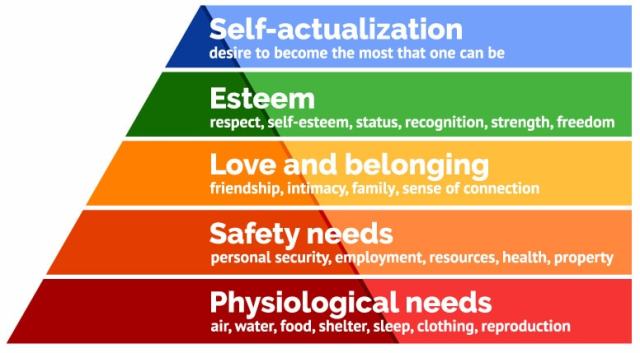 Maslow (1943) identified two motivational types: tension-reducing motives; arousal-seeking motives. According to Maslow, there are five needs forming a hierarchy, progressing from the lower to the higher needs. At the bottom are the basic needs for food, water and air. Then, above them is the need for safety, security, and protection. Maslow argued that if the lower needs are fulfilled the individual would be motivated by needs of the next level of the hierarchy. Cooper et al (2005) criticises Maslow’s theory saying that why and how Maslow selected the basic five needs remain unclear, although Page (2003) feels that it has relevance in understanding how human action is understandable and predictable compared to research which argues that human behaviour is essentially irrational and unpredictable. Though much criticism about Maslow’s theory, the tourism industry has borrowed a lot from Maslow because he provides a convenient set of containers that can be relatively labeled and provide a useful framework for understanding psychological motivational factors in tourism. Thus, for example, although the apparent purpose of a trip may be for shopping, the underlying psychological motivation may be to impress their neighbours and gain higher social status. Iso-Ahola (1982) says that tourists will switch roles while on holiday, and that over time different needs will arise. Single motivation may not always act as the determining factor for travel. If within the holiday, the initial needs are satisfied, other motivations might emerge. Indeed, it is congruent with Maslow’s theories of needs to argue that if initially there is a primary need for relaxation while on a holiday, the satisfaction of that need will create awareness of other needs such as exploration of place as a means of acquiring a sense of belonging or to enable processes of self-actualisation to take place.


 Rashid's Blog: A Place for Inquisitive Souls