Polar bear habitat update: ice forming along Hudson Bay, Wrangel & Franz Josef Islands surrounded

Iowa Climate Science Education's avatarIowa Climate Science Education

Western Hudson Bay polar bears near Churchill will be able to leave shore within days, at most one week later than in the 1980s, although you wouldn’t know that from the climate change activists at Polar Bears International who have spent the last week promoting some egregiously false and misleading statements. PBI controls the narrative surrounding Western Hudson Bay bears through their partnership with the biggest polar bear tourist outfits in Churchill and online.

Yesterday, it was “See how the climate crisis is changing their world”.

Developing no slower than it did in 2007 (16 years of no change), Arctic sea ice is providing polar bears in southern regions with their second-most critical feeding opportunities while in areas like Wrangel Island and Franz Josef Land, they now have easy access to and from important summer refuge/maternity denning islands. And contrary to predictions of increased ‘conflict’ between polar…

View original post 663 more words

Posted in earth | Leave a comment

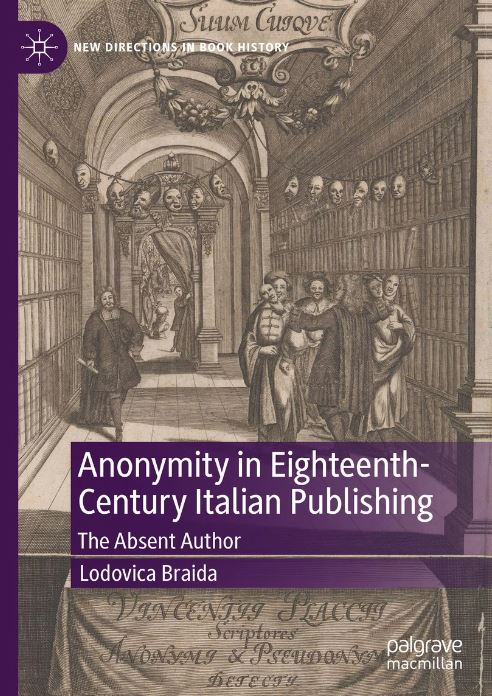
Lodovica Braida, Anonymity in Eighteenth-Century Italian Publishing. The Absent Author (2022)

Clare O'Farrell's avatarFoucault News

Lodovica Braida, Anonymity in Eighteenth-Century Italian Publishing. The Absent Author, Palgrave-Macmillan, 2022

This book focuses on the different forms in which authorship came to be expressed in eighteenth-century Italian publishing. It analyses both the affirmation of the “author function”, and, above all, its paradoxical opposite: the use of anonymity, a centuries-old practice present everywhere in Europe but often neglected by scholarship. The reasons why authors chose to publish their works anonymously were manifold, including prudence, fear of censorship, modesty, fear of personal criticism, or simple divertissement. In many cases, it was an ethical choice, especially for ecclesiastics. The Italian case provides a key perspective on the study of anonymity in the European context, contributing to the analysis of an overlooked topic in academic studies.

The introduction focuses on the aim of the book: to analyse the development of the “author function” (defined as such by Michel Foucault in 1969)…

View original post 280 more words

Posted in earth | Leave a comment

Parks of the 21st Century: New Ways to Reinvent Abandoned Land

Parks of the 21st Century: Reinvented Landscapes, Reclaimed Territories / RizzoliBy Grace Mitchell Tada, Associate ASLA On our heterogeneous planet, finding an overarching commonality between new parks around the world seems daunting. Yet author and architecture historian Victoria Newhouse, with Alex Pisha, argues in the new book Parks of the 21st Century: Reinvented Landscapes, Reclaimed…

Parks of the 21st Century: New Ways to Reinvent Abandoned Land — THE DIRT
Posted in earth | Leave a comment

India’s Strategic Culture: In Search of a Systemic Element (2022)

Clare O'Farrell's avatarFoucault News

Alekseeva-Karnevali, O.A.
India’s Strategic Culture: In Search of a Systemic Element
(2022) Russia in Global Affairs, 20 (3), pp. 134-156.

DOI: 10.31278/1810-6374-2022-20-3-134-156

Abstract
India is emerging as a global power, but its strategic culture remains largely understudied. Expert literature calls into question the very existence of India’s own “systemic” strategic thinking. The article probes into the validity of this viewpoint, postulates that India has its own strategic culture, and highlights its key elements. With the help of Michel Foucault’s genealogical method, the genealogy of the concepts of ‘war’ and ‘power’ in Indian political philosophy is examined and, on this basis, the central conceptual elements of India’s military-political system are determined. This approach shows that India’s strategic culture is distinguished not only by its own systemic strategic thinking, but also by an original (different from the Western one) way of structuring and coding the conceptual space of ‘society,’ ‘politics,’ and…

View original post 81 more words

Posted in earth | Leave a comment