It is common for people to think that the ocean is composed of separate entities (surface, mid-water, and bottom) that are completely independent of one other. But in fact, these ocean environments may be interconnected in a variety of ways. Since they migrate through the water column, mesopelagic (mid-water) species play an important role in connecting surface and bottom communities. They have roles as both predators and prey at the surface and in many cases at or near the bottom. One of our primary research objectives is to define fish and invertebrate communities in offshore surface, mid-water, and benthic (bottom) habitats along the southeastern United States, particularly off North Carolina. Our research team has sampled the whole water column, using several gears, to collect animals from a wide range of habitats. This sampling has been part of an effort to obtain a more complete understanding of the community structure of Sargassum habitat, shelf edge hardbottoms, deep coral banks, and mesopelagic waters.
Surface Communities: Sargassum
The surface waters off the southeastern US are dynamic and constantly in motion due to wind driven waves and the northward flow of the Gulf Stream. The Gulf Stream transports floating pelagic brown algae (Sargassum fluitans and S. natans) through the area. Sargassum is abundant and forms an essential surface habitat that supports a diverse assemblage of marine organisms, including fishes, invertebrates, sea turtles, marine birds, and marine mammals. Sargassum serves as a primary nursery area for many fishes, some of which are commercially important (dolphinfishes, jacks and amberjacks), and it provides a source of energy in an otherwise nutrient poor area of the Atlantic.

The sargassumfish, Histrio histrio, spends its entire life in the Sargassum. This species, as well as many other fish and invertebrate species are camouflaged to blend in with the Sargassum. Click image for larger view and image credit.
Despite its ecological importance, pelagic Sargassum is harvested for commercial use as plant fertilizers and animal feed supplements. In 2003, a Sargassum fishery management plan was approved, which designated pelagic Sargassum as essential fish habitat (EFH, “those waters and substrate necessary to fish for spawning, breeding, feeding or growth to maturity”) in order to provide long-term protection to this unique pelagic habitat.
The primary gear we use to sample surface waters is a neuston net, which we tow in both Sargassum and open water habitats. In just one 15 minute neuston tow in Sargassum habitat, we collected over 3000 fishes in 82 kg (180 lb) of Sargassum, which almost completely ripped the net off the frame! Most fishes associated with Sargassum are juveniles that depend on the algae for food and protection. Filefishes, jacks, triggerfishes, flyingfishes and dolphinfishes are the most abundant fishes that we collect in this habitat.
When Sargassum loses its buoyancy, it sinks to the seafloor, providing energy in the form of carbon to fishes and invertebrates in the deep-sea. Sargassum may provide an important addition to the resources available in the deep-sea.
Benthic Communities: Deep Coral Banks
The deep coral communities that we are studying, which occur along the continental slope of the southeastern US, may benefit from surface derived resources. Deep coral banks, especially off North Carolina, are composed of the cold-water coral Lophelia pertusa. These deep reefs occur in depths of ~350-800 m (~1150-2625 ft), and provide a complex habitat for a diversity of fishes and invertebrates.
Fishes (e.g., coral hake, rattails, conger eels, and slimeheads) and invertebrates (e.g., squat lobsters, sea urchins, brittle stars, sponges) inhabiting deep coral banks are permanent members of these ecosystems. Most species are tightly associated with the coral and do not venture far from their habitat. These species may depend on additional energy coming from the waters above in the form of migrating animals, drifting particles, or dead organisms. Scientists have traditionally thought that the fall of fecal matter and other organic particles (termed “marine snow”) and large “foodfalls” (such as whale carcasses) were the major source of energy to the deep-sea. We are investigating another source of energy: mesopelagic fishes and invertebrates. Mesopelagic species may be an important food source for deep-sea animals, and may provide an important link between surface and bottom habitats.

A common predator that occurs on deep coral banks is Helicolenus dactylopterus (blackbelly rosefish). We are analyzing the stomach contents of this species, among others, to determine what it is eating and how it relates to other species in the energy flow on deep coral banks. Click image for larger view and image credit.
Figure 4. Three common mesopelagic fishes have been observed in dense aggregations near deep coral banks: top- Maurolicus weitzmani (Atlantic pearlside), middle- Polyipnus clarus (slope hatchetfish), and bottom- Ceratoscopelus maderensis (lanternfish). Photograph on the right is a view from the submersible of mesopelagic fishes aggregating near a coral bank. Click image for larger view and image credit.
Mesopelagic Communities: The Connection
The mesopelagic (meso=middle; pelagic= open ocean, away from the bottom) zone occurs between 200 m (~656 ft) and 1,000 m (~3280 ft) depth. Fishes and invertebrates inhabiting this zone spend a majority of their time making daily migrations (diel vertical migrations) from deeper waters to the surface. They are neither full time residents of surface communities nor of benthic communities, but they have been observed and collected in both environments. During the day, mesopelagic animals occur at deeper depths. As the sun sets, they begin their ascent to the surface waters. Near dawn, they begin their descent back down, completing the daily cycle. These organisms, including many species of lanternfishes, hatchetfishes, squid, shrimp, and krill, vertically migrate every day and night. Over continental slope depths it is not uncommon for mesopelagic animals to migrate to the bottom.
The presence of mid-water species at the bottom has significant implications for energy flow. At night, when mesopelagic fishes and invertebrates migrate to the surface, they feed on plankton, crustaceans and fish, such as those associated with Sargassum. Then they carry this energy to the bottom, where energy is transferred to benthic species through predation. We have observed benthic invertebrates and fishes feeding on mesopelagic species, and we are currently examining stomach contents of benthic fishes to determine the full extent of their diets. In deep-sea habitats food may be limited, thus, mesopelagic species provide another source of energy to benthic communities.
Although surface and bottom communities in offshore environments are distinct in some respects, these communities can be linked to one another through energy flow. Further research is needed to determine the food web structures of deep-sea, mesopelagic, and surface communities. This will give us an idea of the degree to which interactions between these communities take place. This will also give us a better understanding of offshore whole water column dynamics, which in turn can provide insight on how human or environmental disturbances could change this intertwined ecosystem.

SOURCE:http://oceanexplorer.noaa.gov/explorations/05coralbanks/logs/Oct31/Oct31.html


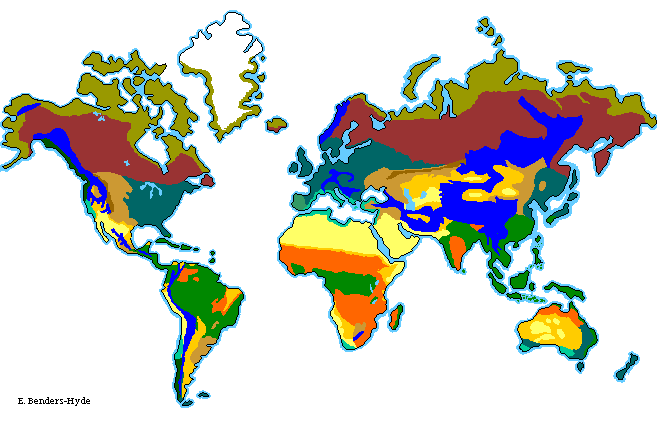
 TUNDRA
 Deciduous Forests
 Savanna
 Taiga
 Chapparal
 Rainforests
 Grasslanda
 Desert
 Alpine
 Desert-Scrub