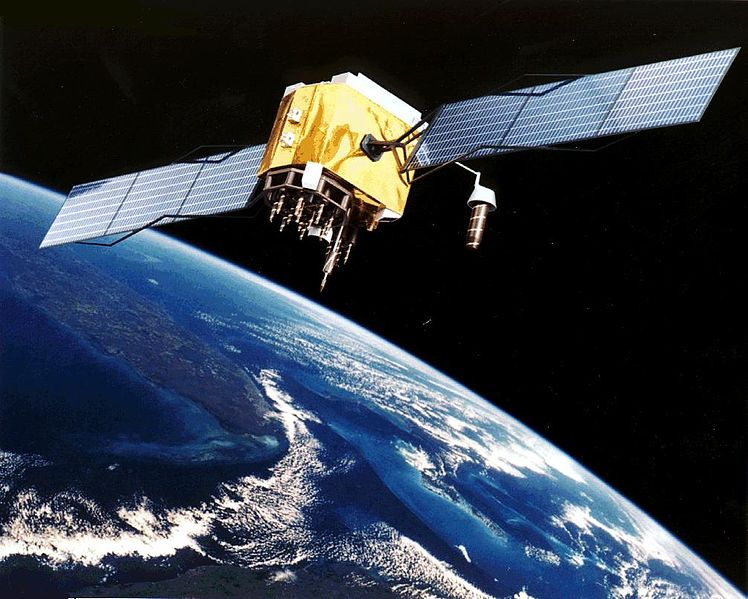
Worldly Navigation System (WNS) is the standard generic term for satellite navigation systems that provide autonomous geo-spatial positioning with global coverage. GNSS allows small electronic receivers to determine their location (longitude, latitude, and altitude) to within a few metres using time signals transmitted along a line-of-sight by radio from satellites. Receivers on the ground with a fixed position can also be used to calculate the precise time as a reference for scientific experiments.
As of 2009, the United States NAVSTAR Global Positioning System (GPS) is the only fully operational GNSS. The Russian GLONASS is a GNSS in the process of being restored to full operation. China has indicated it will expand its regional Beidou navigation system into the global COMPASS navigation system by 2015. The European Union’s Galileo positioning system is a GNSS in initial deployment phase, scheduled to be operational in 2013.The global coverage is achieved by constellations of about 30 MEO satellites in different orbital planes.
History
Early predecessors were the ground based DECCA, LORAN and Omega systems, which used terrestrial longwave radio transmitters instead of satellites. These positioning systems broadcast a radio pulse from a known “master” location, followed by repeated pulses from a number of “slave” stations. The delay between the reception and sending of the signal at the slaves was carefully controlled, allowing the receivers to compare the delay between reception and the delay between sending. From this the distance to each of the slaves could be determined, providing a fix.The first satellite navigation system was Transit, a system deployed by the US military in the 1960s. Transit’s operation was based on the Doppler effect.
Modern systems are more direct. The satellite broadcasts a signal that contains orbital data (from which the position of the satellite can be calculated) and the precise time the signal was transmitted. The orbital data is transmitted in a data message that is superimposed on a code that serves as a timing reference. The satellite uses an atomic clock to maintain synchronization of all the satellites in the constellation. The receiver compares the time of broadcast encoded in the transmission with the time of reception measured by an internal clock, thereby measuring the time-of-flight to the satellite. Several such measurements can be made at the same time to different satellites, allowing a continual fix to be generated in real time.
The original motivation for satellite navigation was for military applications. Satellite navigation allows for hitherto impossible precision in the delivery of weapons to targets, greatly increasing their lethality whilst reducing inadvertent casualties from mis-directed weapons. Satellite navigation also allows forces to be directed and to locate themselves more easily, reducing the fog of war.
Current global navigation systems
GPS
The United States’ Global Positioning System (GPS) is the only fully functional, fully available global navigation satellite system. It consists of up to 32 medium Earth orbit satellites in six different orbital planes, with the exact number of satellites varying as older satellites are retired and replaced. Operational since 1978 and globally available since 1994, GPS is currently the world’s most utilized satellite navigation system.
GLONASS
Formerly Soviet, and now Russian, GLObal’naya NAvigatsionnaya Sputnikovaya Sistema, or GLONASS, was a fully functional navigation constellation but since the collapse of the Soviet Union has fallen into disrepair, leading to gaps in coverage and only partial availability. The Russian Federation has pledged to restore it to full global availability by 2010 with the help of India, who is participating in the restoration project.
Proposed global navigation systems
Compass
China has indicated they intend to expand their regional navigation system, called Beidou or Big Dipper, into a global navigation system; a program that has been called Compass in China’s official news agency Xinhua. The Compass system is proposed to utilize 30 medium Earth orbit satellites and five geostationary satellites. Having announced they are willing to cooperate with other countries in Compass’s creation, it is unclear how this proposed program impacts China’s commitment to the international Galileo position system.
Galileo
The European Union and European Space Agency agreed on March 2002 to introduce their own alternative to GPS, called the Galileo positioning system. At a cost of about GBP £2.4 billion, the system is scheduled to be working from 2012. The first experimental satellite was launched on 28 December 2005. Galileo is expected to be compatible with the modernized GPS system. The receivers will be able to combine the signals from both Galileo and GPS satellites to greatly increase the accuracy.
read more

 Scientists have discovered the striking remnants of an ancient lake. Though dry and frigid now, the traces it left behind hint at a water body younger than any other on the planet, and its sediments are a prime target for finding fossilized alien life.