Are the deserts getting greener?

It has been assumed that global warming would cause an expansion of the world’s deserts, but now some scientists are predicting a contrary scenario in which water and life slowly reclaim these arid places.The evidence is limited and definitive conclusions are impossible to reach but recent satellite pictures of North Africa seem to show areas of the Sahara in retreat.

It could be that an increase in rainfall has caused this effect.Farouk el-Baz, director of the Centre for Remote Sensing at Boston University, believes the Sahara is experiencing a shift from dryer to wetter conditions.”It’s not greening yet. But the desert expands and shrinks in relation to the amount of energy that is received by the Earth from the Sun, and this over many thousands of years,” Mr el-Baz told the BBC World Service.”The heating of the Earth would result in more evaporation of the oceans, in turn resulting in more rainfall.”
read more

Posted in Ecosystem, Landforms | Leave a comment

Chandrayaan-1 develops critical malfunction

India’s first moon mission Chandrayaan-I, launched in October last with a two-year life span, has lost a major sensor and may meet a premature end, ISRO said on Friday. ( Watch ) “Unfortunately, during the last month we have lost a vital sensor — the star sensor,” ISRO Chief G Madhavan Nair said. “Like in the olden days when one used to look at the stars to fix a direction, likewise an onboard electronic equipment was doing all this and it was required for precise pointing (towards the moon). With its loss we are really worried,” he said. “But to the credit of the ISRO scientific team, they have worked out a very innovative way of overcoming the problem,” the ISRO chief said, but added that if some more failures happen, “then we will have problems”. Nair, however, said that in the last eight months of the operation of the mission, “we have collected almost all the data that we wanted” and that most of its objectives have already been completed. Chandrayaan-I was launched from the spaceport of Sriharikota in Andhra Pradesh on October 22 last year. ISRO Spokesperson S Satish said, “We are not sure how long we will be able to sustain it. The life of Chandrayaan-I designed for two years may be reduced”. He, however, maintained that the mission is not crippled adding, “it is continuing satisfactorily.” ISRO said it has devised innovative technology and is using antenna pointing mechanism and gyroscopes to overcome the problem.

Source:Times of India

Posted in India' Moon Mission | Leave a comment

Highest and Lowest Points on Mars

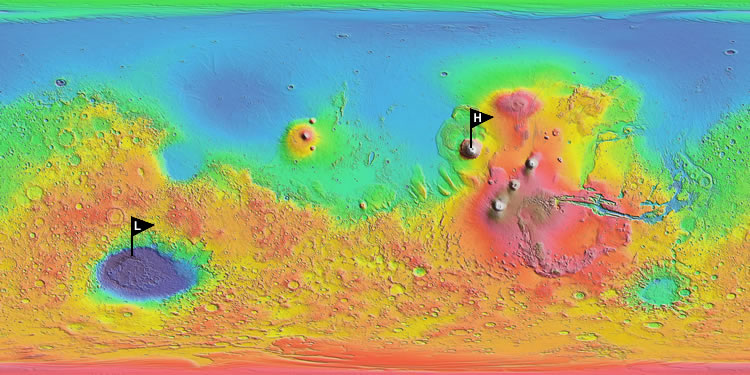
The image above is a colorized topographic map of Mars. This Mercator projection map shows low elevations as a deep blue color and high elevations as a white color (see elevation scale below). The map was prepared by NASA and is based on data from the Mars Orbiter Laser Altimeter, an instrument on the Mars Global Surveyor spacecraft. The highest point on Mars is the Olympus Mons Volcano (marked by a flag with the letter “H”). The peak of Olympus Mons is 21,229 meters (69,649 feet) above the Mars areoid (a reference datum similar to Earth’s sea level). The lowest point is within the Hellas Impact Crater (marked by a flag with the letter “L”). The lowest point in the Hellas Impact Crater is 8,200 meters (26,902 feet) below the Mars areoid.

source

Posted in Solar System | Leave a comment

Beware, Your Brain May be Hacked

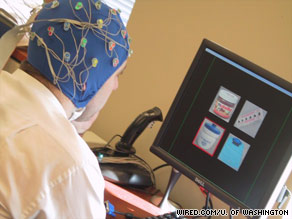
Hackers who commandeer your computer are bad enough. Now scientists worry that someday, they’ll try to take over your brain. Scientists can use brain signals to control computers — hands free. In the past year, researchers have developed technology that makes it possible to use thoughts to operate a computer, maneuver a wheelchair or even use Twitter — all without lifting a finger. But as neural devices become more complicated, and go wireless, some scientists say the risks of “brain hacking” should be taken seriously. “Neural devices are innovating at an extremely rapid rate and hold tremendous promise for the future,” said computer security expert Tadayoshi Kohno of the University of Washington. “But if we don’t start paying attention to security, we’re worried that we might find ourselves in five or 10 years saying we’ve made a big mistake.” Hackers tap into personal computers all the time. But what would happen if they focused their nefarious energy on neural devices, such as the deep-brain stimulators used to treat Parkinson’s and depression, or electrode systems for controlling prosthetic limbs? According to Kohno and his colleagues, who published their concerns July 1 in Neurosurgical Focus, most devices carry few security risks. But as neural engineering becomes more complex and more widespread, the potential for security breaches will mushroom.

source

Posted in News | Leave a comment