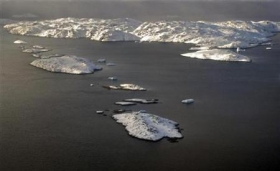
Arctic sea ice ties for smallest ever

Even at its biggest, Arctic sea ice extent this winter was among the smallest ever seen, apparently tying with 2006 for the least amount of ice covering the region around the North Pole, U.S. researchers reported.

Sea ice on the Arctic Ocean usually starts growing in September and hits its maximum area in February or March; this year, the maximum appeared to occur on March 7, when ice stretched over 5.65 million square miles (14.64 million square km), according to the National Snow and Ice Data Center.

That area of ice-covered water is 471,000 square miles (1.2 million square km) below the average maximum ice extent observed by satellites from 1979 to 2000, the center said in a statement.This thin ice is sensitive to weather, which can make it move or melt quickly, and it often stays around the maximum for days or weeks, as it has done this year.

Links and Source:
ENN ,Reuters

Posted in climate change, Global Warming, oceans | Leave a comment

Matter Spotted a Millisecond Away from Black Hole

The European Space Agency’s Integral gamma-ray observatory has spotted extremely hot matter just a millisecond before it plunges into the oblivion of a black hole. But is it really doomed? These unique observations suggest that some of the matter may be making a great escape.

read here

Posted in Space | Leave a comment

Forests are Expanding in the Northern Latitudes

According to a recent United Nations report, forested areas in Europe, North America, the Caucasus, and Central Asia have grown steadily over the past two decades. While tropical areas have steadily lost their forests to excessive logging and increased agriculture, northern areas have seen increases caused by conservation efforts. However, the long-term health and stability of northern forest lands may be imperiled by the effects of climate change.

The UN says that forests in these areas have grown by 25 million hectares in the last 20 years.

These forests play a great role in the world’s carbon cycle, acting as a repository for carbon dioxide, a primary greenhouse gas. Northern forests account for about 40 percent of the world’s forest according to the UNECE. They are generally classified as boreal or temperate. The 25 million hectares which these forests have increased is slightly larger than all of the United Kingdom, and accounts for 8 percent of all the forest in the region. Most of the increase has occurred on the Eurasian continent; North America accounts for only a fifth of the growth.

Links and Sources:

ENN

Image limk

Posted in BIODIVERSITY, climate change, earth, Ecosystem, Environment | Leave a comment

Korean peninsula moved 5 cm according to GPS survey by KASI

The Korean Peninsula has moved a 5 centimetres to the east due to the massive quake that rocked Japan. The Korea Astronomy and Space Science Institute (KASI) said that based on detailed global positioning system (GPS) data, the peninsula moved between 1 cm to 5 cm depending on the location, with Ulleung Island and nearby Dokdo islets in the East Sea being most affected.

The south-western part of the country and Jeju Island off the peninsula’s southern coast moved far less.

Ulleung and Dokdo are the closest South Korean territories to the epicentre of the 9.0 magnitude tremor that devastated the north-eastern part of Honshu Island .

The epicentre was located 130 kilometres east of Sendai city under the Pacific Ocean.

The institute, said that the Japan moved roughly 2 meters to the east.

Source: The Hindu

Posted in earth, GPS, Japan Tsunami, News, seismic activities | 1 Comment