
Total Visitors
- 5,621,169
Search Inside
My You Tube Channel
-
Visitors on The Site

-
Join 6,676 other subscribers
Fill This Form to Contact Me
Top Posts & Pages
- Waste to Energy in India
- About Me and This Site
- Google Blimps & Balloons to Provide Wireless Networks in Africa
- The Structure of the Ocean Floor(Ocean Topography)
- Social Processes: Concept, Types and Salient Features
- Discontinuities Inside the Earth
- Physical Divisions of North America: An Overview
- Migration Theories : Lee’s Push Pull Theory
- Gond Tribe of India
- Levant: The Term, The Region and Cities
Being Social
Pages
- Article Submission
- Basics of Geography
- Book Reviews
- Disaster Management
- Field Training and Tour
- Geography Notes
- Geography of Tourism
- Geography Study Material for NTA-NET & IAS Exams
- Geomorphology
- Geomorphology Class Black Board
- Hindi Posts
- Human Geography
- My Projects
- New UGC NET Syllabus-Geography
- Online Class
- Posts on Geography Practicals and Statistical Techniques
- Regional Studies
- Settlement Geography
- Social Geography
- Urban Agro Systems
- Urban Systems
- Useful Links
- Water Resources
- About Me and This Site
Blogroll
Digital Blackboards
My Pages
Other Sites I Am Involved With
Recommended Links
Useful Links
Rock Garden: A One Man Marvel of Ingenuity and Passion
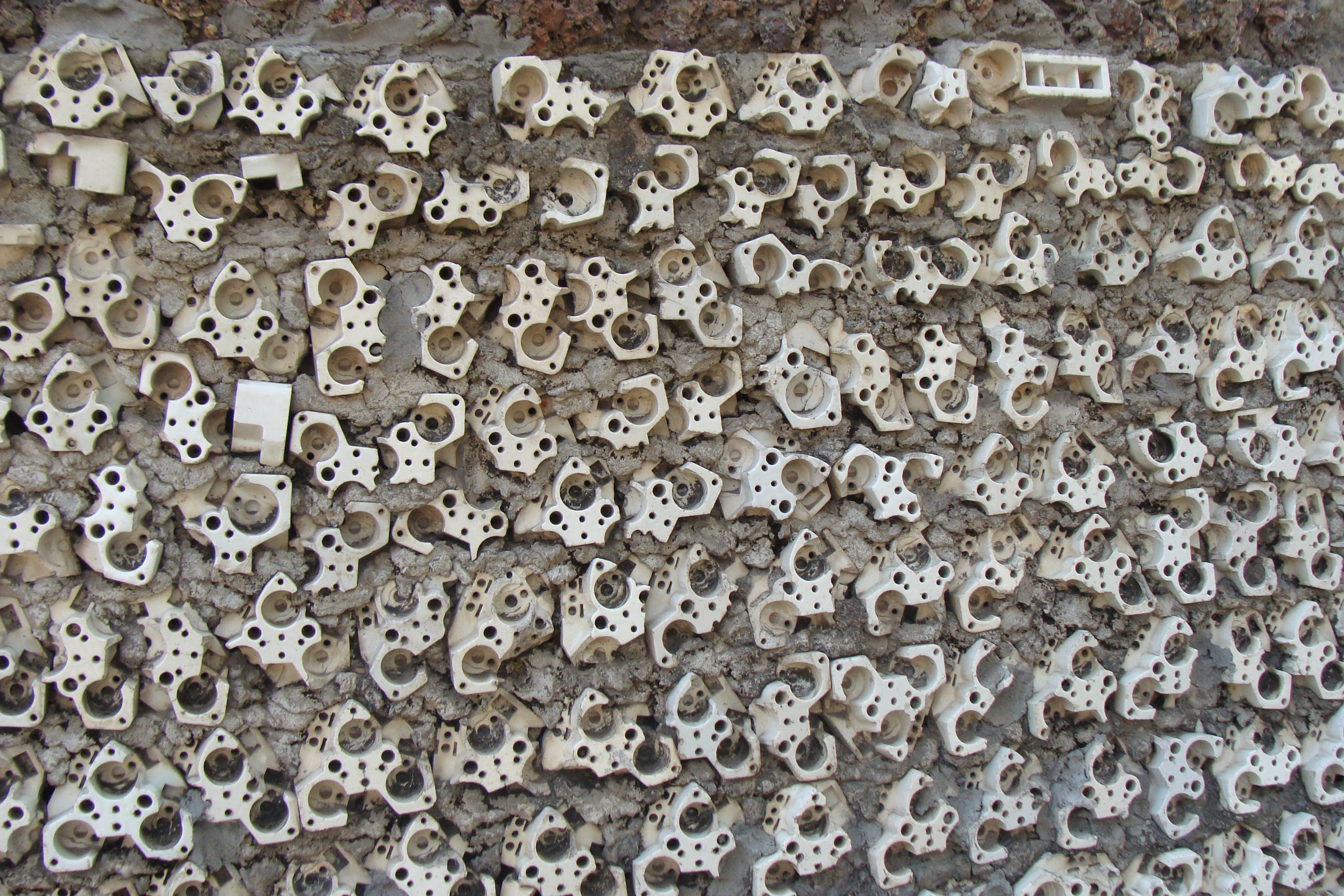
A Wall Made by electrical Waste
Chandigarh rock garden is an epitome of creativity , innovation,ingenuity. It is a

Figures Made by Waste. Notice One hand is Made by a Clay Kettle.
unique garden that consists of various art objects. But the best part about the rock garden is that each of its artwork has been made by using industrial & urban waste. It is located in Sector 1 between the Capitol Complex and Sukhna Lake. The credit for laying its foundation goes to Nek Chand, who was the then Road Inspector in the Engineering Department of Chandigarh Capital Project.
Rock garden has been established in the form of an open-air exhibition hall. The garden houses sculptures made by using a variety of different discarded waste materials like frames, mudguards, forks, handle bars, metal wires, play marbles, porcelain, auto parts, broken bangles etc. Rock garden in Chandigarh, India is a unique creation and connoisseurs come from different parts of the world to see this amazing garden.
In his spare time, Chand began collecting materials from demolition sites around

A Waterfall at Rock garden
the city. He recycled these materials into his own vision of the divine kingdom of Sukrani, choosing a gorge in a forest near Sukhna Lake . The gorge had been designated as a land conservancy, a forest buffer established in 1902 that nothing could be built on. Chand’s work was illegal, but he was able to hide it for eighteen years before it was discovered by the authorities in 1975. By this time, it had grown into a 12-acre (49,000 m2) complex of interlinked courtyards, each filled with hundreds of pottery-covered concrete sculptures of dancers, musicians, and animals.
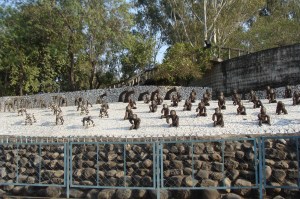
Monkeys and Other Animals
His work was in serious danger of being demolished, but he was able to get public opinion on his side, and in 1976 the park was inaugurated as a public space. Nek Chand was given a salary, a title (“Sub-Divisional Engineer, Rock Garden”), and a workforce of 50 laborers so that he could concentrate full-time on his work. It even appeared on an Indian stamp in 1983. The Rock Garden is still made out of recycled materials; and with the government’s help, Chand was able to set up collection centers around the city for waste, especially rags and broken ceramics.
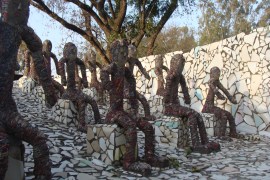
Figures Made by Broken Bangles
When Chand left the country on a lecture tour in 1996, the city withdrew its funding, and vandals attacked the park. The Rock Garden Society took over the administration and upkeep of this unique visionary environment. The garden is visited by over five thousand people daily, with a total of more than twelve million visitors since its inception.
We have recently gone to chandigarh for a conference at Punjab university . There we visited this magnificent garden among other places and clicked some picture. All the pictures in this post are those.Enjoy.
A Note of Caution : Rock garden Can be Hired

Pandal for Marriage
We noticed some pandals being

Food Being Prepared in Rock Garden.
errected and at some distance food was being prepared.It seemed that it was meant for marriage. On enquiring the people there told that one can hire Rock garden for marriages for rent. I think this can be detrimental to the environment and to this precious monument.
Links and Sources:
Related articles
- Rock Garden at Chandigarh (idyllic.wordpress.com)
- Things to do in Chandigarh (mahindrahomestays.com)
- Rock garden (imjustwalkin.com)
- Landscaping With Flowers by Region (redenvelope.com)
And A Poll for Readers

(Translated by Afton Halloran from the original comment in Politiken, Denmark’s largest newspaper)
By Afton Halloran, Agricultural Development MSc student, Ole Fryd, Assistant Professor, Forest and Landscape, and Jakob Magid, Associate Professor, Department of Ecology, University of Copenhagen
~ ~
Copenhagen’s urban gardens and urban agriculture projects have achieved a steady increase in popularity in both the media and at the grassroots level. The projects are situated in places like Prags Boulevard, Otto Krabbe’s Square and in Ørestad. There is a great interest in the way that these projects create social relationships, build capacity and strengthen communities in urban areas. They also help to create green spaces in the city and provide children and adults with experiencing the origin of their food from a close range.
But, when we compare with other places in Europe and North America it is clear that there is untapped potential to grow vegetables in a large scale…
View original post 717 more words
Posted in Uncategorized
1 Comment
Pros and Cons of Urbanization
Urbanization brings with it several consequences – both adverse and beneficial. They impact on social and environmental areas.
Adverse effects of Urbanization
There is increasing competition for facilities in urban areas, which results in several negative effects. Many people mainly farmers who move to cities in search of a better life and better occupational opportunities end up as casual labourers. This leads to menacing problems of urbanization – the growth of slums and unmanaged Urban Sprawl. Urban sprawl often leads to negative consequences.
Slums are urban areas that are heavily populated with substandard housing and very poor living conditions. They are manifestations of urban poverty.
- Land insecurity – Slums are usually located on land, not owned by the slum dwellers. They can be evicted at any time by the landowners.
- Poor living conditions – Crowding and lack of sanitation. This often contributes to outbreak of diseases. Utilities such as water, electricity and sewage disposal are also lacking in these areas.
- Unemployment – Since the number of people aspiring for jobs is more than jobs available, unemployment is a natural outcome of situation.
- Crime – Slum conditions make maintenance of law and order difficult. Patrolling of slums is often not on priority list of law enforcing officers. Unemployment and poverty force people to engage in anti-social activities. Slums therefore, often become a breeding ground for criminal activities. The Social Disorganisation Theory discusses about the relation.
Environmental Impact
- Temperature Increase- Due to factors such as paving over formerly vegetated land, increasing number of residences and high-rise apartments and industries, temperature increase due to increased absoption of Sun’s energy and production of more and more heat due to very intense human activity.
- Air pollution-Factories and automobiles are most visible symbols of urbanization. Due to emissions of harmful gases and smoke from factories and vehicles, air pollution results.High amount of suspended particulate matter in air, particularly in cities, which contributes to allergies and respiratory problems becoming a huge health hazard.
- Changes in Natural Water Cycle – When urbanization takes place, water cycle changes as cities have more precipitation than surrounding areas. Due to dumping of sewage from factories in water bodies, water pollution occur which often resulting in outbreaks of epidemics.
- Destruction of Natural Habitats of Flora and Fauna – In making of an urban area, a lot of forested areas are destroyed which otherwise would have been natural habitats to many birds and animals.
- We have extended the urbanisation to the sea also. This tendency is damaging the ocean ecosystem also.
Benefits of urbanization
Urbanization is not all bad, it has its benefits.
- Efficiency – Cities are often more efficient than rural areas. Less effort is needed to supply basic amenities such as fresh water and electricity. Research and recycling programs are possible only in cities. In most cities flats are prevalent. In flats many people can be accommodated within a small land area.
- Convenience – Access to education, health, social services and cultural activities is more readily available to people in cities than in villages. Life in cities is much mored comfortable, compared to life in villages. Cities have more advanced communication and transport networks.
- Concentration of resources – Since most major human settlements were established near natural resources from ancient times, lot of resources are available in and around cities. Facilities to exploit these resources optimally also exist only in cities.
- Concentration of Educational facilities – More schools, colleges and universities are established in cities to train and develop human resources. Variety of educational choices are available offering students a wide choice for their future careers. In this age of knowledge society it has become more and more important.
- Better Social integration – People of many castes ,groups and religions live and work together in cities, which creates better understanding and harmony and helps breakdown social and cultural barriers.
- New Markets-Internet has opened up a new market world wide. Any one can sell in this market by posting Free classifieds web from the comfort of the home.
- Economic Improvement – High-tech industries earn valuable foreign exchange and lot of money for the country. Occupational period briefings help in maintaining the work life balance.
All in all, if you still need essay help on urbanization topics from professional academic writers, don’t hesitate to buy essay from CustomWritings.com now.
Posted in Urban Studies
27 Comments


