


Total Visitors
- 5,612,731
Search Inside
My You Tube Channel
-
Visitors on The Site

-
Join 6,676 other subscribers
Fill This Form to Contact Me
Top Posts & Pages
- Waste to Energy in India
- About Me and This Site
- Physical Divisions of North America: An Overview
- Levant: The Term, The Region and Cities
- The Structure of the Ocean Floor(Ocean Topography)
- Silt: Environmental Impact
- Gond Tribe of India
- Migration Theories : Lee’s Push Pull Theory
- Discontinuities Inside the Earth
- Book Reviews
Being Social
Pages
- Article Submission
- Basics of Geography
- Book Reviews
- Disaster Management
- Field Training and Tour
- Geography Notes
- Geography of Tourism
- Geography Study Material for NTA-NET & IAS Exams
- Geomorphology
- Geomorphology Class Black Board
- Hindi Posts
- Human Geography
- My Projects
- New UGC NET Syllabus-Geography
- Online Class
- Posts on Geography Practicals and Statistical Techniques
- Regional Studies
- Settlement Geography
- Social Geography
- Urban Agro Systems
- Urban Systems
- Useful Links
- Water Resources
- About Me and This Site
Blogroll
Digital Blackboards
My Pages
Other Sites I Am Involved With
Recommended Links
Useful Links
Your House Is Energy Efficient OR Not?(link)

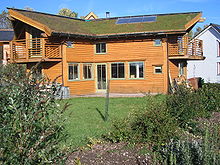
An eco-house at Findhorn Ecovillage with a turf roof and solar panels
Energy efficiency of Green Buildings
Green buildings also often include measures to reduce energy consumption – both the embodied energy required to extract, process, transport and install building materials and operating energy to provide services such as heating and power for equipment.
As high-performance buildings use less operating energy, embodied energy has assumed much greater importance – and may make up as much as 30% of the overall life cycle energy consumption. Studies such as the U.S. LCI Database Project show buildings built primarily with wood will have a lower embodied energy than those built primarily with brick, concrete or steel.
To reduce operating energy use, designers use details that reduce air leakage through the building envelope (the barrier between conditioned and unconditioned space). They also specify high-performance windows and extra insulation in walls, ceilings, and floors. Another strategy, passive solar building design, is often implemented in low-energy homes. Designers orient windows and walls and place awnings, porches, and trees to shade windows and roofs during the summer while maximizing solar gain in the winter. In addition, effective window placement (daylighting) can provide more natural light and lessen the need for electric lighting during the day. Solar water heating further reduces energy costs.
Onsite generation of renewable energy through solar power, wind power, hydro power, or biomass can significantly reduce the environmental impact of the building. Power generation is generally the most expensive feature to add to a building.
from the dilbert blog by Adom Scott
click here also
read my paper about green buildings
Related articles
- Passive solar building design (en.wikipedia.org)
- Nation’s first five-star rated green building to come up in Jaipur (panchabuta.com)
- Jean Caroon, Sustainable Preservation: Greening Existing Buildings, Chapter 1 (buildingreuse.wordpress.com)
- Toward Resilient Architectures 2: Why Green Often Isn’t (resilience.org)
New tree porcupine species discovered in Brazil

From mongabay.com:
New species tree-dwelling porcupine discovered in critically threatened Brazilian habitat
April 11, 2013
Scientists in Brazil have described a new species of tree-dwelling porcupine in the country’s most endangered ecosystems. The description is published in last week’s issue of Zootaxa.
A team of researchers led by Antonio Rossano Mendes Pontes [2009 interview], a biologist at the Federal University of Pernambuco, found the porcupine in a small forest fragment in the state of Pernambuco. They christened the rodent Coendou speratus, a combination of its local name “coandu-mirim” and the Latin word “speratus” for “hope”.
The name choice is appropriate given the porcupine’s high risk of extinction. About 98 percent of its forest habitat has been destroyed, while its population is as fragmented as the forests it inhabits, making the species vulnerable in inbreeding, according to the researchers. The species is also actively hunted…
View original post 242 more words
Posted in Uncategorized
Leave a comment


